A Handy Guide to Hiking in Montenegro & Our Top 10 Trails

Discover everything you need to know about the best hikes in Montenegro, including where to go, the top trails from easy to expert, hiking tips, and how to stay safe.

This post may contain affiliate links, which means we might earn a small commission on anything purchased through these links at no extra cost to you. Learn more on our disclaimer page.
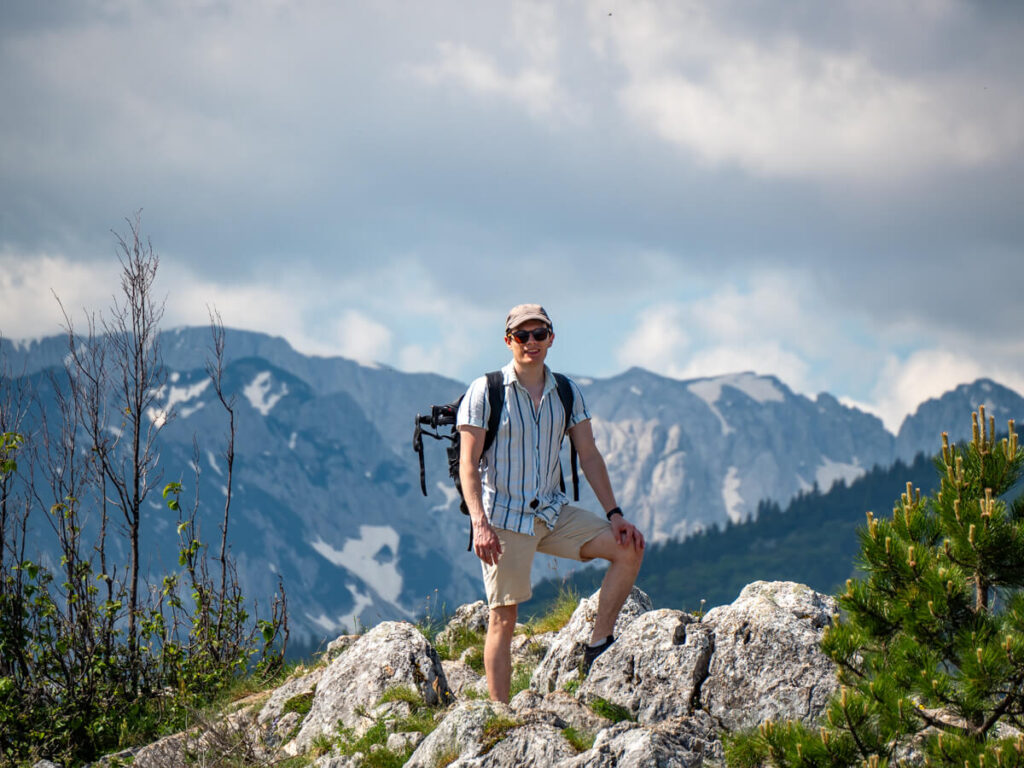
Montenegro may be best known for its beautiful bays and beaches, but it’s actually one of the best hiking destinations we’ve visited in Europe. Despite being a relatively small country, it has an incredible amount of varied terrain to explore, from the rugged limestone peaks in the north to the forests and mountains in the country’s centre. You don’t have to be an experienced mountaineer to enjoy many of the country’s trails, but there are plenty of hikes that deserve to be taken seriously.
Heralded as a cheaper and quieter version of the Italian Dolomites with equally impressive views, we made the trip ourselves to see if what social media says is true. We visited specifically to hike in Montenegro’s five national parks and spent five weeks driving around the country, hiking as much as we could along the way. Along the way, we got lost, underestimated how long hikes would take us, and found ourselves on trails that felt considerably more exposed or strenuous than the descriptions had suggested online, so we’ve tried to be realistic about what you can expect rather than making every hike sound easier or more romantic than it is.
Whether you’re just getting into hiking as we were on this trip or an experienced hiker, read on to discover our favourite hikes in Montenegro, from easy trails I’d recommend to my mum to more challenging mountain routes I didn’t tell her about until after we completed them, along with what each hike is actually like, how difficult we found it, and our practical safety tips for hiking in Montenegro. We’ll also cover what to pack, how to prepare, navigation, weather, wildlife, and the things we wish we’d known before hitting the trails in this Montenegro hiking handbook.
Hiking in Montenegro at a glance

More Hiking in Montenegro
Why go hiking in Montenegro?
For such a small country, Montenegro is an unusually good hiking destination. The country’s official tourism board lists around 1,860 miles (3,000 km) of mountain trails woven across the mountainous fabric of its landscapes, from the rugged peaks of the north to the limestone mountains rising above the Adriatic coast.
But what really sets Montenegro apart from many hiking destinations in Europe is the sheer diversity packed into what’s a relatively small area. From challenging treks around glacial lakes, jagged peaks, and high-altitude peaks to easy walks with spectacular coastal scenery, there really is something for every kind of hiker.
Compared with some of Europe’s better-known hiking destinations, Montenegro feels quieter, cheaper, and less spoiled by mass tourism. Yes, cruise ship crowds descend on Kotor’s Old Town in summer, but that’s exactly what makes getting out into the countryside and hiking so appealing.
However, the very same thing that draws hikers-in-the-know to Montenegro is what makes it difficult to travel. Trail information can be inconsistent, signage varies considerably between routes, weather can change quickly in the mountains, and mobile signal isn’t something you should always rely on. As Montenegro becomes increasingly popular with hikers, it’s also worth being honest about the realities of hiking here, because it isn’t always as it appears on Instagram or outdated travel blogs.
The best places for hiking in Montenegro
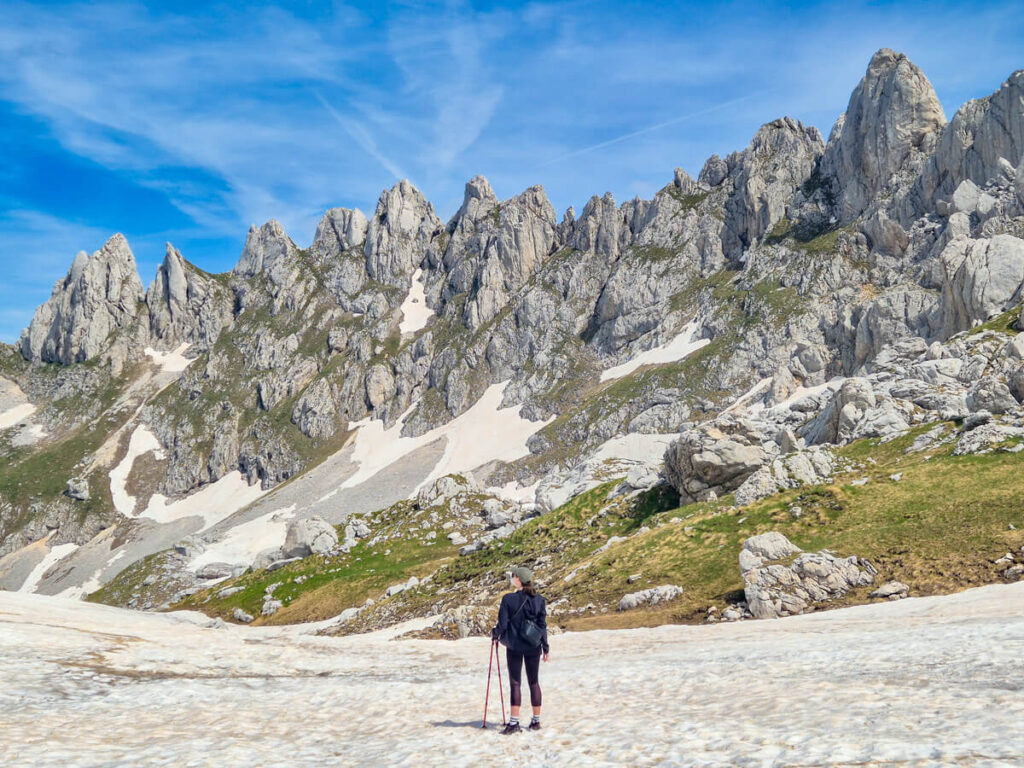
Arguably, the best places for hiking here are Montenegro’s five national parks, which cover about 10% of the country’s total territory. But there are some stellar hiking trails outside these natural protected areas, too. We’ve written a guide to each national park, including several dedicated guides to specific hikes, so we’ve really chosen our favourite hikes to highlight in this post.
The main areas for hiking in Montenegro are:
If you’re looking for a break from the mountains, Lake Skadar National Park offers a completely different side of Montenegro, with peaceful lakeside trails, wetlands, birdlife, and spectacular views across the country’s largest lake, but with fewer established hiking trails.
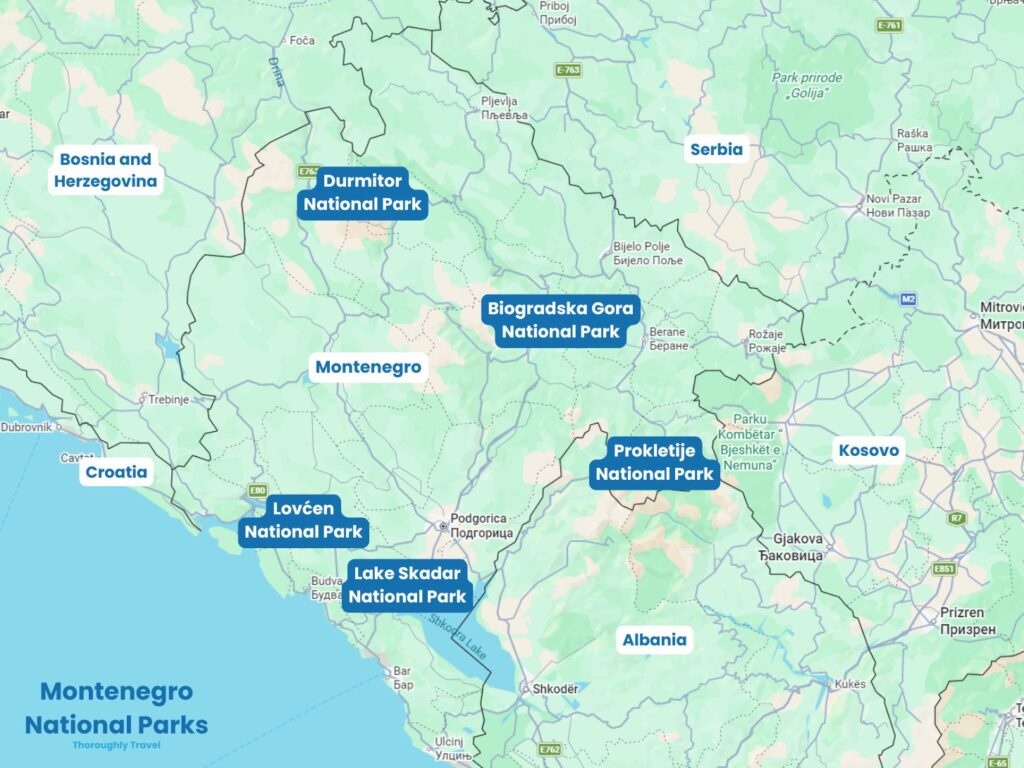
Hiking in Montenegro Map
To help you get your bearings, the map below shows the location of Montenegro’s national parks, which are some of the country’s best hiking areas.
1. Durmitor National Park
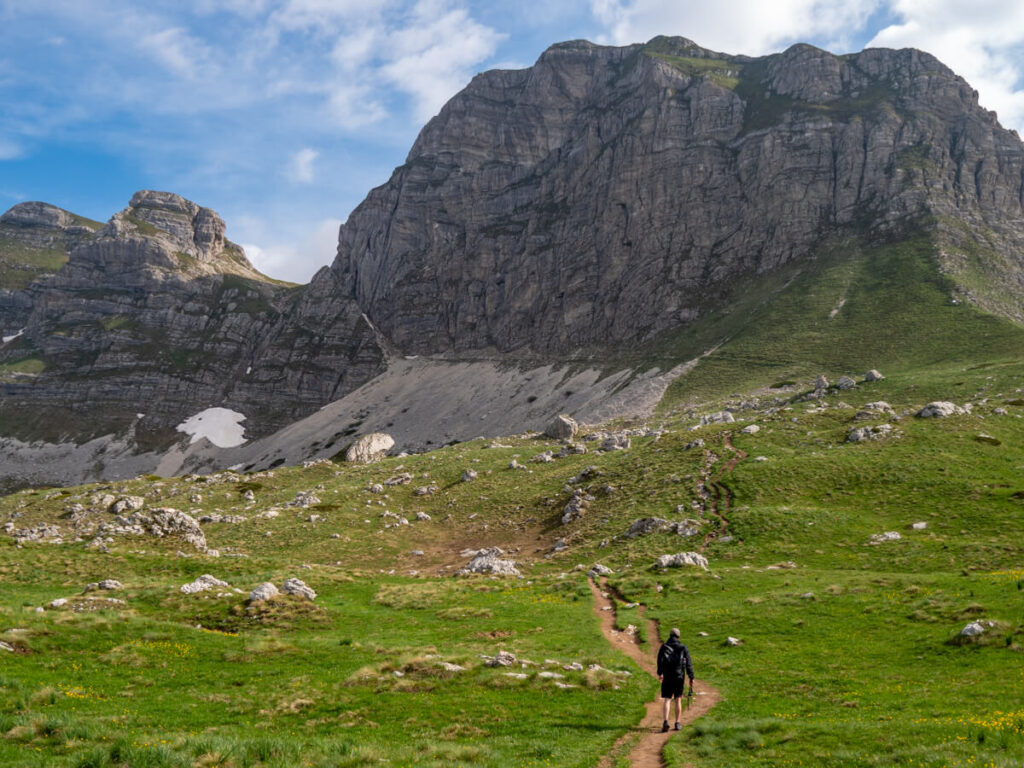
If you’re looking for classic mountain hiking in Montenegro, Durmitor National Park is the place to go. You can easily reach trails that wind between glacial lakes, high alpine meadows, and a spectacular jumble of limestone peaks. Hiking highlights include the fairly short and flat Black Lake loop, easy but hilly out-and-back Ćurevac Peak hike, and the epic Bobotov Kuk hike.
The terrain here ranges from easy 1-hour walks to demanding, full-day summit climbs involving steep slopes and exposed scrambling, so there’s something here for most reasonably fit hikers, as well as families and regular walkers.
Durmitor is the largest national park in Montenegro and where we spent the longest amount of time exploring. It has by far the most tourism infrastructure, which is great for backpackers and families, but negates a little of that truly wild feel.
Durmitor is also a popular ski destination in winter, which is no surprise when you realise that the park’s gateway town, Žabljak, is the highest town in the Balkans. But that does mean snow can linger well into early summer, so it’s worth timing your trip between July and September if you’re keen to do the more challenging hikes in Durmitor National Park.
2. Prokletije National Park
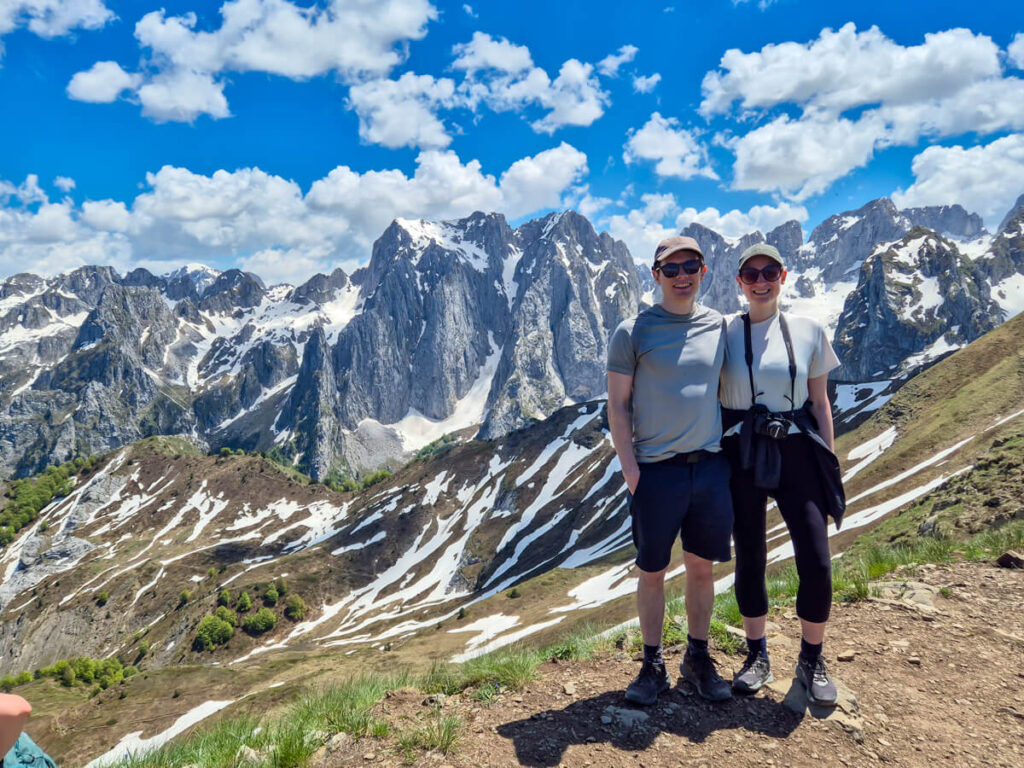
For a really rugged and remote mountain experience, head east to Prokletije National Park. This is the most Dolomites-looking of Montenegro’s major hiking areas, with serrated limestone walls, narrow valleys, alpine meadows, and high border peaks, including Zla Kolata, the country’s highest summit.
Hiking trails in Prokletije National Park range from relatively gentle walks in the Ropjana Valley to serious mountain routes. Undoubtedly, the star of the show is the Three Peaks Trail, with its short out-and-back option to Volušnica and epic views over the Karanfili massif and Albania.
Prokletije is also perfectly located along the iconic Peaks of the Balkans Trail if you’re looking for multi-day, multi-country hiking routes.
We’d recommend Prokletije most to experienced hikers who enjoy quieter trails and proper mountain terrain – even in spring, snow can remain on some of the higher routes. But you could also road trip to the Grebaje Valley and stay in a local katun with views of the jagged mountaintops without even hiking. Its insane landscapes put Prokletije at the top of our favourites list.
3. Lovćen National Park
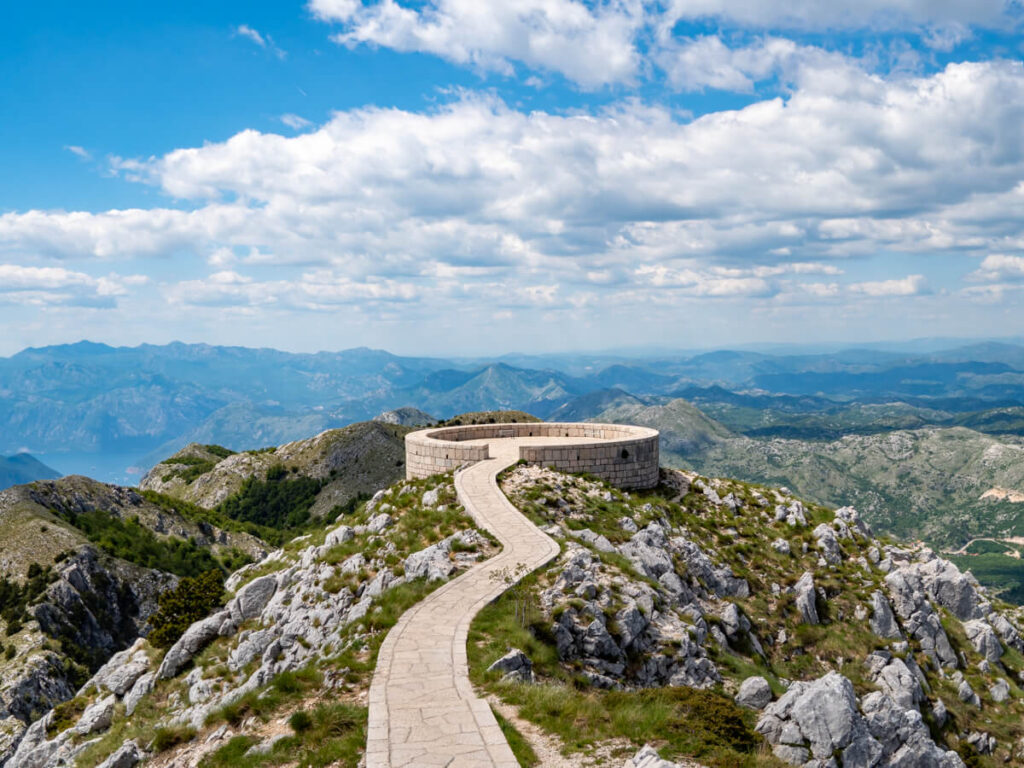
Just inland from the Bay of Kotor, Lovćen National Park is a much more accessible introduction to Montenegro’s mountains, containing forested slopes, exposed limestone ridges, and expansive views over the coast.
The most famous route is the 461-step-climb to Njegoš Mausoleum on top of Jezerski Vrh, a peak that sits at around 1,657 metres (5,436 ft) above sea level. For more traditional-style hiking, the area around Ivanova Korita is home to long and short trails that take you to peaks and viewpoints over the Bay of Kotor.
We’d particularly recommend Lovćen if you’re short on time but would like to experience Montenegro’s mountains without straying too far from the coast.
4. Bay of Kotor
The Bay of Kotor offers some of Montenegro’s most dramatic hiking despite being on the coast. The mountains rise almost directly from the water, creating steep limestone slopes with trails climbing from medieval villages and historic towns to panoramic ridges.
The Ladder of Kotor hike is the obvious classic, taking you high above Kotor Old Town for epic views of the whole bay. Other trails in the area include the Kotor Fortress trail (more of a climb up stairs than a hike), trails on the Vrmac Peninsula, and routes around the surrounding mountains.
This was one of our favourite areas to hike, as you get such a high reward for relatively little effort – it’s a super accessible part of the country and the trails are a bit easier than the more remote ones in the northern mountains. Being at lower elevations also makes this area a better option for hiking outside the main summer mountain season.

5. Biogradska National Park
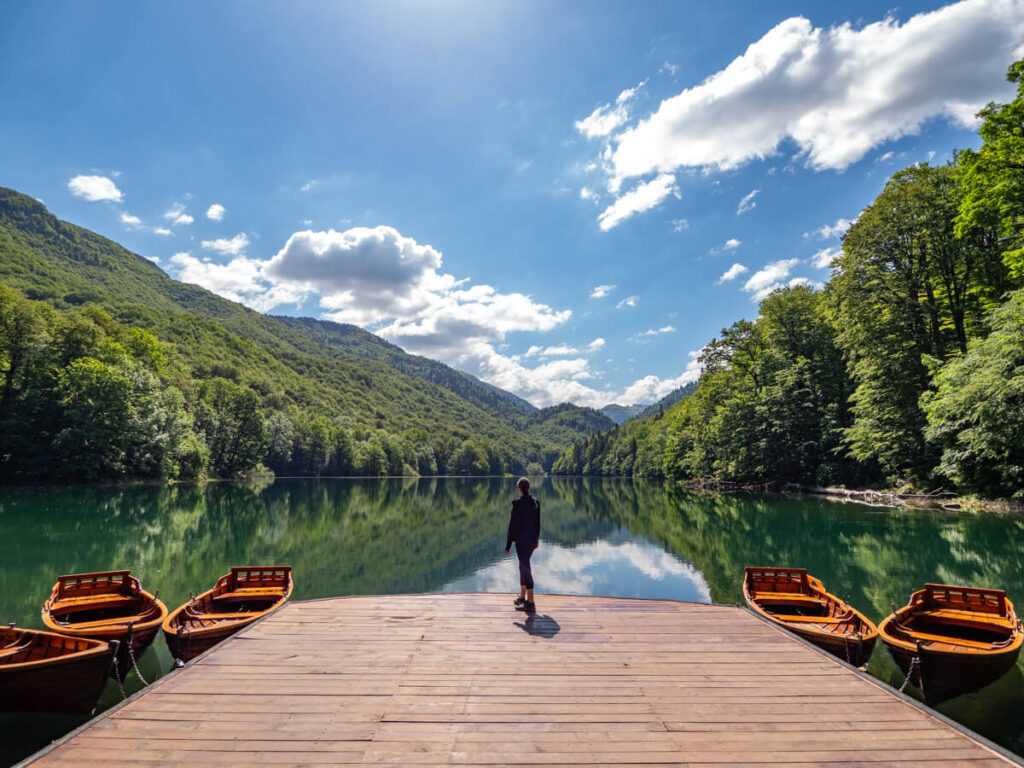
Biogradska National Park is almost the complete opposite of the stark limestone landscapes and coastal cliffscapes that we’ve mentioned so far. Hidden in the Bjelasica mountains near Kolašin, the park is famous for its ancient primeval forest, where huge beech, fir, and spruce trees create a cool, green landscape.
The easy 1-hour Biograd Lake loop is the obvious starting point for hiking here, while longer trails climb towards Bendovac Viewpoint, Crna Glava Peak and the park’s other glacial lakes.
We’d recommend Biogradska Gora for woodland walking, families who prefer flatter trails, and anyone who wants mountain scenery without constantly climbing steep, rocky peaks. It really is a unique landscape like nowhere else we saw in Montenegro, and the perfect place to find a bit of peace.
6. Komovi
The Komovi mountains, east of Kolašin and around Andrijevica, are one of the best choices for hikers who want spectacular scenery without the crowds of some of the national parks. The landscape is dominated by three distinctive high peaks – Kom Kučki (2,487 metres), Kom Vasojevićki (2,461 metres), and Kom Ljevorički (2,465 metres) – rising dramatically above green mountain pastures and valleys.
The classic summit routes are proper mountain hikes, with steep ascents and some exposed terrain, while the Komovi massif circuit gives a chance to experience the landscape without committing to one of the highest summits.
Komovi is a real up-and-coming hiking destination in Montenegro, but it’s still firmly off the established tourist trail. It’s not a national park (yet!), but it is part of the Komovi Nature Park (Park Prirode Komovi). That means it’s a great place for pro hikers to get off the beaten path, but there’s not a lot of infrastructure, so you need to be well-researched and prepared for a hiking trip here.
Sadly, Komovi is the only destination we didn’t reach, but we drove past, and the mountain range really does look stunning, if not incredibly remote. Maybe it’s one for our next trip!

The best hikes in Montenegro
Montenegro is small enough that you can move between very different hiking environments in a single trip, but the trails themselves vary enormously. We’ve included everything from a gentle walk around a glacial lake to exposed mountain summits, so this isn’t a list of hikes that all require the same level of fitness or experience – we’ve mixed it up.
Here are the best hiking trails in Montenegro, the routes we most enjoyed, and the hikes we’d recommend to our besties to see the best of Montenegro on foot. Make sure to go check out our dedicated guides to each hike for more information on transport, parking, trailhead locations, and what each route is actually like to walk.
1. The Ladder of Kotor
The Ladder of Kotor is one of the most popular hikes in Montenegro, climbing from just outside Kotor’s Old Town towards Krstac Pass on the old route linking Kotor with the mountains around Njeguši. The trail zigzags up the steep limestone slopes in more than 60 switchbacks, with increasingly impressive views over the Bay of Kotor as you gain altitude.
The full route is around 6 miles (9.5 km) return, with options to make it longer from the top of the ladder, or shorter if you don’t want to go the whole way. You gain about 600 metres (1,960 ft) from the bottom to the top (more if you keep going), so it’s not an easy hike, but the switchbacks mean the incline is a lot gentler than many of the hikes we did in other places.
The Ladder of Kotor has historically been combined with visiting the San Giovanni Fortress, which you get epic views of pretty much the whole way, but it’s now not possible to access the fort from the hike for free.
Even if you don’t do the whole route, it’s worth it for the absolutely epic views over the bay, which are only rivalled by the Kotor Serpentine and the Kotor Cable Car, both of which require transport or a fee.
2. The Black Lake (Crno Jezero)
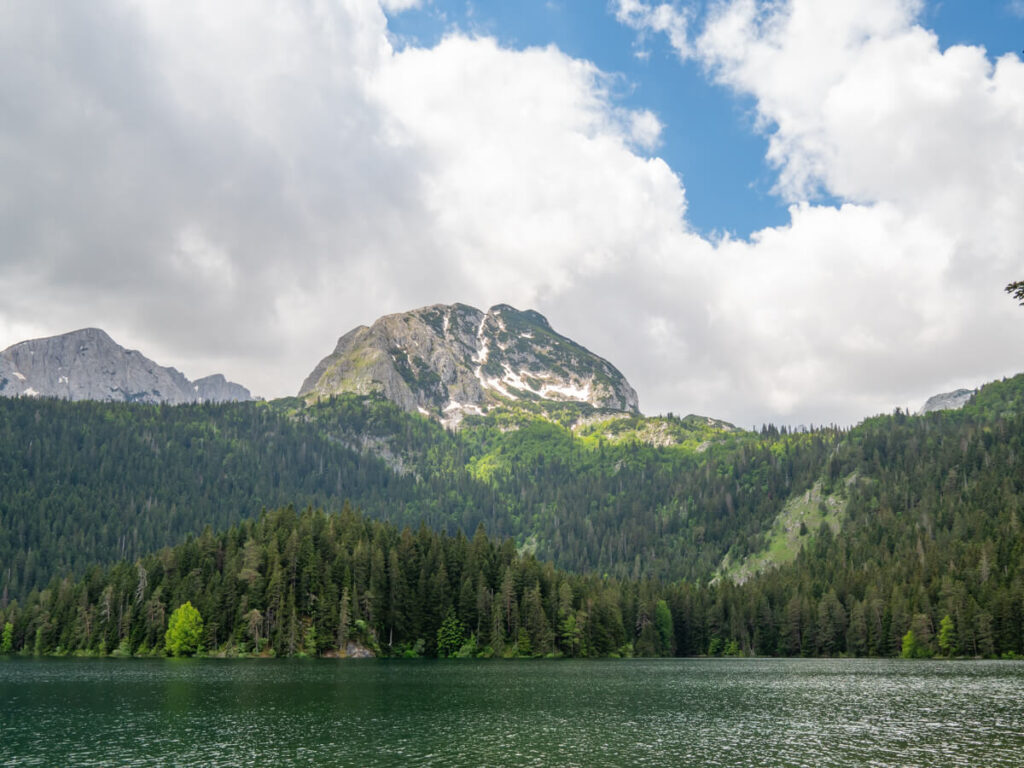
If you want to experience the sheer beauty of Durmitor National Park without committing to a serious mountain hike, the Black Lake (Crno Jezero) is the hike for you. Located just outside Žabljak, the trail circles the park’s best-known glacial lake, passing through dense conifer forest with the dramatic Međed massif rising behind the water.
The loop is around 2 miles (3.5 km) and almost entirely flat, taking around 1-1.5 hours at an easy pace. The terrain is mostly straightforward but can be rocky, rooty, or muddy in places. It’s not suitable for strollers, but a great hike for families with children who love exploring the outdoors.
The Black Lake is also the launch pad for much longer and more strenuous routes deeper into the national park, including Planinica Peak, Bobotov Kuk, and Ledena Pećina (Ice Cave).
3. Bobotov Kuk
At 2,523 metres (8,278 ft) high, Bobotov Kuk is the highest summit entirely within Montenegro. Climbing it is an accolade for sure, but it’s also a challenge.
The classic route starts at Sedlo Pass, taking you through high alpine meadows before the landscape becomes increasingly rocky and exposed on the approach to the summit. The route is roughly 6.2 miles (10 km) return, depending on the exact route you take and which trailhead you use, with around 900 metres (2,950 ft) of elevation gain.
This is a strenuous full-day hike, with steep terrain, loose rock, scrambling, and fixed steel cables in some sections, so it’s best suited to experienced, sure-footed hikers. The nice thing about it, though, is that much of the first two-thirds of the route is pretty moderate in difficulty, so you can see how far you get and turn around at any point.
Bobotov Kuk was the pinnacle of our hiking trip to Montenegro and what we worked up to for weeks. We were nervous about it as we visited a little too early in the season – snow can linger well into June, making summiting without crampons incredibly dangerous. But we were able to complete most of the hike without summiting, and it was such a joyous hike. Be sure to time your visit in peak summer, July to September, if you’re keen to summit.

4. Prutaš Peak
Prutaš is a good alternative to Bobotov Kuk, offering stunning scenery without quite the same intensity as its more famous neighbour – although it’s still a difficult mountain hike, so don’t underestimate it.
The 2,393-metre (7,851 ft) summit rises above the Škrka Lakes valley, with its distinctive layers of rock giving the mountain its unusual striped appearance. The usual route from the Dobri Do Valley is around 5 miles (8.2 km) return, with approximately 770 metres (2,530 ft) of elevation gain.
We’d class it as moderate, with a mixture of grassy slopes, rocky ground, and steeper sections but no technical climbing, so it’s a good choice for a challenging hike in Durmitor without scrambling.

5. Ćurevac Peak
For one of the most overlooked hikes in Montenegro, we’d recommend Ćurevac Peak. It’s a relatively easy 1.3 miles (2.1 km) return hike with a gentle incline that offers the most insane views over the Tara River Canyon.
We did this hike on our last morning in Durmitor, and it pleasantly surprised us, being super rewarding for much less effort than a lot of the other mountain hikes on this list. The short trail climbs through forest and open mountain terrain before reaching the exposed summit, where the sparkling Tara River cuts dramatically through Europe’s deepest canyon. We even saw river rafters floating far below.
We’d rate the standard route easy to moderate, making it a good option for families with older children and less experienced hikers who still want a genuinely impressive mountain viewpoint without committing to a full-day hike.

6. The Three Peaks
The Three Peaks is our favourite trail in Montenegro, with the most incredible scenery we’ve possibly ever seen on a hike.
Located in the beautiful Grebaje Valley, it leads you into Montenegro’s Accursed Mountains, where you traverse the ridges of Popadija (2,030 metres), Talijanka (2,057 metres), and Volušnica (1,879 metres), the latter of which you can do an out-and-back hike to if you’re not up for the full loop.
The full loop is about 6.5 miles (10.4 km), with 970 metres (~3,180 ft) of elevation gain, which sounds similar to some of the other challenging hikes on this list, but with the constant undulating peaks and steep incline/decline, it was an absolute killer, especially on the knees.
The Three Peaks hike was the first proper mountain hike we did in Montenegro, and we won’t lie, we underestimated it a little. We got lost, took far longer than anticipated, and weren’t properly prepared with an offline map, but the rewarding views blew us away. You pass dense forest, open alpine meadow, narrow ridgelines, and panoramic views into the Karanfili massif, surrounding valleys, and into Albania. There’s really nothing else like it.
We’drecommend this trail for fit hikers who are comfortable with heights and a long day in the mountains, ideally in the peak of summer when it’s free of snow.
7. Lake Biograd
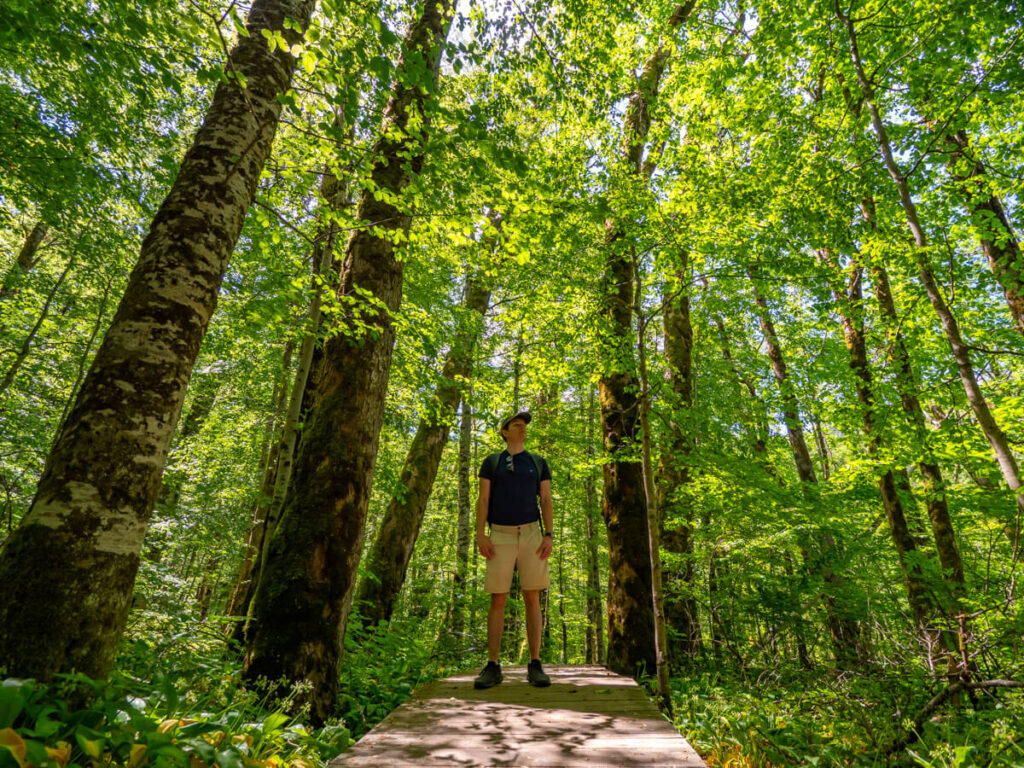
The walk around Lake Biograd is one of the gentlest hikes on this list and shows you a completely different side of Montenegro. Nestled in the heart of Montenegro, it takes you around the shore of the lake through one of three remaining primeval forests in Europe, with towering beech and fir trees creating a cool, green atmosphere.
The circuit is around 2.1 miles (3.4 km) and has very little elevation gain, taking roughly an hour to complete, depending on how often you stop. It’s very similar to the Black Lake loop, but we thought it was far more peaceful and preferred the calm sense of being surrounded by towering trees to the more dramatic atmosphere of Black Lake.
This hike is great for families, casual walkers, and anyone wanting a relaxing day out without much effort.
8. Oko Skakavice
Hidden in the Ropojana Valley near the Albanian border, Oko Skakavice is a short but beautiful hike to one of the region’s most striking natural features – a vivid turquoise karst spring where water emerges from beneath the limestone mountains. You probably won’t find this one in many guidebooks, but it was such a nice change of pace to enjoy a shorter, flatter walk to a beautiful natural spring after strenuous days in the mountains.
The trail passes through forest and mountain countryside before reaching the crystal-clear pool, making it a much gentler introduction to Prokletije than its high summit routes, perfect for families and seniors. It’s also a lovely, refreshing place to have a dip on a hot day in summer, although in spring, it was too flooded for us to go in.

9. Njegoš Mausoleum
We’d maybe call this one more of a walk than a hike, but it’s worth including because it’s the star of the show in Lovćen. The climb to the Njegoš Mausoleum on Jezerski Vrh peak requires a climb through a tunnel and up 461 steps to the mausoleum of Petar II Petrović-Njegoš, sitting at around 1,657 metres (5,436 ft) above sea level. The ascent is short but continuous, usually taking around 15-25 minutes, and the reward is a huge panorama across the Bay of Kotor and the mountainous interior of Montenegro.
The mausoleum is said to be the highest in the world and is the final resting place ofMontenegro’s 19th-century prince-bishop, ruler, philosopher, and celebrated poet, who chose this summit as his burial place. He originally built a small chapel here in 1845, but after it was damaged and later replaced, the present mausoleum was constructed between 1971 and 1974 to a design by renowned Yugoslav sculptor Ivan Meštrović.
It’s easy to moderate rather than a serious hike, making it ideal for families, non-hikers, and anyone who wants spectacular mountain views without spending half a day on the trail.

10. Vrmac Ridge Trail
The Vrmac Ridge Trail is a good option if you want mountain scenery without leaving the Bay of Kotor behind. The forested Vrmac Peninsula forms a natural ridge between Kotor Bay and Tivat Bay, meaning the views constantly alternate between the two bodies of water as you walk along the crest.
The full ridge route is roughly 9 miles (15 km), but if you’ve rented a car in Montenegro, you can drive along the top and skip out a lot of the switchbacks from the lower trailhead and make it shorter by turning around earlier, cutting it down to about 5.5 miles (9 km).
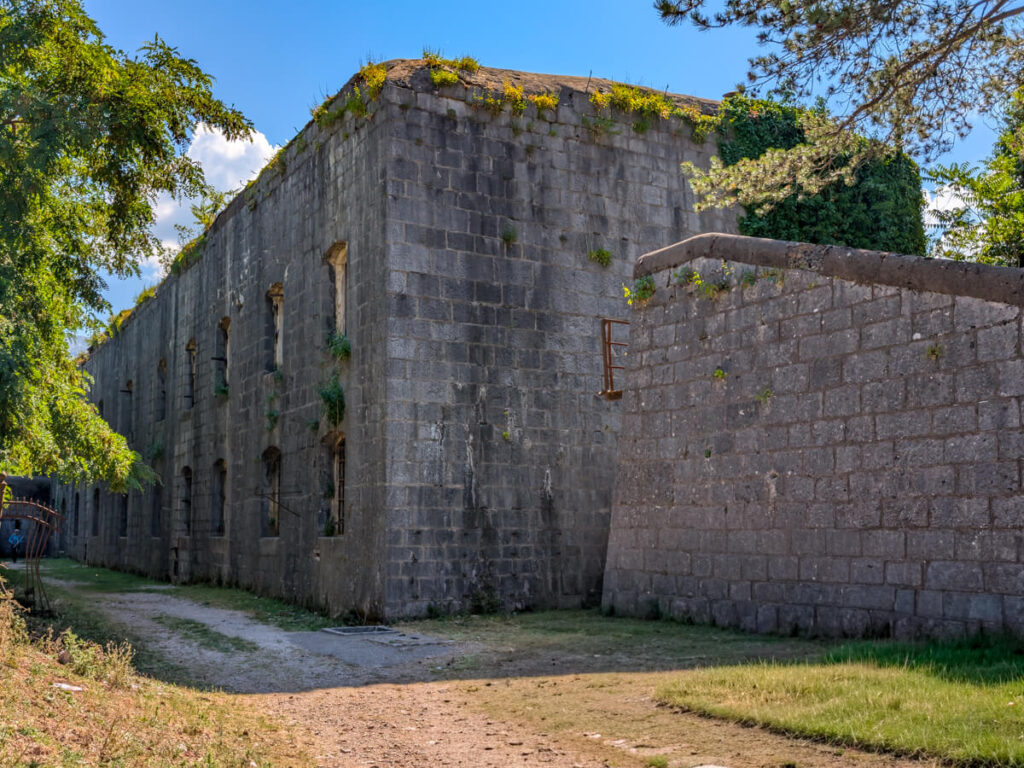
The terrain is a mixture of old military roads, dirt paths, stone tracks, and forest, with the remains of Austro-Hungarian Fort Vrmac providing an interesting destination along the way. It’s harder to reach without a car than the Ladder of Kotor, but worth it if you’re staying in the surrounding region and are interested in history, as it’s one of the best hikes near Kotor.
When to go hiking in Montenegro?
Generally, Montenegro’s hiking season runs from mid-June to mid-October in the national park and mountainous regions like Durmitor and Prokletije. To be sure you can hike the trails you want, we’d recommend timing your visit with the summer months of July and August.
If you are planning a trip in the off-peak seasons and are worried about snowy trails, stick to the areas around the coastal towns like Kotor and Lovćen National Park, where trails are easier to access from about mid-April to the end of October.
Quite frankly, there’s not much point in planning a hiking trip to Montenegro at the wrong time of year. The coast can be warm and perfectly hikeable while the higher mountains are still buried beneath snow.
Many of the best hikes in Montenegro are completely covered in snow in winter, so we wouldn’t bother visiting between November and February, unless you’re happy to swap your hiking boots for snowshoes.
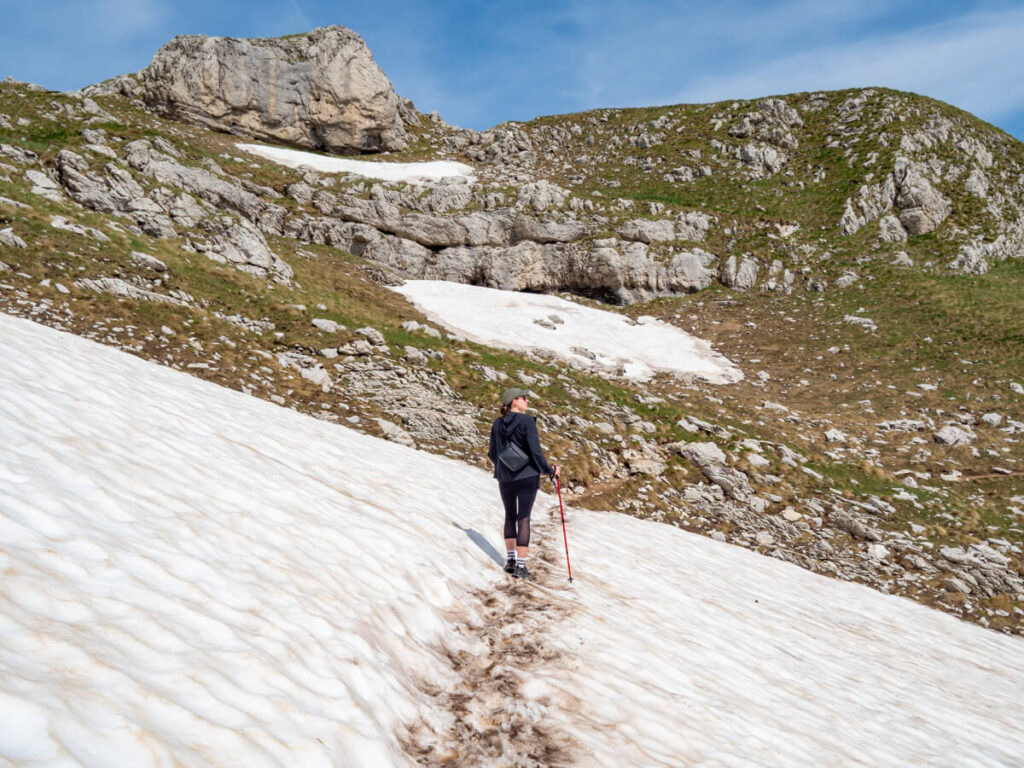
While spring is a great season to avoid the summer cruise crowds that descend in July and August, it’s worth knowing that it’s not ideal for hiking. Even though June is the start of the summer season in much of Europe, it’ss till not ideal for hiking in some parts of Montenegro, especially more remote and mountainous parts. We were surprised how much snow still lingered at the end of May and the beginning of June in areas around Prokletije and Durmitor. Depending on conditions, you may need mountaineering equipment – a local guide told us he was planning to take a group to the summit of Bobtov Kuk in June with crampons in mid-June.
Early autumn is a good time to visit, particularly September, when the summer heat starts to ease but the higher mountain trails are still generally clear. October can also be a lovely month for hiking, particularly around the coast and at lower elevations, but we’d be more cautious about planning a trip around the highest peaks as the winter weather starts to arrive.

What to know before hiking in Montenegro
Hiking in Montenegro doesn’t require specialist mountaineering skills, and a lot of trails are beginner-friendly, but it does require a little more preparation than you might be used to on popular hiking routes elsewhere in Europe.
Waymarkers
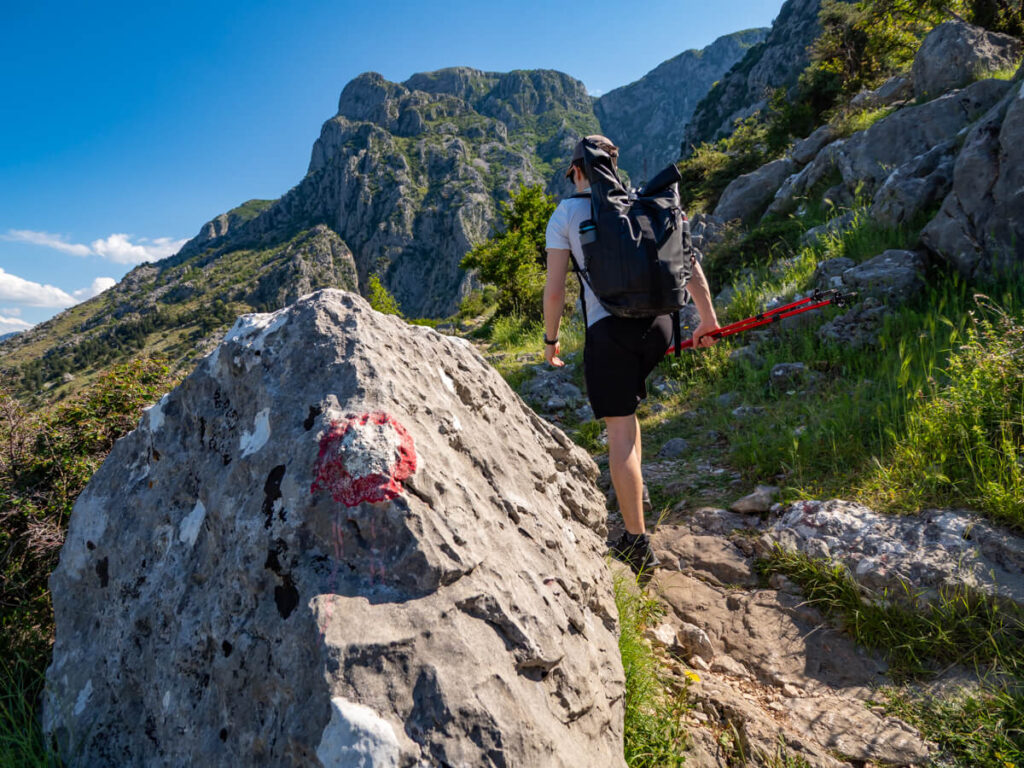
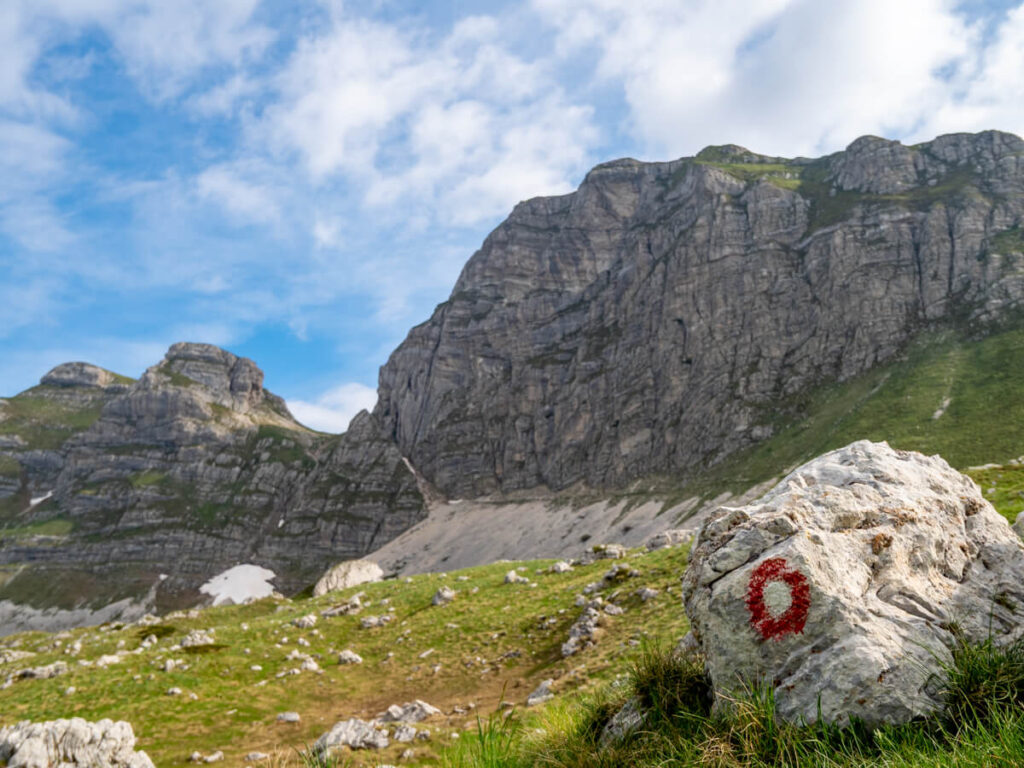
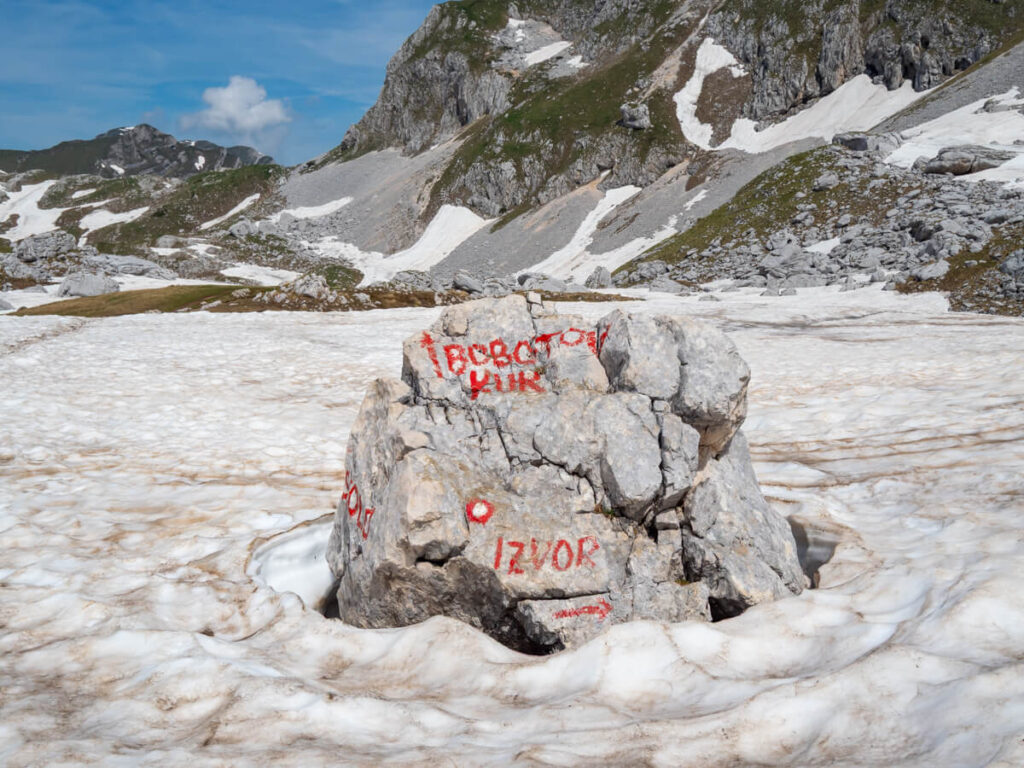
Trail markings vary considerably between routes. Some of Montenegro’s most popular trails are well marked with the familiar red-and-white hiking blazes, while less-travelled routes can have faded markings, widely spaced paint, or sections where it’s not immediately obvious which way to go.
There’s also not really a standardised trailmarking system. We saw all sorts, including:
Don’t assume that seeing one marker means the entire route will be this straightforward – keep checking for the next one, particularly at junctions. We learned this the hard way on the Three Peaks route where we got lost, and from then on, religiously looked out for these trail markers on our hikes. If you haven’t seen one in a while (every 5-10 minutes or so), stop and check your map.


Signs
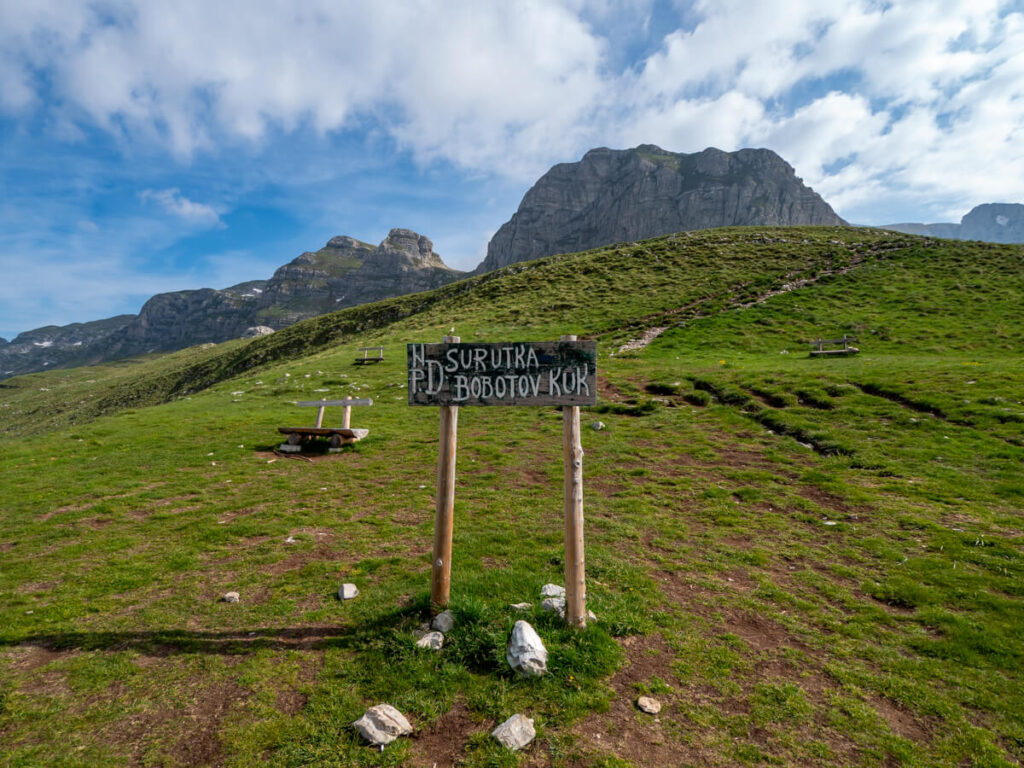
Signposts are useful when you find them, but they aren’t that frequent. Montenegro’s ordinary hiking fingerposts are officially yellow and tend to show the destination, direction, and distance in kilometres.
On some routes you’ll encounter clear directional signs at trail junctions, while elsewhere you’ll be following a much less obvious mountain path with no signs whatsoever. We’d never relied solely on physical signage, as it was few and far between.

Maps
Our biggest piece of advice for hiking in Montenegro is to always have a map or downloaded route with you, particularly if you’re heading into the rural northern mountains. Mobile signal can disappear surprisingly quickly once you get into the mountains, so download anything you’ll need before leaving your accommodation.
AllTrails was pretty consistent for most trails, but was missing a few. Wikiloc and Komoot were also pretty good. You have to check each route carefully, as some maps are inaccurate.
On each of our hiking guides, we’ve linked the exact maps we used and routes we recommend.
Water
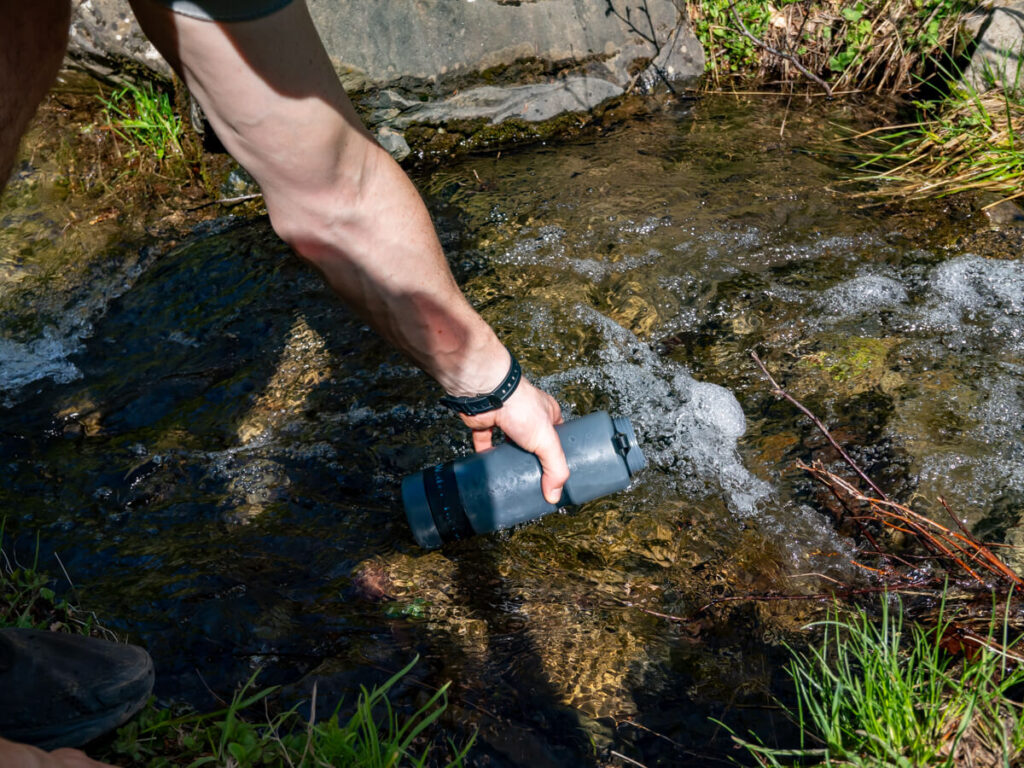
Don’t assume you’ll find somewhere to refill your bottle along the trails, especially in summer when rivers can dry up. Some trails pass springs or streams, but these aren’t guaranteed to be flowing or safe to drink from.
For a full-day hike, we’d generally carry at least 2 litres of water per person, and more if the route is exposed or temperatures are high. We always carry a reusable bottle each, but on this trip, we were also grateful for our filter bottles, which we could fill up on the go without worrying about getting sick.
Food
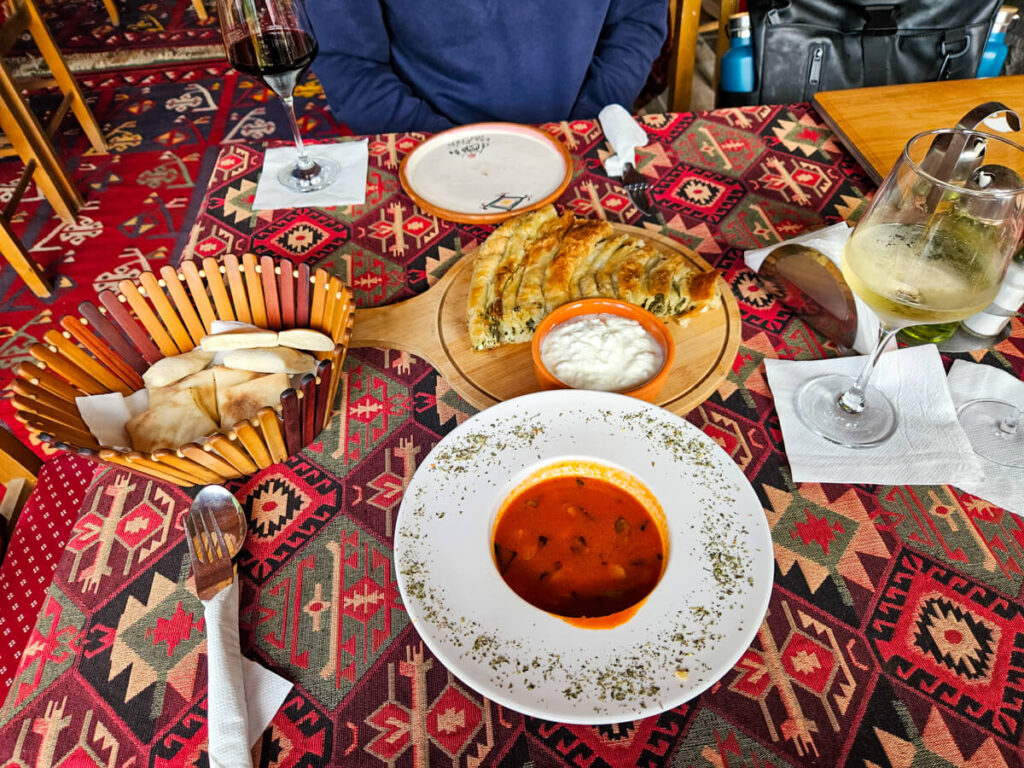
The same goes for food. Outside the towns and main visitor areas, there may be absolutely nothing to buy once you’re on the trail. You might expect it in remote parks like Prokletije and Durmitor, but even trails around Kotor can have nothing nearby. Even the famous Cheese Shop not the Ladder of Kotor can be closed at times, so bring snacks with you.
Even relatively popular mountain routes can take several hours, so pack enough food to keep you going – sandwiches, fruit, nuts, cereal bars, or whatever you actually enjoy eating. We made the mistake of thinking we’d be back in time for lunch on a couple of hikes, only to arrive back in the afternoon and not have taken a picnic with us. We’d much rather carry an extra snack than discover halfway up a mountain that our lunch consisted of optimism and slightly squashed biscuits.
Weather
Mountain weather can change much faster than conditions at the coast, and a warm, sunny morning doesn’t guarantee a comfortable afternoon at altitude. Check the forecast immediately before setting off, but also be prepared for conditions to change. A lightweight waterproof, an extra layer, and sun protection should be part of your kit even on a seemingly perfect summer day.
Tips for hiking in Montenegro
A little preparation goes a long way when hiking in Montenegro. These are the things we’d keep in mind before setting off.
What to wear to go hiking in Montenegro
Even if you’re visiting Montenegro in the middle of summer, don’t be fooled by the extreme temperatures you might experience on the coast. Temperatures drop as you gain altitude, and exposed mountaintops can be surprisingly cold and windy, while evenings in the mountains can be chilly even after a hot day down by the sea.
The weather can also change quickly, so we’d always pack for more than just the conditions you expect when you leave.
When we visited in May and June, we were comfortable hiking in full-length hiking trousers or leggings and quick-dry T-shirts. We were very glad to have jumpers with us in the evenings, particularly when staying in more rural accommodation like Eko Katun Rosi. We also appreciated the extra layers when starting hikes early in the morning – Bobotov Kuk was particularly windy when we arrived, despite it being super sunny.
We both carried waterproof jackets, and we’d recommend doing the same whatever time of year you visit. Mountain storms can roll in surprisingly quickly, and even a promising forecast isn’t a guarantee of dry weather once you’re high in the mountains.
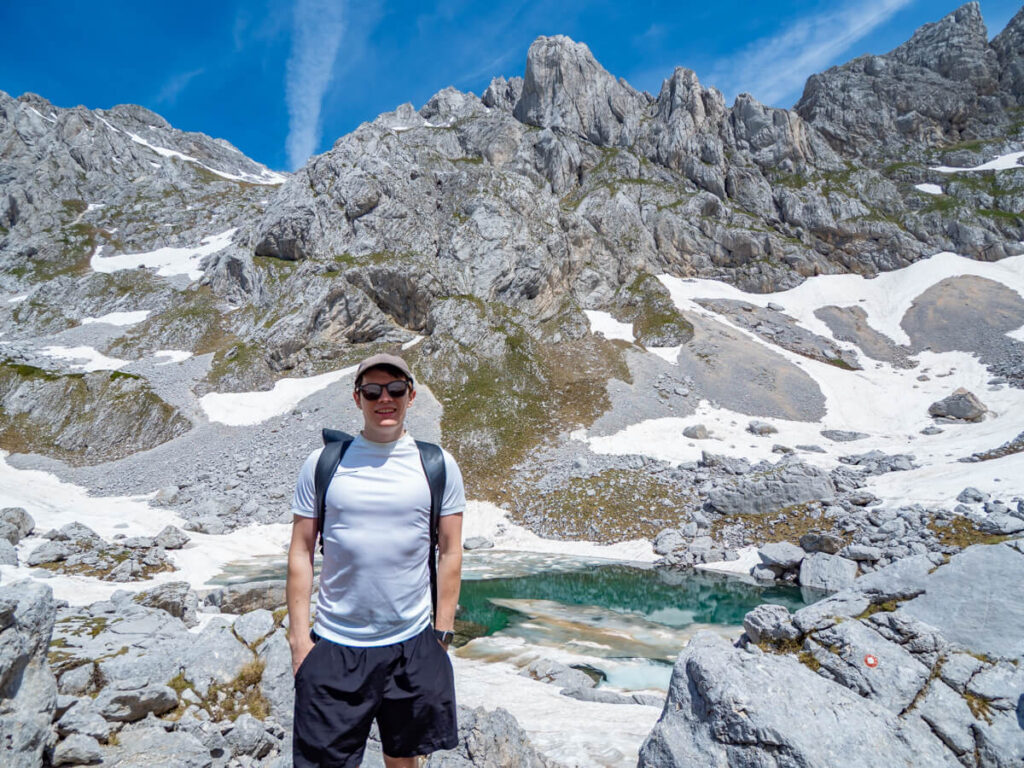
As for footwear, sneakers just won’t cut it for most of Montenegro’s hikes. You don’t necessarily need heavy-duty mountaineering boots, but we’d strongly recommend a comfortable, broken-in pair of hiking boots or trail-running shoes (our preference) with good grip.
For higher or more technical routes, particularly where there’s lingering snow, steep scree, or scrambling, you’ll need to take your footwear and equipment much more seriously. Don’t choose what to wear based solely on how the trail looks in a summer photograph – conditions can be very different when you actually arrive.

What to pack to go hiking in Montenegro
It’s best to be prepared for hiking in Montenegro. Don’t forget to pack your:
Leave your drone at home, as it’s illegal to fly in the national parks (be aware that you need to apply for a permit before importing it into Montenegro anyway).
How much does hiking in Montenegro cost?
One of the best things about hiking in Montenegro is that you don’t need to spend a fortune to enjoy the mountains. Many of the best trails are completely free, although you’ll need to budget for national park entrance fees on some of the most popular routes.
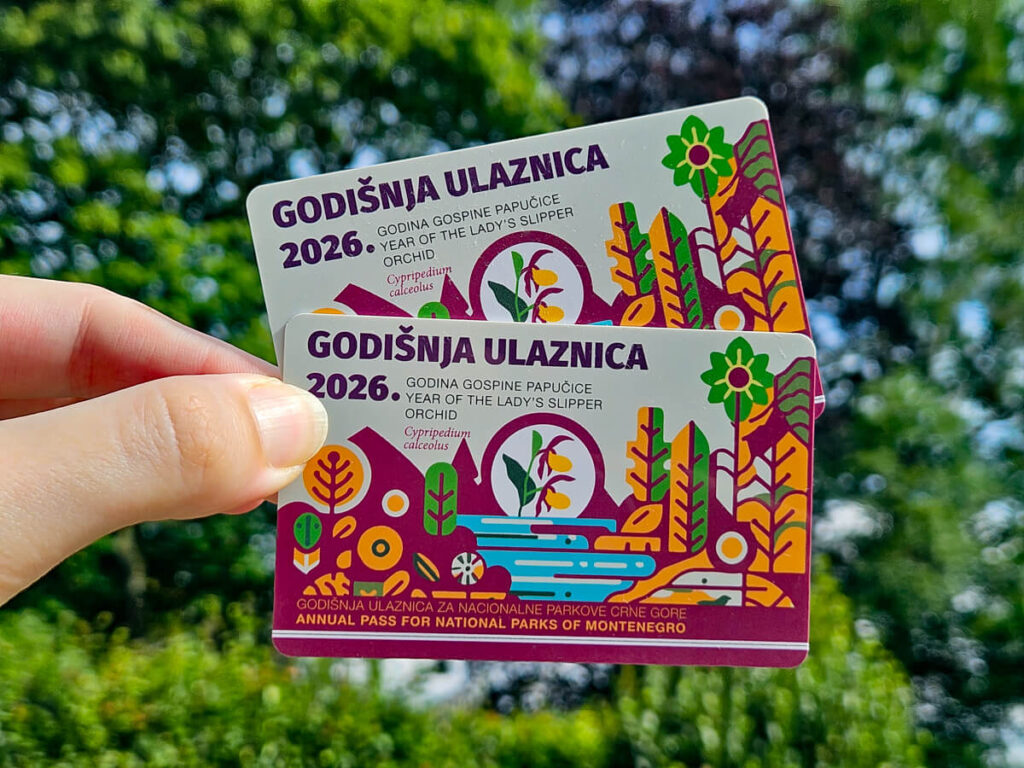
The five national parks have entrance fees ranging from €3-5 per person per day. If you’re planning to visit a couple, we’d highly recommend getting the annual pass for €13.50 if you plan to visit the other national parks too. You can also buy it online in advance or in person at a national park booth with your passport.
The bigger expense is usually getting to the trailhead. If you’re travelling independently, a rental car gives you much more freedom in the mountains, but you’ll obviously need to factor in the cost of the car and fuel.
Staying in mountain towns like Žabljak or Kolašin, which can be reached by public buses, can make a hiking trip considerably cheaper than booking organised excursions every day, but there are often very limited options into the national parks themselves or to trailheads.
Is hiking in Montenegro worth it?
Hiking in Montenegro is one of our favourite trips we’ve ever done, so YES, it’s absolutely worth it! The biggest reason to hike here is the sheer variety of landscapes packed into a relatively small country. You can walk to viewpoints of the Adriatic Sea one day and be among glacial lakes, alpine meadows, and 2,000-metre+ peaks the next. Durmitor and Prokletije in particular offer genuinely spectacular mountain scenery like we’ve seen nowhere else, while places like Lovćen, Biogradska Gora, and the Bay of Kotor give you very different types of hiking.
Add to that that Montenegro is still up-and-coming, relatively affordable to travel, not ruined by commercial tourism, and still retaining authentic local character, especially in the mountains, and it’s a winning combo.
We also found that Montenegro offers a nice balance between accessible hikes and genuinely challenging mountain routes. You can spend an hour wandering around Black Lake or climbing to the Njegoš Mausoleum, or spend a full day tackling Bobotov Kuk or the Three Peaks. That makes it possible to build a hiking trip around your own ability rather than committing to serious mountain days every time you lace up your boots.
The downside is that hiking in Montenegro can be less straightforward than hiking in more developed mountain destinations in western Europe. Trail markings aren’t always consistent or clear, route information online can vary considerably, and remote trails don’t necessarily have the infrastructure you’d find in the Alps. Weather can also change quickly, and lingering snow can make some high-level routes much more serious than they initially appear.
You also need to be prepared for the fact that the best scenery isn’t always the easiest to reach. Some trailheads require a long drive along narrow mountain roads, public transport is limited in many of the mountain regions, and having a car makes a big difference if you want to explore beyond the main tourist bases. Driving in Montenegro is a bit of a steep learning curve if you’re not used to driving abroad, but it is really integral to being able to access the best hikes easily.
So, is hiking in Montenegro worth it? Absolutely, if you’re comfortable with a little more independence and unpredictability. If you want perfectly maintained paths, extensive mountain infrastructure, and a cable car to every viewpoint, there are easier destinations to visit. But if you want dramatic scenery, challenging trails, relatively low costs, and the feeling of discovering somewhere still authentic, Montenegro is an excellent choice for hiking.

Hiking in Montenegro quick-fire recommendations
If you’re not sure which type of hiking experience is right for you, here are a few of our top recommendations to point you in the right direction.

Hiking in Montenegro FAQs
To help you plan your hiking trip to Montenegro, we’ve answered these frequently asked questions.
Is Montenegro good for hiking?
Montenegro is an excellent hiking destination, particularly if you enjoy dramatic mountain scenery, challenging trails, and a bit of adventure. Durmitor, Prokletije, Biogradska Gora, Komovi, and Lovćen all offer very different hiking experiences, from easy lakeside walks to demanding alpine routes. The main downside is that some trails are less clearly marked and less developed than you might expect in more established European hiking destinations, so you’ll need to be a little more self-sufficient.
What is the best hike in Montenegro?
If we had to choose just one hike in Montenegro, we’d go for the Three Peaks Trail in Prokletije National Park. The combination of high alpine ridges, huge limestone peaks, and views across Montenegro and Albania makes it one of the most spectacular hikes we’ve done in the country. For something shorter, we’d choose the Black Lake or Lake Biograd, and for something more accessible, we’d choose Bobotov Kuk, which was our most enjoyable hiking day in Montenegro.
What are the most beautiful hikes in Montenegro?
This is obviously subjective, but we think the most beautiful hikes in Montenegro are the Three Peaks Trail in Prokletije for its jagged limestone peaks (bonus if there’s lingering snow), Prutaš Peak for its layered waves of multi-coloured rocks, Bobotov Kuk in Durmitor for its epic valleys and pinnacles, and the Ladder of Kotor for unbeatable views over the Bay of Kotor. We’d also put Lake Biograd on the list if you prefer forests and peaceful scenery to exposed mountain ridges.
Is Albania or Montenegro better for hiking?
Montenegro is arguably the easier choice for hiking if you want to combine spectacular mountain hiking with a relatively compact itinerary and well-established tourist bases such as Žabljak and Kolašin. Albania, meanwhile, has an even stronger sense of wilderness in places and some fantastic hiking around the Accursed Mountains, Theth, and Valbona. If you want a more straightforward first hiking trip in the Balkans, we’d probably choose Montenegro; if remote mountain landscapes and a slightly more adventurous feel are your priority, Albania could win.
Is Croatia or Montenegro better for hiking?
We’d choose Montenegro for serious mountain hiking, but Croatia can be the better option if you want to combine hiking with coastal scenery, historic towns, and easier infrastructure. Montenegro has higher, wilder mountains and more opportunities for demanding alpine-style hikes, particularly in Durmitor and Prokletije. Croatia has some brilliant mountain trails too, especially around Velebit, Paklenica, and Biokovo, but we’d pick Montenegro if the hiking itself is the main reason for the trip.
Read next:
All 5 Montenegro National Parks Compared + Our Favourites
What It’s Really Like to Hike the Ladder of Kotor
How to Visit Lovćen National Park & Mausoleum of Petar II Petrović-Njegoš
Our Ultimate Guide to Visiting Durmitor National Park
12 Best Hikes in Durmitor National Park From Easy to Expert
A Comprehensive Guide to Visiting the Black Lake (Crno Jezero)
What It’s Really Like Hiking Bobotov Kuk: Montenegro’s ‘Highest’ Mountain
A Complete Guide to Hiking Ćurevac Peak
Complete Guide to Visiting Prokletije National Park: Montenegro’s Accursed Alps
10 Best Hikes in Prokletije National Park From Easy to Expert
What It’s Really Like to Hike the Three Peaks Trail in the Grebaje Valley
How to Visit Biogradska Gora National Park: Europe’s Last Remaining Rainforest
