A Detailed Guide to Driving in Montenegro + Our Top Tips

Discover everything you need to know about driving in Montenegro, including road conditions, hazards, local habits, and tips to stay safe on the road.
This post may contain affiliate links, which means we might earn a small commission on anything purchased through these links at no extra cost to you. Learn more on our disclaimer page.
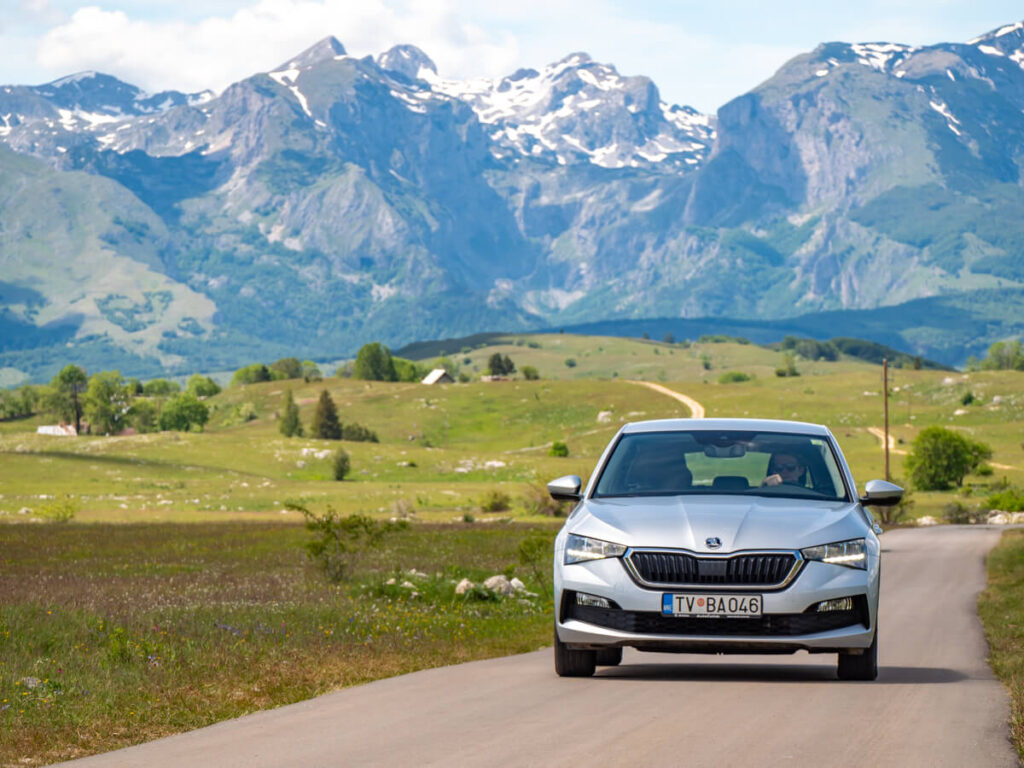
Driving in Montenegro is without a doubt one of the best ways to explore what we consider one of Europe’s most underrated countries. While buses connect most of the major towns, many of the region’s most spectacular viewpoints, mountain roads, national parks, and hidden beaches are simply inaccessible to those relying on public transport. Having a hire car also gives you the freedom to travel at your own pace, whether you’re winding around the Bay of Kotor or driving through the dramatic landscapes of Durmitor National Park.
We rented a car from Kombo Rent a Car and it was the best decision we made when planning our Montenegro trip. Having a car allowed us to explore all five Montenegro national parks in five weeks, cross into Croatia and back, into Bosnia and Herzegovina for day trips, and see way more of the country than we’d have been able to on buses. Having the flexibility to stop at scenic viewpoints, detour to small villages, and avoid relying on public transport schedules made it much easier to experience parts of the country that many visitors miss.
However, driving in Montenegro isn’t without its challenges and we wouldn’t recommend it to everyone. Narrow mountain roads, limited parking in popular towns, congested cities, and occassional questionable driving habits can catch first-time visitors by surprise. In this guide, we cover everything you need to know about driving a car in Montenegro, including what it’s like, road conditions, parking, tolls, fuel, and practical tips to stay safe and feel confident on a road trip around Montenegro.
10 quick tips for driving in Montenegro
- Drive on the right-hand side of the road.
- Keep your dipped headlights on at all times, even during the day.
- Don’t underestimate driving times, even if distances are short.
- Choose a small car if you can (a 4×4 isn’t necessary).
- Drive defensively and expect the unexpected.
- Check traffic on Google Maps before setting off, but don’t trust its detours.
- Fill up with fuel before heading into the mountains and don’t let your tank drop below a third.
- Avoid driving after dark if you can.
- Carry your driving licence, passport, rental documents, and Green Card with you.
- Slow down and enjoy the journey.
Is it worth having a car in Montenegro?
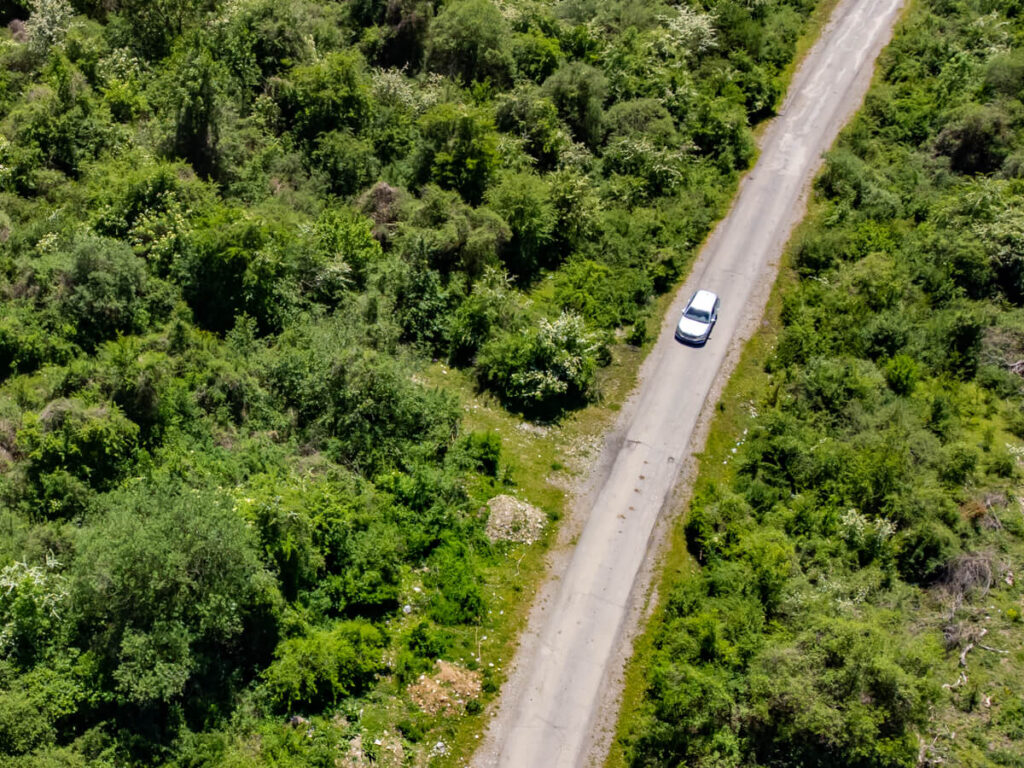
You can definitely get away without a rental car on the coast, but for any other parts of Montenegro you really do need to hire a car. If you’re only staying in one or two places like Kotor and Budva for a couple of days or backpacking along the coast, buses will do the job (although they’re not the most comfortable way to travel).
While it’s technically possible to follow a Montenegro itinerary into the mountains by bus, it’s going to take you a lot longer to complete, as you’ll be stuck following unreliable transport schedules. There’s not a lot to do in the gateway towns and you’ll struggle to get around to popular hikes and national parks without a car (and taxis can be expensive). We picked up a couple of Polish hitchhikers in Lovćen National Park who had been walking for 3 hours in the intense heat due to not having their own transport and met a girl in Durmitor National Park who was stranded because the buses didn’t run on the national holiday.
The only other alternative is a tour or transfer service, where you pay for convenience, which is a good option if you’re not keen to drive, but is generally a lot more expensive than a rental car.
In all honesty, we consider a rental car a non-negotiable for experiencing more than just a handful of touristy beach towns. If you truly want to experience the diversity of the country, from its remote and mountainous national parks to its sprawling beach towns and hidden gems, you just can’t get by with public transportation.

Our experience driving in Montenegro
We seriously considered whether we could get away without a rental car in Montenegro – it is generally a big expense, and we know the Balkans is super backpacker-friendly. We actually spent 10 days backpacking Bosnia and Herzegovina before landing in Montenegro. But in the end, we knew to really experience the best of the country beyond its most popular beach towns, we were going to need our own wheels.
After five nights in Kotor’s old town, which we didn’t feel we needed a car for – it’s super walkable and day trips like the cable car and Perast are easy to get to on the bus (which means you don’t need to navigate parking, too) – we picked up a rental car from Kombo Rent a Car.
We did have a bit of an advantage when it came to driving in Montenegro, because we’ve rented cars and driven abroad in over 16 countries, including Italy, Croatia, Slovenia, Australia, New Zealand, Costa Rica, Belize, Fiji, and Hawaiʻi (USA). So we’re reasonably experienced when it comes to a variety of road conditions, unpredictable driving habits, and renting cars through local agencies.
Having said that, we were still a little nervous. Having heard descriptions of how risky driving in the Balkans is – which Montenegro is lumped into – we were still slightly nervous before setting off. We’d heard plenty of warnings about Montenegro’s roads, from steep mountain passes and tight bends to local driving styles that can feel aggressive if you’re not used to them.
The reality was a mix of everything we expected and a few surprises. Some roads demanded concentration, particularly in the mountains, but the scenery, freedom and access to places we would have otherwise struggled to reach made driving one of the highlights of our Montenegro trip.
I will also say that my little brother and his girlfriend both drove a rental car in Montenegro when they met us towards the end of our trip – this was their first time driving abroad on the right-hand side of the road, and they found it relatively simple (prepared with some of our top tips in advance), too.
Is driving in Montenegro difficult?
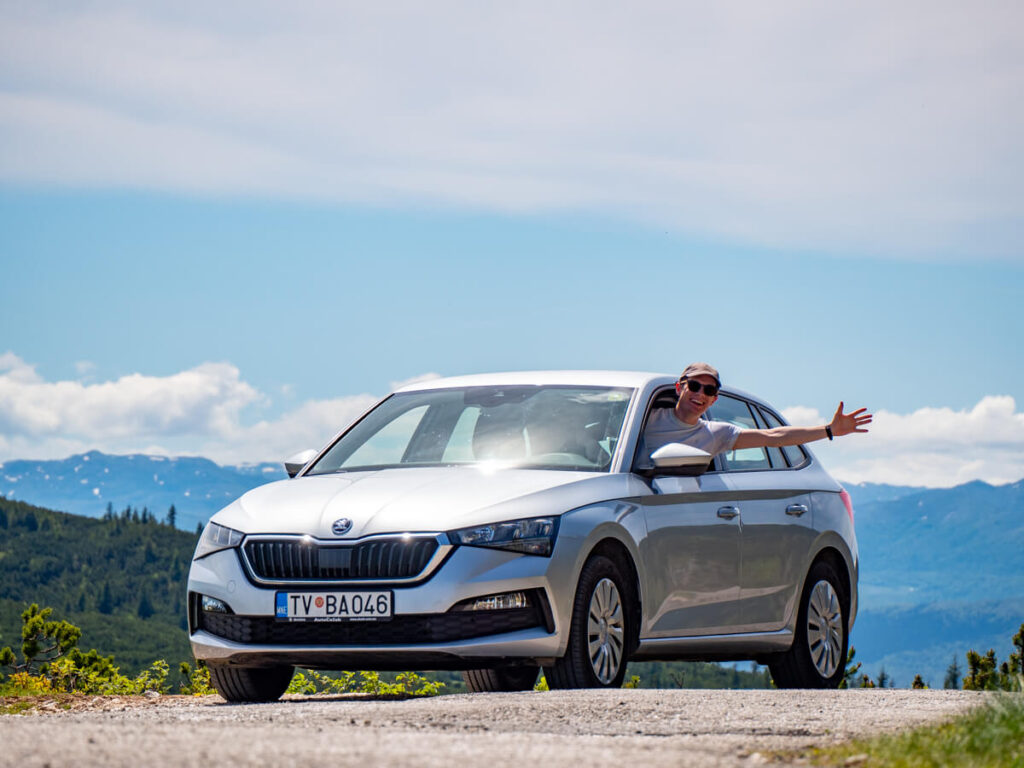
We were really curious to find out how difficult driving in Montenegro is, as we’d read conflicting accounts. At the end of the day, it really comes down to personal experience.
Ultimately, I think it depends on what you find difficult when driving. We both grew up in the countryside and are used to narrow, winding lanes. It’s congested city traffic, impatient drivers, and unpredictable lane changes that we struggle with more.
Compared with places like Italy, we found Montenegro noticeably more relaxed to drive in. The roads were generally quieter, traffic was lighter, and we rarely felt pressured by other drivers.
Unlike in other countries, we didn’t really have any close calls. Maybe it’s actually safer or it could be that we’re more experienced and aware of what to look out for – practising defensive driving, expecting the unexpected, leaving extra space, not rushing overtakes, and adjusting our speed to the conditions. We found the roads quite quiet, especially in mountain regions and surprisingly on the motorways. The Bay of Kotor was, however, as congested as everyone says and Podgorica was a whole chaotic experience in itself.
Overall, we wouldn’t describe driving in Montenegro as difficult, but it does require confidence, patience and a willingness to adapt. If you’re comfortable driving abroad and can take your time, having a car opens up a huge part of Montenegro that many visitors miss.
Montenegro driving laws
Before setting off, it’s worth familiarising yourself with the basic driving rules in Montenegro. Most regulations will feel familiar if you’ve driven elsewhere in Europe, but there are a few things that caught our attention, especially coming from countries where driving rules are slightly different.
Drive on the right-hand side of the road
One of the biggest challenges is that Montenegro drives on the right-hand side of the road, the same as most of mainland Europe and the USA. But if you’re from the UK like us, or Australia or New Zealand, you’re on the “wrong” side of the road. Manoeuvres like roundabouts and junctions are reversed, and it can be really challenging to re-train your brain. We find saying little mantras like “right-hand side of the road” whenever we set off and “left long way round” or “right short way round” at junctions helpful.
Have your headlights turned on
The number one rule you might not be used to is that headlights are required throughout the day as well as at night, even in good weather. Make this the first thing you check when getting in the car, as it’s easy to forget if you’re used to only using lights after dark. We found leaving them on Auto meant we didn’t need to remember to turn them on and off manually.
Follow the speed limits
Standard speed limits are generally:
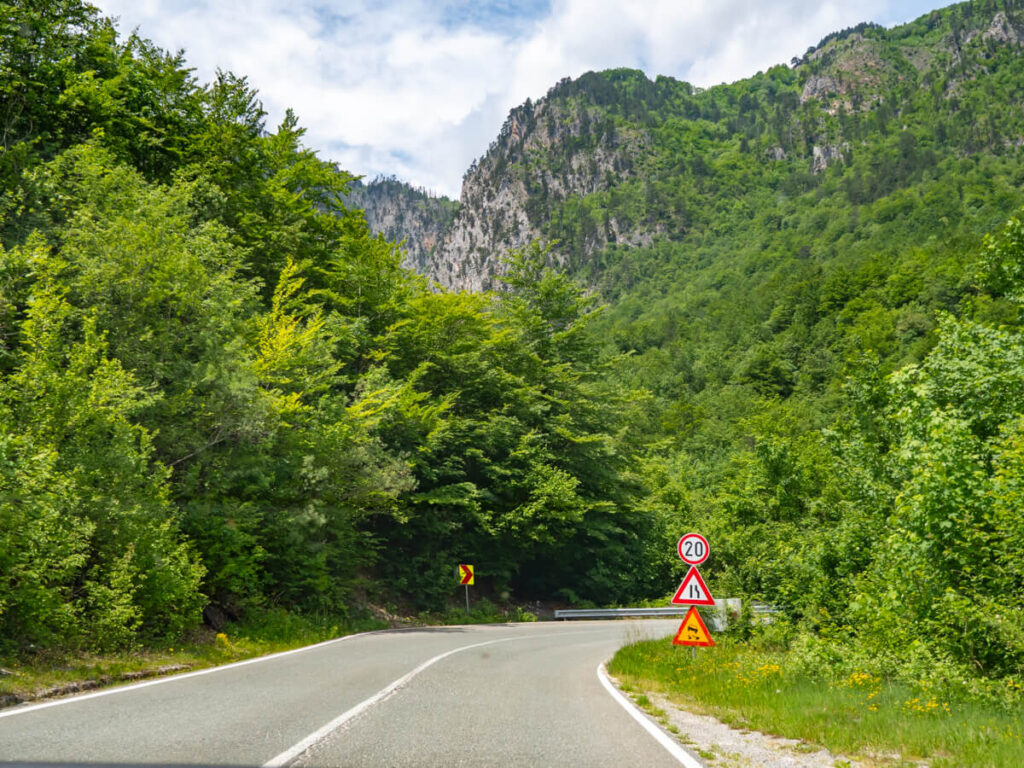
Always follow posted signs, as limits can change on mountain routes and tight corners. It’s polite to pull over (somewhere safe like a gravel pull-in area) to let traffic pass if you’re slower than it.
We found that some speed limits can feel surprisingly slow for the road conditions, and you’ll occasionally notice local drivers travelling faster than the signs suggest. However, it’s not worth copying them. Police checks and speed cameras do exist, and fines can quickly wipe out any time you save.
Know when to use your horn
Officially, you should only use your horn to warn other road users of your presence or to help avoid a dangerous situation.
Don’t be alarmed if another driver honks at you. It’s not always a sign of aggression – using the horn is often intended as a warning to let you know someone is overtaking you or passing by. We often got beeped at as a thank you when we’d pull over to let faster vehicles pass, too.
On super tight corners like switchbacks, especially in tunnels like the road to Piva Lake, you can also do a small honk to warn oncoming traffic around the corner that you’re coming around.
Obey signage (and know when not to)
One thing that did catch us out was the placement of some signs. On slip roads and turning lanes, speed limits are often displayed before the turn begins, which can make it look like the restriction applies to the main road rather than the exit you’re taking. Stop signs on side roads can also appear at an unusual angle, making them look like they’re intended for another lane. Take an extra second to check which road the sign applies to.
Wear a seatbelt
Seatbelts are mandatory for all passengers, both in the front and rear seats. Children must use appropriate child restraints based on their age, height and weight.
Don’t use your phone
Using a handheld mobile phone while driving is prohibited (although you’ll see plenty of locals breaking this law). If you need navigation, set up your route before leaving or use a hands-free mount.
Don’t drink and drive
Montenegro has a strict legal blood alcohol limit of 0.03% (0 for drivers under 24), and the safest approach is the same as anywhere: if you’re driving, don’t drink. This is particularly important in Montenegro because many scenic routes involve mountain roads where concentration and reaction time are essential.
There are some amazing local vineyards in Podgorica and the Lake Skadar region, but you have to remember that you can’t taste the wine if you are the driver. To get around this, we actually booked a couple of nights at a few vineyards and stayed over.
Only overtake when legal and safe
Overtaking is only permitted when it is safe and legal to do so. On Montenegro’s mountain roads, you’ll often find long stretches of winding roads with limited visibility, so avoid overtaking unless you have a clear view ahead.
People will overtake, undertake, and cross multiple lanes in front of you without indicating. Undertaking is quite common (although not legal), and it doesn’t just happen on highways. A couple of times, we experienced a car cutting us off at junctions and turning the way we were going but from the wrong lane.
What to watch out for when driving in Montenegro
Driving in Montenegro is a fantastic way to see the country, but it does come with a few challenges. The biggest thing we’d recommend is to drive defensively. Don’t assume other road users will always follow the rules exactly as you expect, and always leave yourself extra time and space to react.
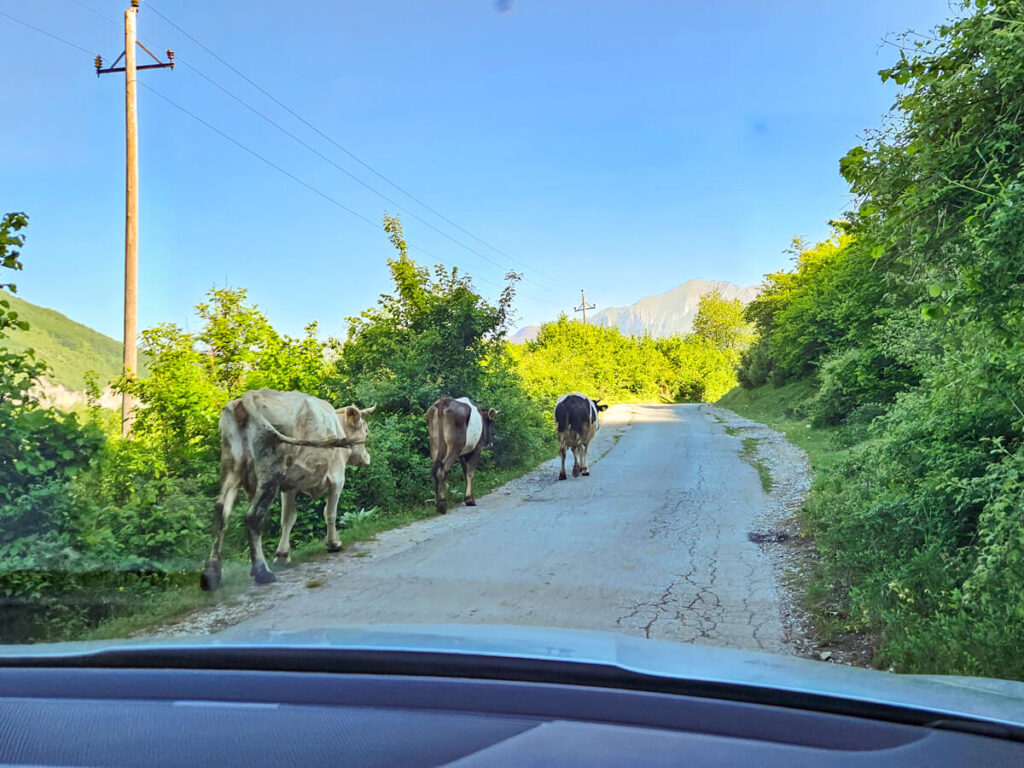
There are also a few hazards that you might not be used to, including:
The Balkans is a big motorbiking destination – beware of them coming round corners on your side of the road, especially on tight bends like the Kotor Serpentine. They also travel in groups, so where there’s one, expect a few more to come along.
Large tourist coaches are common around Montenegro’s more popular sights, particularly the Bay of Kotor, Budva, and major viewpoints. Coaches may need to take a wider line around tight corners (expect them on your side of the road), can temporarily block traffic while manoeuvring (they get stuck on the Kotor Serpentine), and may stop suddenly near viewpoints or attractions.
Montenegro road conditions
Road conditions vary across Montenegro, from modern motorways and well-maintained coastal roads to winding mountain passes and the occasional pothole-filled rural route.
There’s a nationwide push to improve infrastructure, and we did come across quite a lot of roadworks between Kotor and Budva. As Montenegro booms in popularity (which is happening at an increasing rate), and especially as they look to join the EU in 2028, the roads will only get better. But in the meantime, you do need to be careful when driving along areas where they’re ripping up the roads, adding roundabouts that didn’t exist before, and leaving manholes uncovered on the side of the road.
Speaking of roundabouts, there seemed to be nationwide confusion on how to use them (said snobbily by a Brit who’s very used to roundabouts). Considering Montenegro only introduced its first roundabouts during the urban modernisation in the early 2000s and the ones in Tivat and Kotor were still being built during our visit, it’s understandable why. The main thing is to stay alert, don’t assume other drivers will signal or choose the correct lane, and simply follow the usual rules: give way to traffic on the left already on the roundabout unless signs or road markings indicate otherwise, keep to your lane, and take things slowly if you’re unsure. We actually stalled on a couple in Podgorica (oops!), but were fine since there was slow-moving traffic.
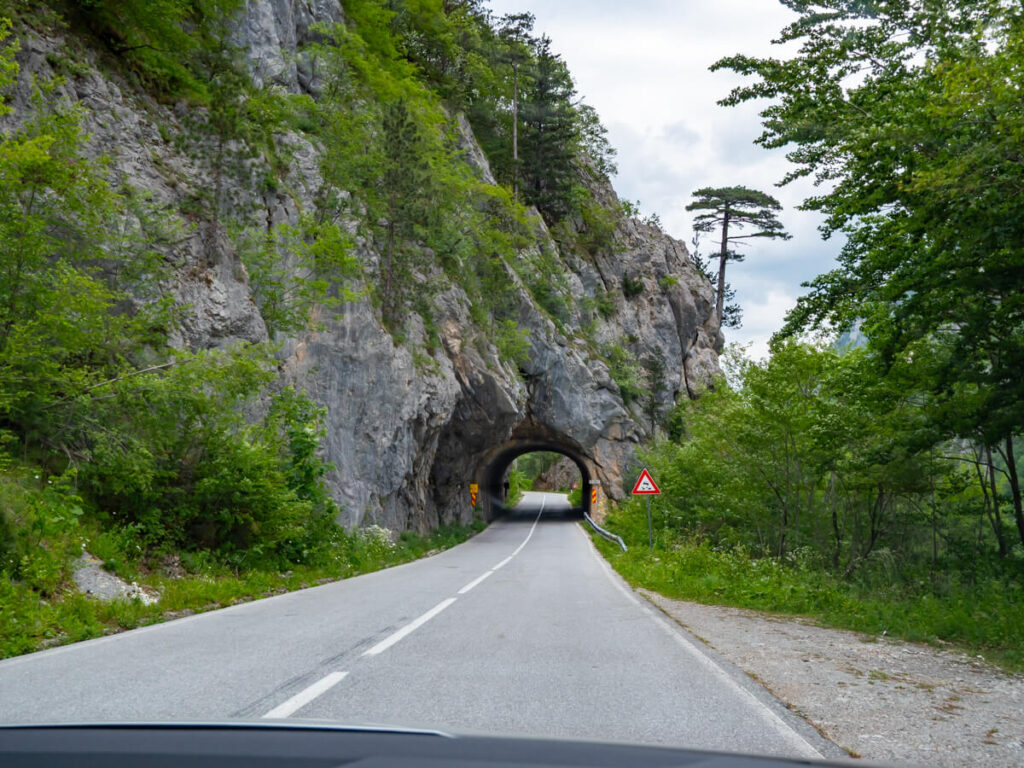
Coastal roads
The coastal roads are some of Montenegro’s most scenic and busiest routes. The route around the Bay of Kotor (the M1) is beautiful but can be slow, especially during summer. Expect narrow sections following the coastline, traffic congestion around Kotor, Perast, and Tivat, tourist buses squeezing through tight areas, and limited overtaking opportunities. The views are incredible, but don’t plan your journey based purely on distance. A short route along the coast can take much longer than expected thanks to heavy congestion.
Herceg Novi is quite built up and has some interesting one-way roads – they’re quite intuitive but tend to have parked cars down them. Additionally, the old town has some tight bends and narrow streets.
We highly recommend taking the Lepetani-Kamenari ferry, which can cut 30-60 minutes off your journey time. You simply queue up in dedicated lanes (you’ll be directed by staff), buy a ticket at the booth at the front (€5 per car), drive on (directed by staff), enjoy the views (less than 10 minutes crossing), and drive off again. They run constantly throughout the day and go every 5-10 minutes when full.
From the Bay of Kotor, it’s easy to reach the coast via the E80 Vrmac Tunnel.
The coast from Budva to the Albanian border via Sveti Stefan, Petrovac, and Bar is an easy highway to drive, but can be busy, especially in the summer months. It’s part of the M1, also known as the Adriatic Highway, and offers scenic ocean views pretty much the whole way. It’s also part of the European route E80, also known as the Trans-European Motorway, which crosses 10 countries around 3,792 miles (6,102 km) from Portugal to Turkey.
Budva itself was pretty horrible to drive. The main road passes right through the middle of the city and is crazily congested in the middle of the day. It’s mainly two lanes on the outskirts, changing to three lanes with traffic-light-controlled intersections. You can pretty much just stick in the right lane to go straight on, with the exception of one specific intersection on the way towards Kotor just after this Adriatic Bank, where the right lane becomes a right-turn, and everyone gets caught out by it and tries to merge back into the left lane, which is now the middle lane. Side roads aren’t any better, being tight, hilly, and a lot of them are one-way systems.
Sveti Stefan is tiny with tight roads, but the tricky bit isn’t the driving but the parking, which we’ve covered below. Petrovac was one of the nicer coastal towns to drive (and in our opinion overall to visit), maybe because it’s slightly further south and less popular (and hopefully it stays that way).
There are some incredible viewpoints to stop off at along the way, but it’s best to have them pinned on Google Maps and know when they’re coming up, as they’re often small and don’t always have space to stop in busy periods.
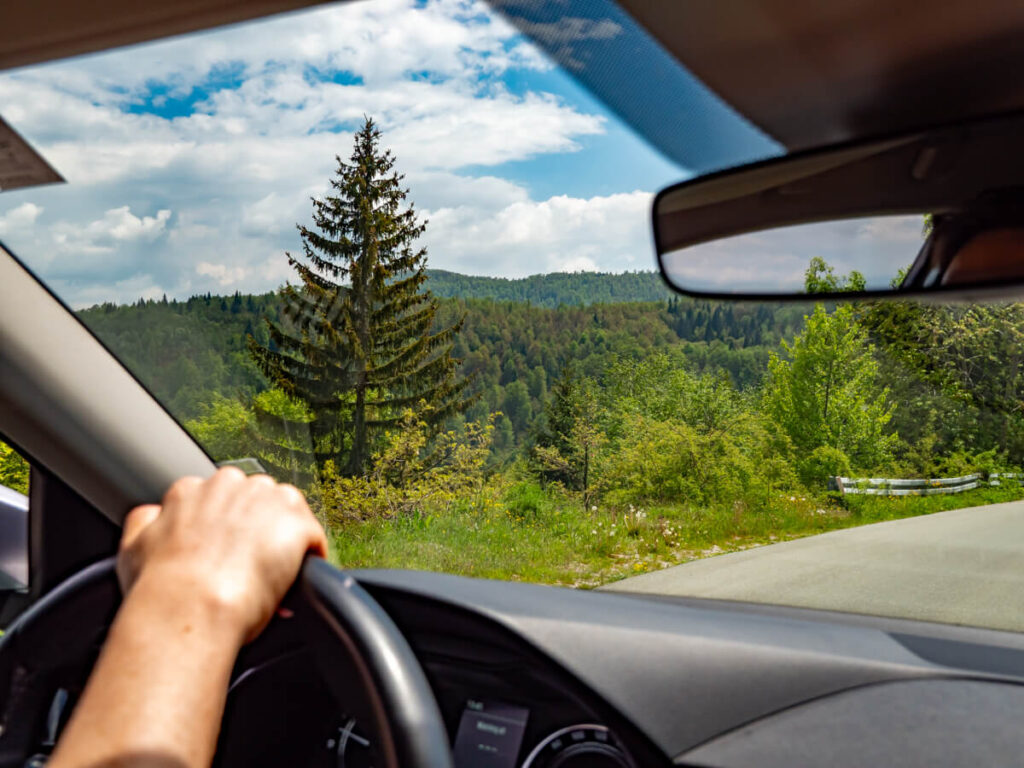
The Kotor Serpentine
The Kotor Serpentine (P1) is probably the most famous road in Montenegro. A winding set of 25 tight hairpin bends, it snakes for around 5 miles above the Bay of Kotor and into Lovćen National Park. While it’s an unforgettable drive with spectacular views, it’s also one of the country’s most demanding roads.
Driving the Kotor Serpentine was the first thing we did after picking up our hire car, and it was quite literally a steep learning curve. The carriageway is narrow, visibility around many corners is limited, and you’ll often encounter tour buses, campervans, and motorcyclists travelling in both directions (often on your side of the road on the corners).
Coaches sometimes need to use both lanes to negotiate the tightest bends, so approach every corner slowly and expect oncoming traffic to be wider than you anticipate – stop well back if you see a bus coming to let it pass. When traffic is heavy, coaches can get stuck and completely block the road. We were advised to check Google Maps before driving up and to not bother if the live traffic was showing as yellow or red.
There’s an official regulation between 25th May and 15th October each year that you:
Apparently, the police will impose fines on those breaking the rules, but in reality, traffic flows both ways all day long, and no one was around to check when we went. We’d personally recommend driving the Serpentine as early in the morning as possible, before traffic builds up. Use the designated pull-offs to enjoy the views rather than stopping on the road itself, and don’t feel pressured to drive faster than you’re comfortable with. It’s not a road that requires a 4WD, but a smaller hatchback is certainly easier to manoeuvre than a large SUV, especially in tight parts where you don’t want to scratch your car against the rocks or cement barriers.
If you’re unsure about driving the Serpentine, we’d recommend taking the Kotor Cable Car, which provides very similar panoramic views from the top of the mountain, without the nail-biting drive.

Mountain passes
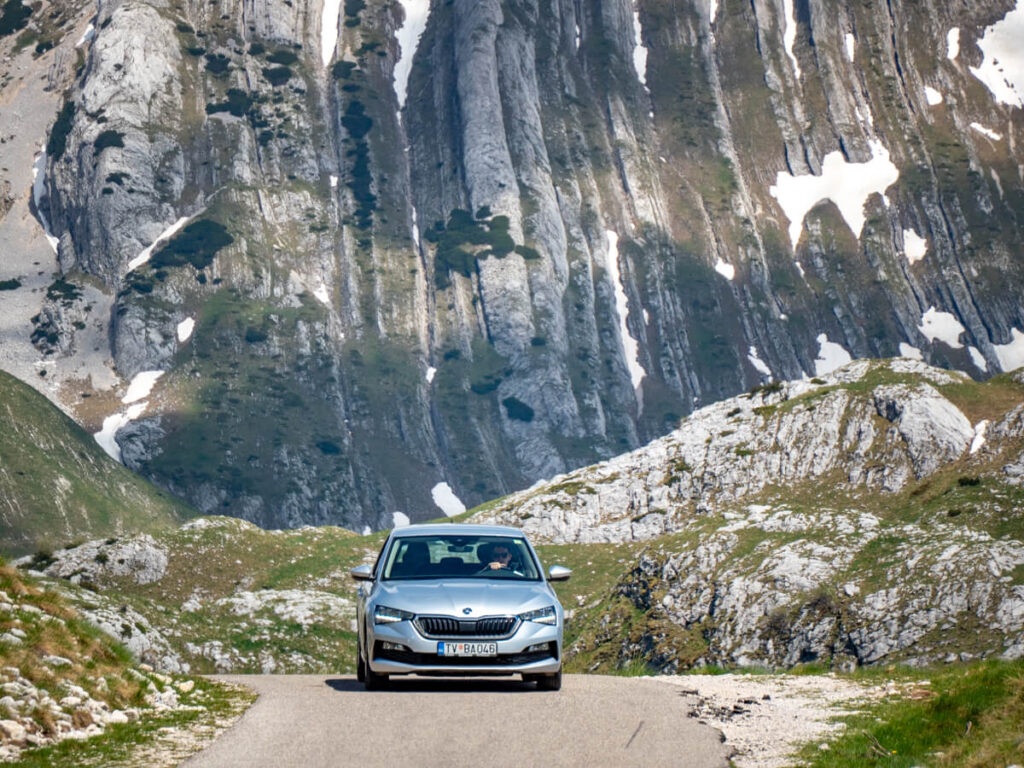
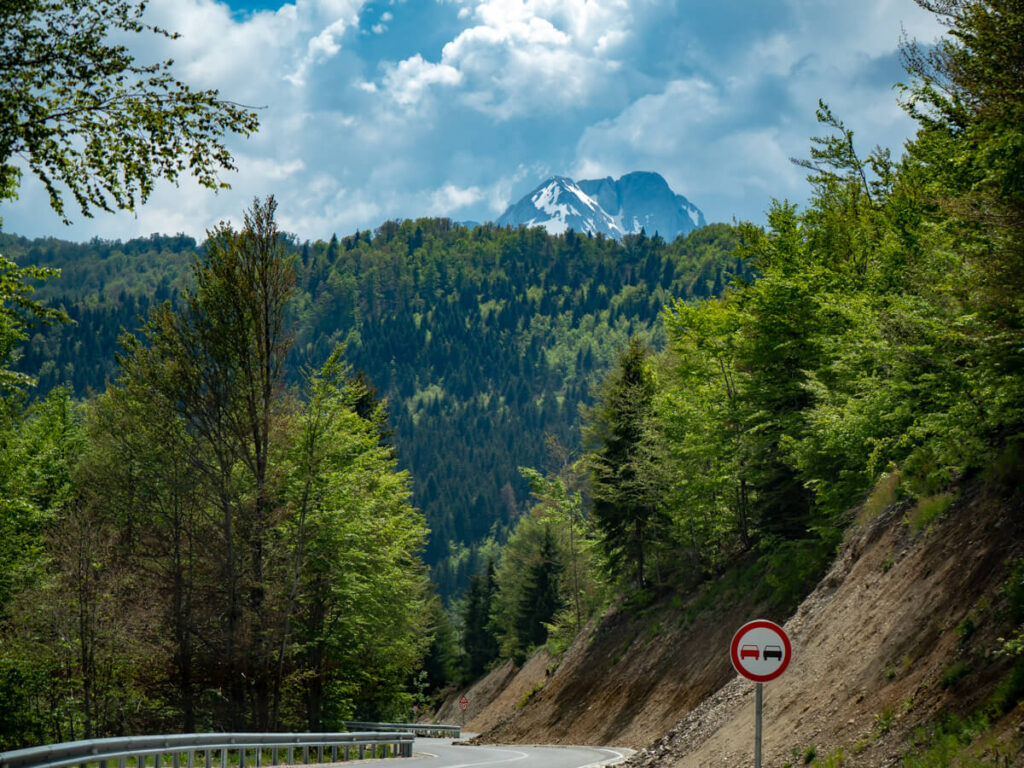
Mountain roads are a highlight of driving in Montenegro, but they require concentration and confidence. You’ll navigate hairpin bends, steep climbs and descents, blind corners, occasional loose gravel or rocks, and limited barriers on some sections. But you’ll be rewarded with incredible views.
Some of the trickiest mountain sections we drove were the Kotor Serpentine, the road to Ostrog Monastery, and the Durmitor Ring Road.
Most roads in these areas are paved, although conditions vary, especially in winter. In the east, the A1 and M9 are paved, smooth, and enjoyable towards Plav, while the smaller road after the P9 towards Gusinje and Prokletije National Park had significant potholes.
Between Prokletije and Biogradska Gora National Park, the P2 and M5 were in great condition. We thought about taking the Trešnjevik Pass (M19) and Lubnice-Jelovica routes, but with snow still hanging around in high-altitude locations at the end of May, we opted for the faster northern valleys bypass.
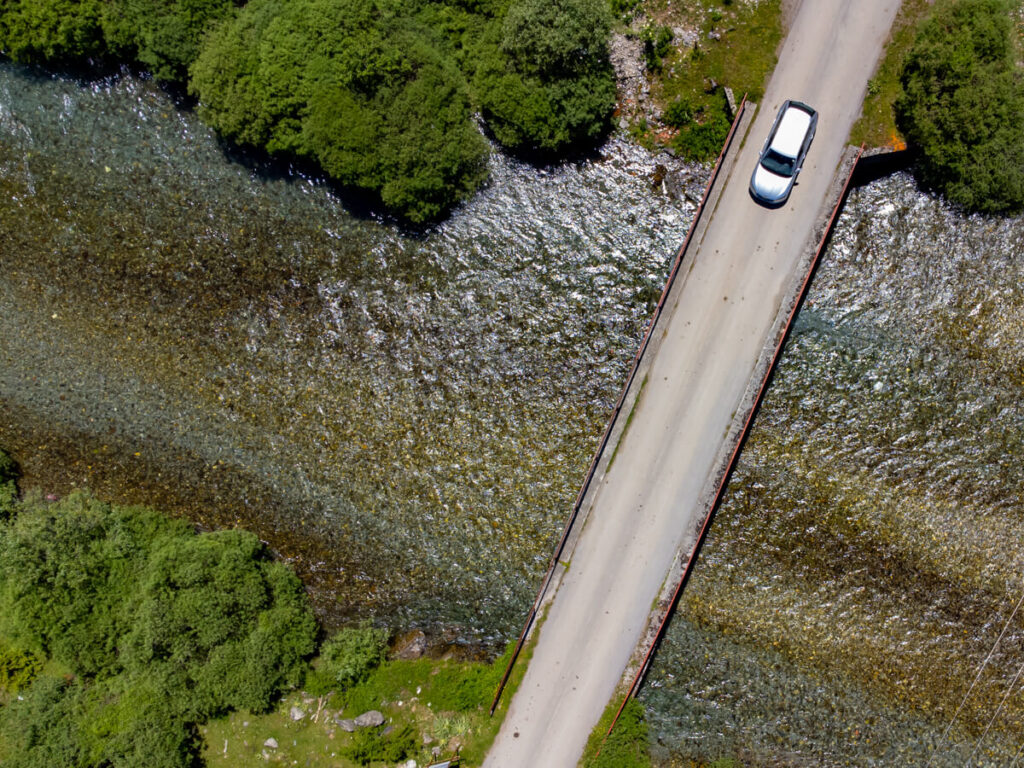
We had no issues reaching Durmitor National Park on the P4 and M6. We passed the (somewhat underwhelming) Tara Bridge on the way. Driving the ring road (P14) was one of our longest days – about 3 hours of driving, but it took us 8 hours with lots of stops and a detour to Piva Lake. The roads here are more challenging than the main roads throughout the country, being only wide enough for one car in most places, so you have to do a lot of pulling over and manoeuvring past other vehicles. The only bit that was tricky was a particularly narrow and hilly section where we encountered some very nervous campervan drivers. It’s recommended to drive the route anti-clockwise, set off early, and go slowly and carefully.
After that, the M6 and E762 to Nikšić and Ostrog were pretty easy. The road to the monastery itself is very tight and winding, but after the Kotor Serpentine on our first day with our rental car, it was a doddle.
If you’re on a narrow road or creating a queue because you’re driving slowly, you’ll often find gravel pull-in areas where you can move aside to let traffic pass.
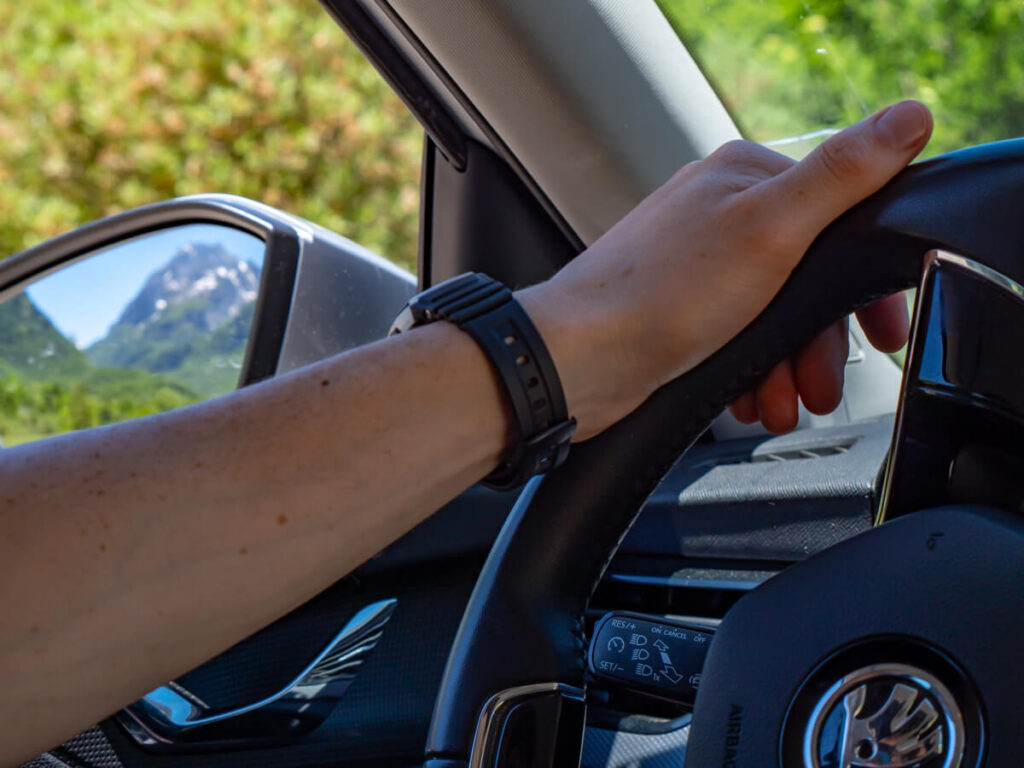
When it comes to single-track lanes (of which we encountered many in Durmitor and the wine region around Lake Skadar), Dan’s become pretty experienced at reversing and manoeuvring into tiny gaps on the side of the road, so when we clocked a tourist car coming towards us that looked nervous, often we’d move out of the way. A couple of times, especially going down the tiny road above the Strana Viewpoint, we were grateful for experienced locals who did the same for us.
Generally, however, locals won’t budge. In fact, we often encountered situations where we stopped and began pulling in for an oncoming car, which wouldn’t stop (or even slow down) and would push past before we could properly move out of the way.
We learned when we needed to stand our ground, and that sometimes when we could clearly see the other car had more room or a safer, flatter area to pull in, to point it out or keep edging forwards on our side. It did result in some very tight squeezes where there was barely an inch between our car and the one beside us, but if we’ve learned one thing from driving in Montenegro, it’s that locals really know exactly how wide their vehicles are and just how much space they need to get through.
We also noticed that a friendly wave of thanks isn’t as common as it is back home (although it didn’t stop us putting a hand up in thanks each time) – a hard stare seemed to be the cultural norm or a brief nod if we were lucky.
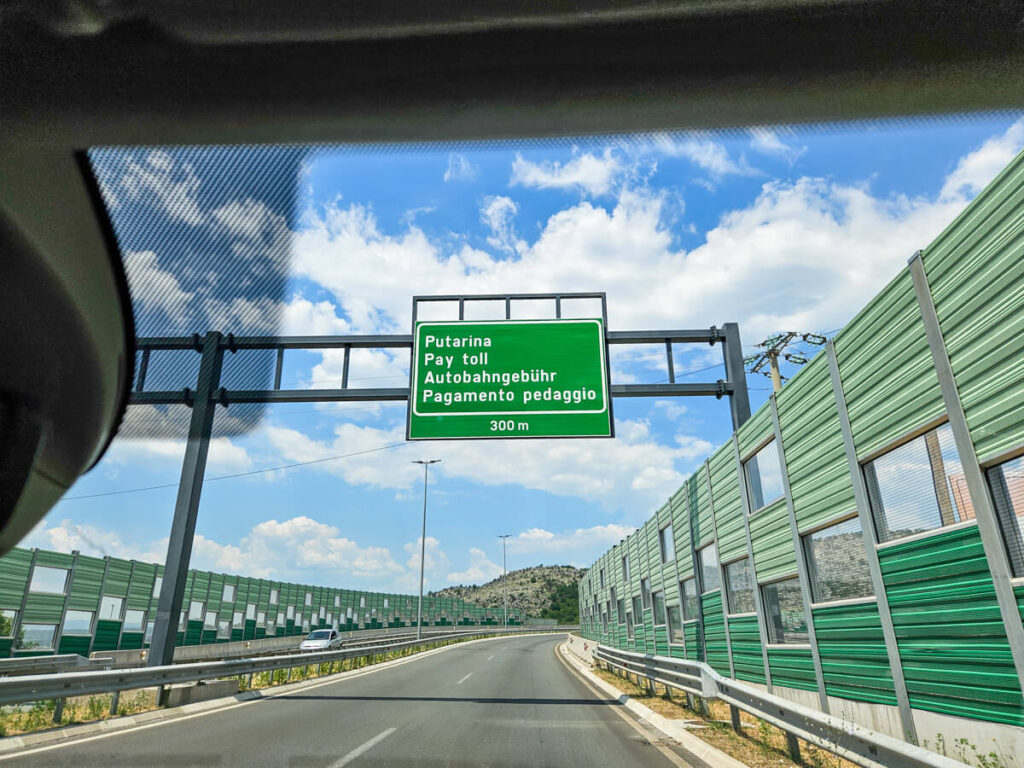
Motorways and toll roads
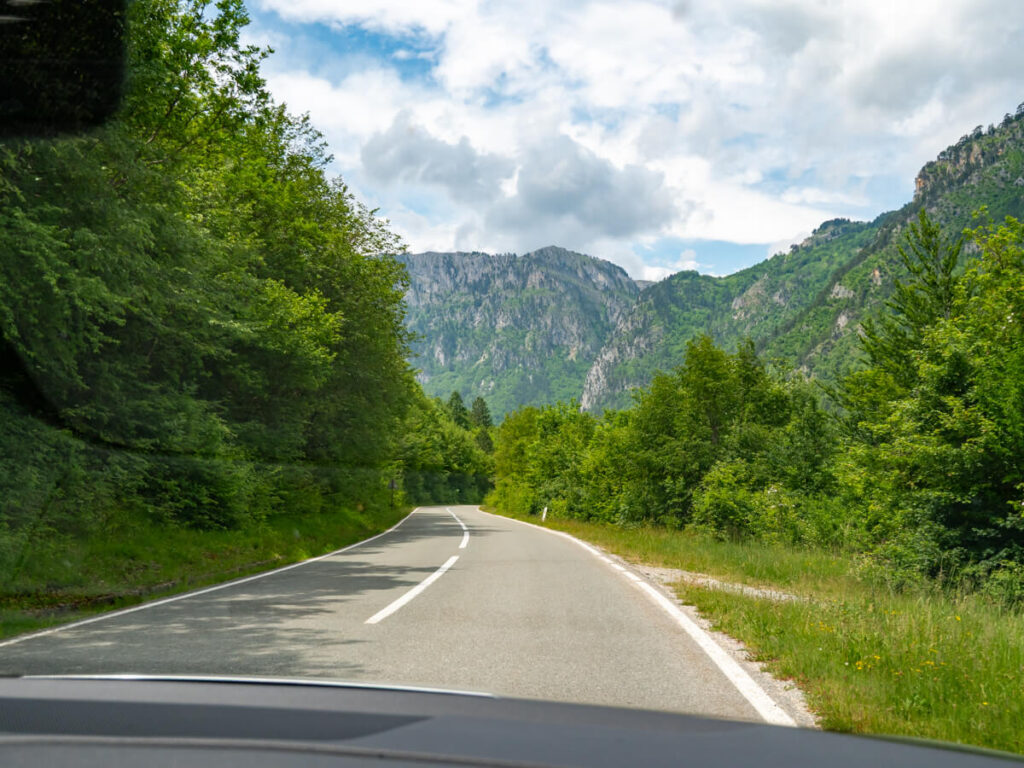
Montenegro has a relatively small motorway network, but the newer sections are smooth, easy to drive, and quiet.
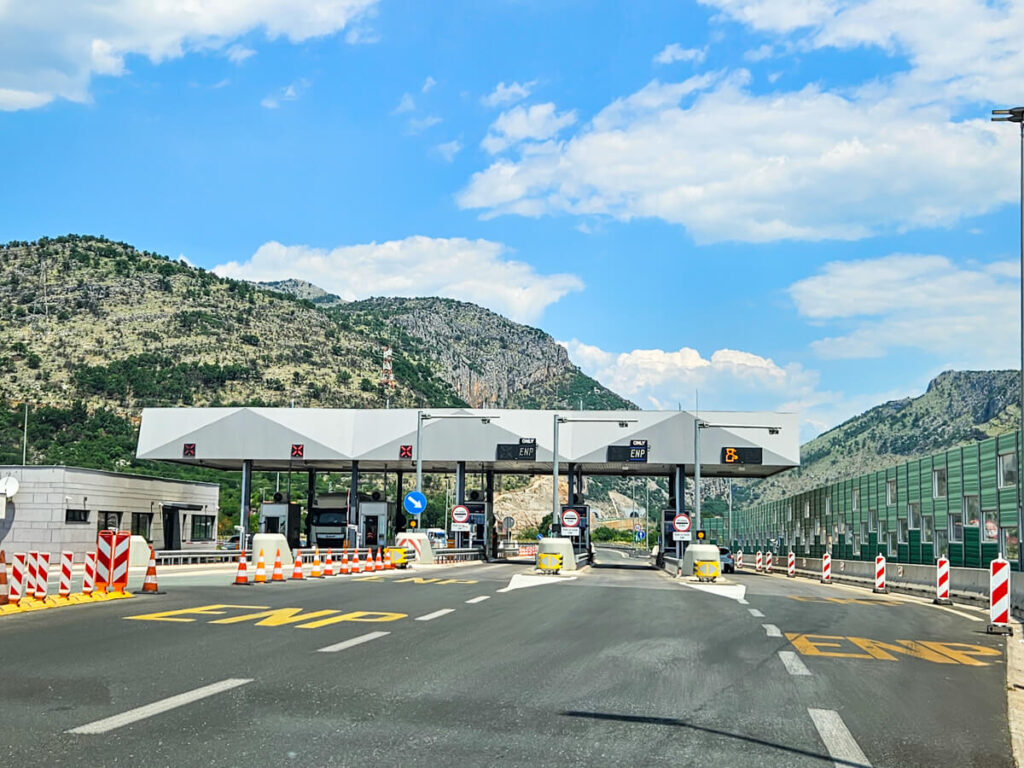
The main motorway visitors are likely to use is the A1 motorway north of Podgorica. We took it to reach Prokletije, and it’s modern, quiet, and a pleasant drive, especially compared with the winding mountain roads. It’s €3.50 for passenger cars, paid in cash or card at the toll booth (choose the correct lane by identifying the picture of a person and/or card above the lane).
A few things to know:
Montenegro has relatively few toll roads. The best-known toll point for many visitors is the Sozina Tunnel, which connects the coast with the Podgorica area, Lake Skadar, and inland Montenegro. It’s €2.50 per car, and you can pay in cash or card at the booth.
One thing we noticed is that many roads don’t have traditional hard shoulders, but dedicated emergency pull-in areas spaced at intervals.
Podgorica
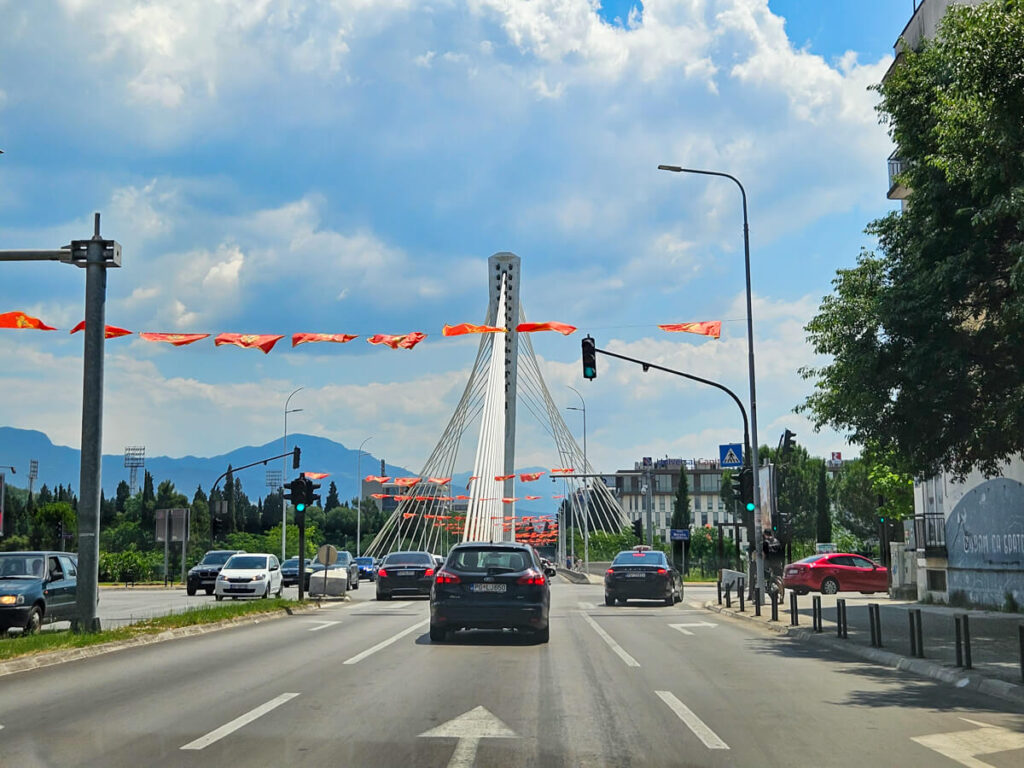
Driving in Montenegro’s capital is a very different experience from the quiet mountain roads and deserves its own section.
Unlike most of the rest of the country, Podgorica has:
A few things that caught us out:
Driving here requires more awareness. At busy junctions, you may need to be confident and decisive while still driving defensively. For example, when turning across traffic, locals may gradually edge forward rather than waiting for a completely empty road – something visitors may find unfamiliar.
Montenegro driving distances
It’s easy to look at a map and think “wow, Montenegro is tiny”, and while it’s true it’s much smaller than many of its neighbours, the reality is that driving times are often much longer than map distances. Thanks to the country’s mountainous terrain, winding roads and busy coastal routes, journeys often take much longer than Google Maps suggests.
As a rough guide, these are the journey times we experienced:
As you can see, by breaking up your itinerary and not trying to fit too much into one day, you don’t have to spend the whole day driving. We tried to plan our time so that no journey day was more than 3 hours driving, and then with stops, traffic, and detours, we wouldn’t spend longer than 5 hours in the car.

Driving at night in Montenegro
If you can, we’d recommend planning most of your driving during daylight hours, especially if it’s your first time driving in Montenegro.
Many of the things that make Montenegro such a spectacular road trip destination also make night driving more demanding. Mountain roads are often unlit, hairpin bends can appear with little warning, and it’s much harder to spot hazards like stray dogs, goats, cows, or rockfall on the road ahead.
Visibility can also be reduced by heavy rain, fog or low cloud, particularly at higher elevations. During our trip, we experienced afternoon thunderstorms that rolled into the mountains surprisingly quickly, making it much more difficult to judge corners and braking distances.
The coastal roads and main highways are generally easier to drive after dark, although traffic around the Bay of Kotor can remain busy well into the evening during summer.
Parking in Montenegro
We’ll be honest, parking in some parts of Montenegro is a nightmare. In popular tourist towns like Kotor, Budva, and Perast, parking can be one of the biggest frustrations of driving, especially during the summer months. Spaces fill up quickly, paid car parks are in high demand, and the narrow streets of the old towns aren’t designed for modern traffic.
Luckily for us, we explored Kotor on foot before picking up our car. We did revisit with family later on and preferred Parking Autoboka, which was a reasonable €0.90 an hour and always had spaces.
We knew Perast would be a nightmare for parking, so visited on the bus from Kotor. We later revisited with family (in two cars) and getting parked was tricky. There are two very tiny free parking areas on either side of the town, and then everything else is private and expensive. We didn’t fancy paying €15 for the paid lots when we’d only be staying a few hours, but luckily managed to get one of the cars into a free space on the east side parking area. After circling back around as there were no spaces on the west entrance to Perast (where a barrier stops you from driving into the town), we managed to slip into a space right by the family’s car in the east side spaces as someone was leaving. We were lucky because it was late in the day and before the summer season started. Our advice would be to arrive very early to visit Perast, or take the bus from Kotor or a boat trip, so you don’t need to park.
For Herceg Novi, we parked in Zone III parking just after passing Forte Mare. It’s street-side spaces and we paid in person at the Pic Nic restaurant a few minutes’ walk down the road (not having a Montenegrin SIM to pay by text and the app is notoriously unreliable and didn’t work for us). It was a bit of a faff, but central and cheaper than most local parking lots, which charge anything from €1.20-3.00 an hour.
Budva was a complete nightmare to drive. We stayed in a beautiful hotel with underground parking (Hotel Pima), which was the best decision, as we could leave the car and walk to the old town on foot. But the traffic was horrendous and we actually warned our family against a day trip there due to how busy it was. During peak season prices can reach a whopping €5.00 an hour, so you’re better off finding somewhere that has a flat fee like €15.00 a day.
Perhaps the worst place to park was tiny Sveti Stefan. You literally hit a barrier before the town and are directed into one of two car parks. We stayed for a couple of hours and were charged €8!
However, Petrovac was pretty easy to park in. We got into the lot opposite Voli, which was super central. It’s free in the off-season and in June we were charged €5 for 5 hours, but it seems the police have stopped this happening, as recent reports claim it’s free again year-round.
We tried not to stop in Podgorica, as it’s big, built up, and not particularly interesting. But we did find free parking in the shopping area opposite the Super Voli (the shop’s own car park is paid).
Nikšić was also built up, but we found paid parking near the centre to grab coffee to go. There also seemed to be free spaces outside the Orthodox temple of St. Vasilije of Ostrog (not Ostrog Monastery). For the famous Ostrog Monastery, there are two parking lots at the top – the main lot at the barrier a few staircases down from the Upper Monastery and another closer to the top that seemed to be for disabled persons and families with buggies. There’s also one outside the Lower Monastery (all free).
Parking at the national parks was never an issue, as it was free in most cases. Biogradska Gora has a huge dedicated parking lot, Prokletije is so off-the-beaten-path that car parks are generally grassy fields or gravelly areas, and Durmitor has a lot of gravelly areas where you could park up off the road.
Žabljak was actually one of the harder towns to park in. It has endless street-side parking, but you need a Montenegrin SIM to pay by text (an eSIM won’t cut it). We ended up parking in this car park to do a grocery shop in Voli, and then tried to avoid the town for the rest of our stay. Durmitor’s Black Lake was also another hurdle, with two private car parks charging €3 an hour. You can stay all day for €24, and we were also offered 5 hours for €15 (which we chose) and 3 hours for €9.
Lake Skadar wasn’t too difficult to park in, as we’d planned ahead, but I think it would be stressful if you don’t go in with a plan. Virpazar is very small with a lot of pedestrians walking in the road. Our recommendation is the car park west of the train tracks, which accesses the town via a short underground walkway. It’s free, but touts may hang around and claim you need to pay for a boat tour to stay there – untrue. You need to arrive early (before 10:00 AM and earlier in summer) to grab a spot.
People also park along the road that leads away from here towards the mountains, but it’s very tight with drop-offs on either side. Instead, we’d recommend going over the train tracks and turning immediately left, where you can park along the long gravel road for free.
Rijeka Crnojevića is even tinier than Virpazar, with some free street parking. We just used the space outside our hotel (Hotel S Family Jovicevic) and walked around the town from there.
Cetinje was one of the easiest places to park. This car park is big, spacious, and close to the centre (and only charges €0.50 an hour), but check out the free parking spaces outside the entrance first!
Whew! That’s a lot of parking information. In short, we’d strongly recommend:
Here are some of the hotels we stayed in and shortlisted that have free on-site parking:

Getting petrol in Montenegro
We never struggled to find a petrol station in Montenegro, even when travelling through the mountains. Although we’d still recommend topping up before heading into more remote areas like Prokletije or parts of Durmitor rather than waiting until the warning light comes on.
Petrol prices are standardised across Montenegro, which means it’s the same price no matter where you pull in to top up.
In over four weeks of driving around Montenegro, a week in Croatia, and a day trip into Bosnia and Herzegovina, we spent around €250 on petrol, which we thought was excellent value. Not only are driving distances in Montenegro relatively short, but fuel prices are also reasonable compared with much of Western Europe. If you’re planning to cross borders, it’s worth topping up in Bosnia and Herzegovina (or Croatia, if that’s more convenient), as fuel is generally even cheaper there than in Montenegro.
In Montenegro, you’ll generally see Benzin (petrol) and Dizel (diesel) at fuel stations. Rental cars can be either, so double-check which one you’ve been given before filling up.
We ended up using EKO petrol stations most of the time. After our first stop, we discovered they accepted all of our travel cards, including Wise, Revolut and Caxton, so we kept returning whenever we saw one. Other chains include Lukoil, Petrol, and EURO Petrol. They’re all typically quite modern, with a shop, (often free) toilet, and café.
As we became used to in Central America, at many stations, an attendant will come over and fill the car for you. You can also choose to fill it yourself. Once the tank is full, you can either pay the attendant in cash or head inside the shop to pay by card.
We typically try not to let our fuel drop below a third of a tank before topping up, and even topped up full from half a tank before heading into the mountains. There are stations in the towns inland, but they’re less frequent in really remote areas.
And don’t forget to check your rental agreement for the fuel policy. If it’s same-to-same, you’ll need to return it with the same level you picked the car up with (check the photo you took when renting your car). If it’s full-to-full, you’ll have picked up the car with a full tank and should return it with one. If you return the fuel level lower than the agreement, agencies will most likely charge you for the fuel that’s missing at a higher rate than petrol stations.
Balkans border crossings
One of the biggest advantages of having a car in Montenegro is how easy it is to combine your trip with neighbouring countries, including:
During our road trip, we drove into both Croatia and Bosnia and Herzegovina, and found the border crossings to be straightforward, if not slow sometimes.
If you’re planning to cross a border to a neighbouring country, you should tell your rental company before booking or collecting the vehicle. Most rental companies will require you to obtain permission for cross-border travel, while border guards may demand to see written paperwork and the correct insurance documentation, often referred to as a Green Card.
Borders can be busy with long queues, especially in summer. We met someone who waited at the Granični Prijelaz Karasovići border crossing from Croatia into Montenegro for 3 hours at 8:00 PM in May. We used it once in June and waited an hour to go into Croatia. We preferred using the Granični prijelaz Vitaljina border crossing – it’s smaller and lesser known. We used this one 3 times and waited about an hour to enter Croatia and about 10-45 minutes to enter Montenegro, depending on the time of day.
We also crossed the Naplatna Stanica Sitnica border crossing from Bosnia and Herzegovina into Montenegro by bus, which took less than an hour in May.
What do you need to drive in Montenegro?
Whether you’re bringing your own car or hiring one, there are a few essential documents you’ll need before getting behind the wheel in Montenegro, including:
There isn’t a minimum age to drive in Montenegro beyond holding a valid licence, but if you’re renting a car, most companies require drivers to be at least 21 years old. Some vehicle categories have higher minimum ages, and drivers under 25 may need to pay a young driver surcharge.
Whether you need an International Driving Permit (IDP) depends on the licence you hold. UK, EU, and US driving licences are generally accepted, so most tourists won’t need one. If your licence is issued in a country that isn’t recognised by Montenegro, or isn’t written in the Latin alphabet, you may need to carry an IDP alongside your original licence.
If you’re renting a car, it’s always worth checking both the rental company’s requirements and the latest guidance for your nationality before you travel.
Common tourist mistakes driving in Montenegro
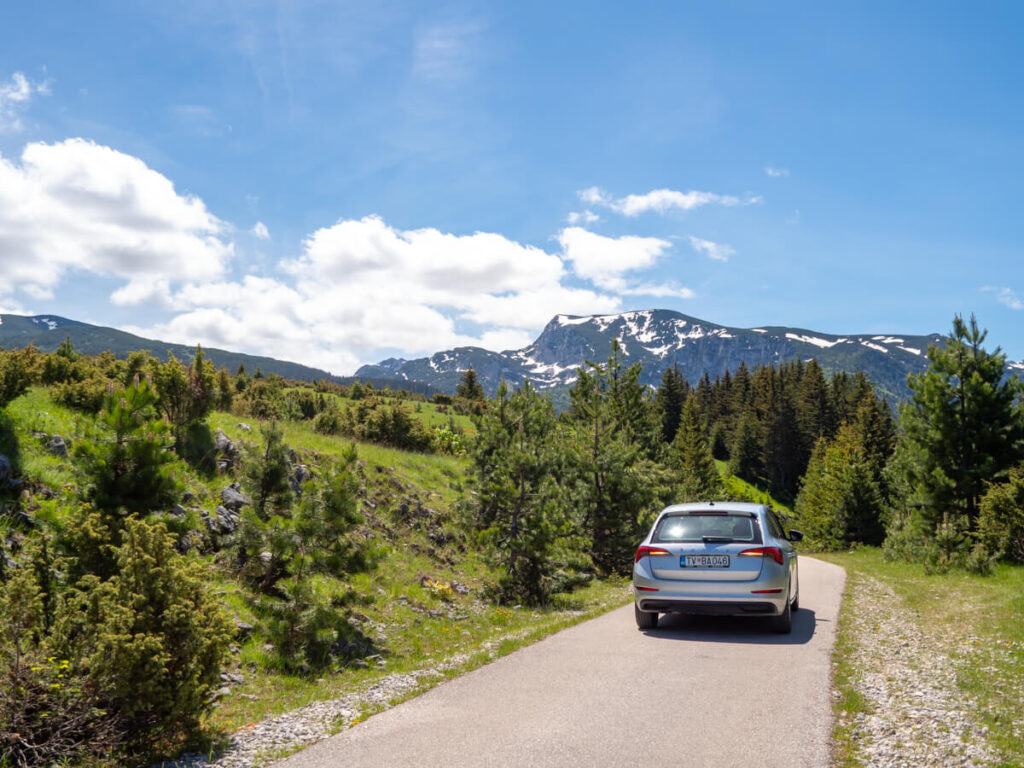
After spending more than a month driving around Montenegro, these are the mistakes we’d try to avoid:

Resources for driving in Montenegro
Having the right apps and a few useful essentials can make driving in Montenegro much smoother, especially if you’re planning to explore beyond the coast.
Driving in Montenegro final thoughts
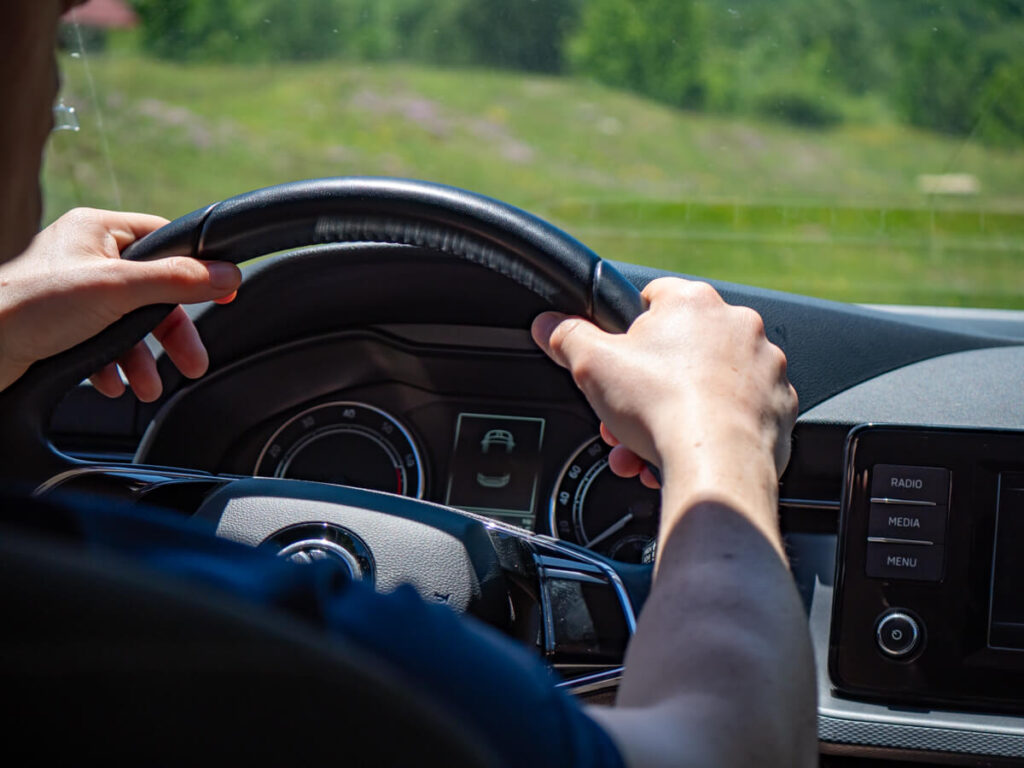
Honestly, I think a lot of the accounts about how bad driving in Montenegro is are either incredibly out of date, overexaggerated, or from inexperienced drivers. That’s not to say they’re not valid, but they’re just not very helpful when it comes to the reality.
For newbie and inexperienced drivers, road conditions may be more challenging than you’re used to. Narrow mountain roads, steep drop-offs, and livestock straying in front of you all require a little more concentration than your average road trip. Getting used to local driving culture can also be a bit of a shock to the system if you’re used to stricter road rules or more patient drivers.
But (as twee as it sounds) the challenges aren’t just outweighed by the reward – they’re part of the stories we’ve brought back with us. The roads in Montenegro aren’t just a way of getting from A to B, they’re part of the adventure.
At the end of the day, driving in Montenegro is one of those things that’s as difficult as you make it. If you drive defensively, stay aware of hazards, don’t let impatient locals pressure you into going faster than you’re comfortable with, and allow plenty of extra time for each journey, you’ll probably wonder what all the fuss was about.
For us, having a car made the trip. We wouldn’t have seen half the places we did without it, and some of our favourite memories came from the drives themselves – the mountain passes between itinerary stops, driving the Durmitor Ring Road, the insane views from the top of the Kotor Serpentine, the unexpected viewpoints of Budva and Sveti Stefan we stopped at along the Adriatic Highway, tortoises crossing the roads around Lake Skadar, staying overnight in locally-owned vinyards in the middle of the countryside, the tiny villages we’d never have reached on public transport, and the freedom to pull over whenever we wanted to. We couldn’t recommend it more.
Driving in Montenegro FAQs
We hope this guide to driving in Montenegro is helpful. To finish off, we’ve answered these frequently asked questions.
Can tourists drive in Montenegro?
Tourists can drive in Montenegro with a valid driving licence that is recognised by the country, provided they meet the local driving and entry requirements.
Is it easy to drive a car in Montenegro?
Driving a car in Montenegro is relatively easy for confident drivers, although winding mountain roads, summer traffic, and driving on the right-hand side can take some getting used to.
Is it safe to drive a car in Montenegro?
Montenegro is generally safe to drive in, particularly if you drive defensively, stick to the speed limits, and allow extra time for mountain routes and busy coastal roads.
Do you need an international driver’s license to drive in Montenegro?
Whether you need an International Driving Permit to drive in Montenegro depends on the country that issued your driving licence. UK and EU licences are generally accepted for short visits, while some other nationalities may require an IDP.
Are road signs in Montenegro in English?
Road signs in Montenegro are not generally in English, but most use internationally recognised symbols and place names written in the Latin alphabet, making them easy for most visitors to follow. Stop signs are interestingly written in English.
Are there speed cameras in Montenegro?
Speed cameras are used in Montenegro, alongside police speed checks, so it’s important to obey the posted speed limits throughout your trip.
How much is a speeding fine in Montenegro?
Speeding fines in Montenegro vary depending on the severity of the offence, with higher penalties applying to drivers who significantly exceed the speed limit. If you get a ticket, you need to go to a bank or post office to pay the fine in person.
Can you turn right on red in Montenegro?
You cannot turn right on a red light in Montenegro, unlike in places like the USA.
Does Montenegro need a vignette?
Montenegro does not require a vignette to drive on its roads. You’ll likely encounter tolls on a small number of roads and tunnels, but these can be paid in cash or by card.
How long would it take to drive around Montenegro?
Driving around Montenegro can technically be done in a day or two, but we’d recommend allowing at least a week to enjoy the country’s coastline, mountain roads and national parks without rushing. Following our Montenegro road trip itinerary, you could easily spend two to four weeks exploring.
Where is the best place to rent a car in Montenegro?
The best place to rent a car in Montenegro depends on your itinerary, with Tivat Airport being the most convenient for the Bay of Kotor and the coast, while Podgorica Airport is better suited to inland road trips and the national parks.
Do you need a 4×4 in Montenegro?
Before visiting Montenegro, we had a lot of questions about the roads. Would a small hatchback be enough? Would we need a 4WD? Were the mountain roads going to be intimidating?
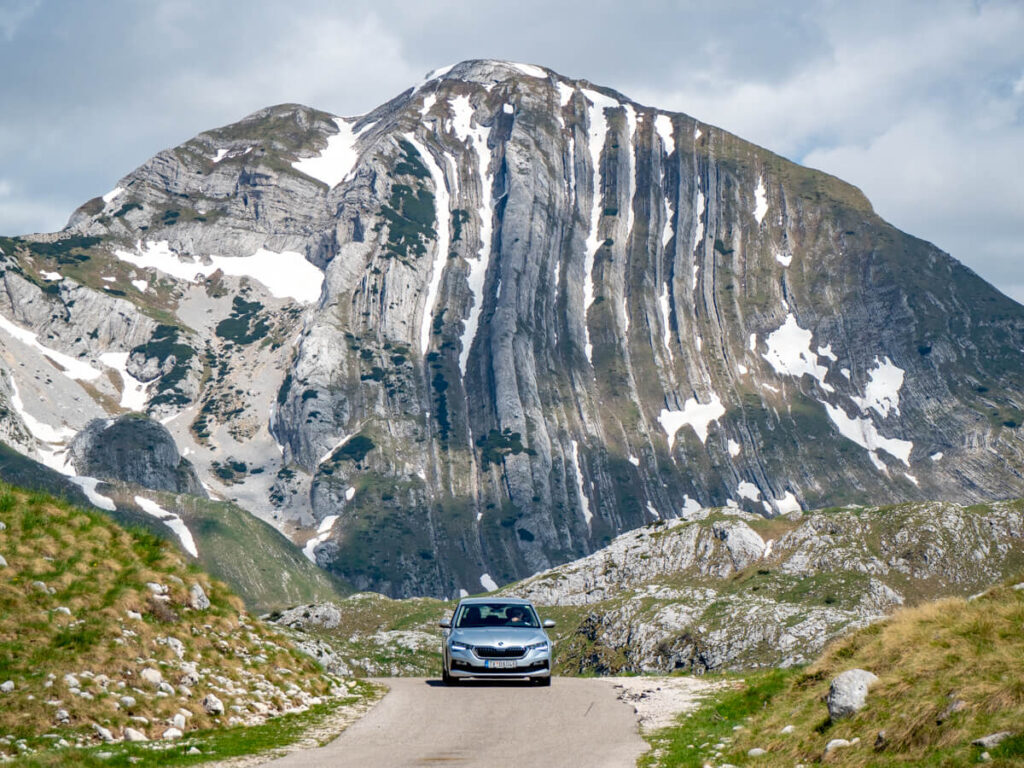
The short answer: for most travellers, a normal car is perfectly capable of handling Montenegro. You don’t need a 4×4 unless you have a very specific itinerary, such as exploring remote unpaved tracks, travelling in winter conditions, or heading deep into mountain areas where conditions can be more challenging.
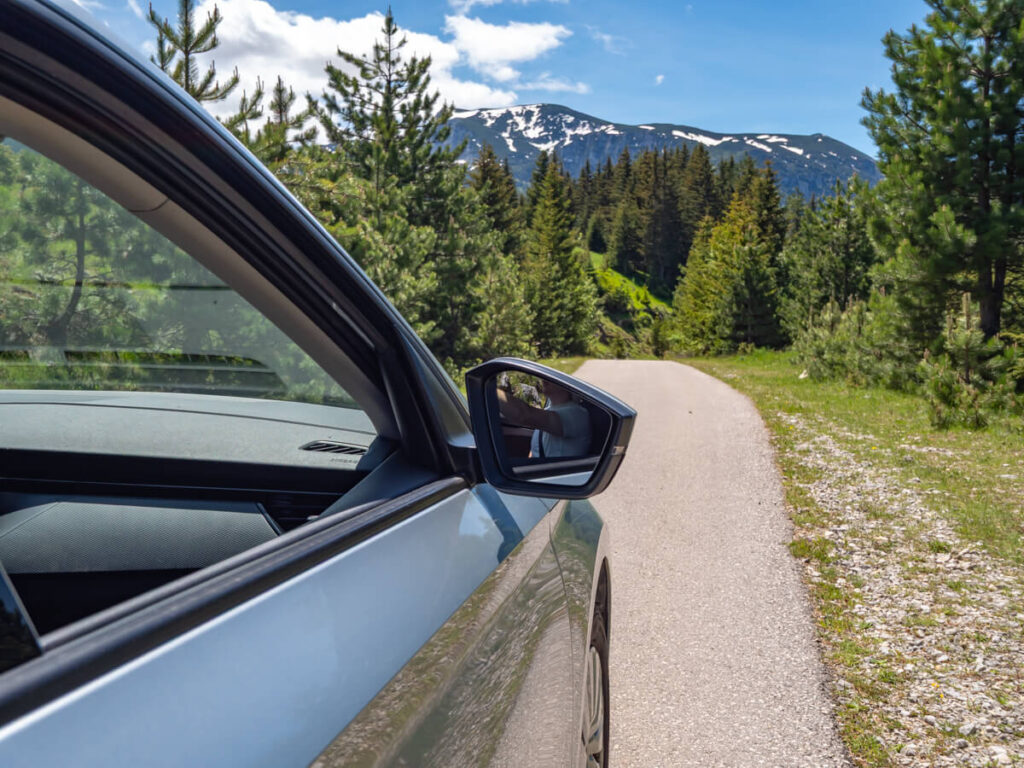
In fact, we’d argue that a smaller car is often the better choice. Many of Montenegro’s roads are narrow, especially around coastal towns and mountain villages, and a compact vehicle is easier to manoeuvre, park, and pass other cars with.
Read next:
Renting a Car in Montenegro: Complete Guide + Kombo Rent a Car Review
Our Ultimate Guide to Visiting Durmitor National Park
Visiting Prokletije National Park: Montenegro’s Accursed Alps
How to Visit Biogradska Gora National Park: Europe’s Last Remaining Forest
A Traveller’s Guide to Lake Skadar National Park: Valleys, Viewpoints & Vineyards
A Concise Guide to Rijeka Crnojevića: The Underrated Gateway to Lake Skadar
A Complete Guide to Montenegro’s Wine Region: Tastings, Tours & Traditional Vineyards
