A Complete Guide to San Juan La Laguna: Lake Atitlán’s Artistic Town

Discover everything you need to know about visiting San Juan La Laguna, Lake Atitlán, from how to visit and what to do to where to stay and eat, in this guide.

This post may contain affiliate links, which means we might earn a small commission on anything purchased through these links at no extra cost to you. Learn more on our disclaimer page.
San Juan La Laguna is often overlooked, but we found it to be one of Lake Atitlán’s best towns (and it quickly became one of our favourite places in Guatemala). A smaller, quieter village than more popular bases like San Pedro and Panajachel, San Juan is home to colourful murals, local cooperatives, and scenic lake views that make it one of the most authentic villages on Lake Atitlán.
We fell in love with San Juan La Laguna and are so shocked that so many people tried to convince us to stay somewhere else. With authentic Maya culture emanating from each vibrantly-painted calle (street), there’s so much to see and do, and the town is wildly underestimated.
In this guide, we break down what San Juan La Laguna has to offer, from art and culture to local dining and excursions, where to stay, and how to get here and around. Whether you’re stopping by for a few hours or planning to stay a night or longer, this post will help you make the most of your visit without missing the village’s best bits.
San Juan La Laguna at a glance

More from Lake Atitlán
About San Juan La Laguna
San Juan La Laguna is one of the smallest yet most charming towns on Lake Atitlán. Nestled between the backpacker hub of San Pedro and the hippie yoga retreat of San Marcos, San Juan feels worlds apart in pace and atmosphere.
San Juan is the artsy town, defined by colour, creativity, and community. Its streets are lined with vibrant murals, many of them telling stories of Maya cosmology, women’s cooperatives, local flora and fauna, and resistance to cultural erasure.

San Juan La Laguna History
San Juan La Laguna has long been an indigenous Maya settlement, historically sustained by agriculture, fishing, and later coffee cultivation on the fertile volcanic slopes above the lake. Like other towns around Lake Atitlán, it has been shaped by centuries of Maya life, Spanish colonisation, and Guatemala’s turbulent modern history.
For much of the 20th century, San Juan remained relatively isolated and economically marginalised. In response, local residents, particularly women, began forming cooperatives in the late 1990s and early 2000s, focused on weaving, natural dyeing, coffee production, and art. These cooperatives became a way to preserve cultural knowledge while also creating economic independence and stability.
Rather than opening the town to mass tourism, San Juan took a more intentional route. Visitors were welcomed, but on the community’s terms. This approach has helped the town retain its identity while becoming one of the most respected examples of sustainable, locally run tourism in Guatemala.

San Juan La Laguna Culture
San Juan is predominantly Tz’utujil Maya, and the language is widely spoken alongside Spanish. Traditional dress is common, particularly among women, who wear richly embroidered huipiles and woven cortes, often made using techniques and patterns specific to the town.
Weaving is central to daily life here, not just as an art form but as cultural memory. Many cooperatives use natural dyes made from plants, insects, and minerals like indigo, cochineal, avocado pits, and workshops often include demonstrations of the symbolism behind certain colours and patterns.
Art is another defining feature of San Juan La Laguna. The town is known for its naïf painting style, with bright, flattened perspectives depicting everyday scenes of lake life, farming, and ritual. The murals throughout the town reflect the same themes: identity, spirituality, nature, and resilience.
Religion in San Juan blends Catholicism with Maya spiritual practices, and ceremonies tied to the agricultural calendar and natural world remain important to locals. Despite its popularity with day-trippers, San Juan still feels like a place that exists primarily for its residents, making it one of the most authentic towns on the lake.

Where is San Juan La Laguna?
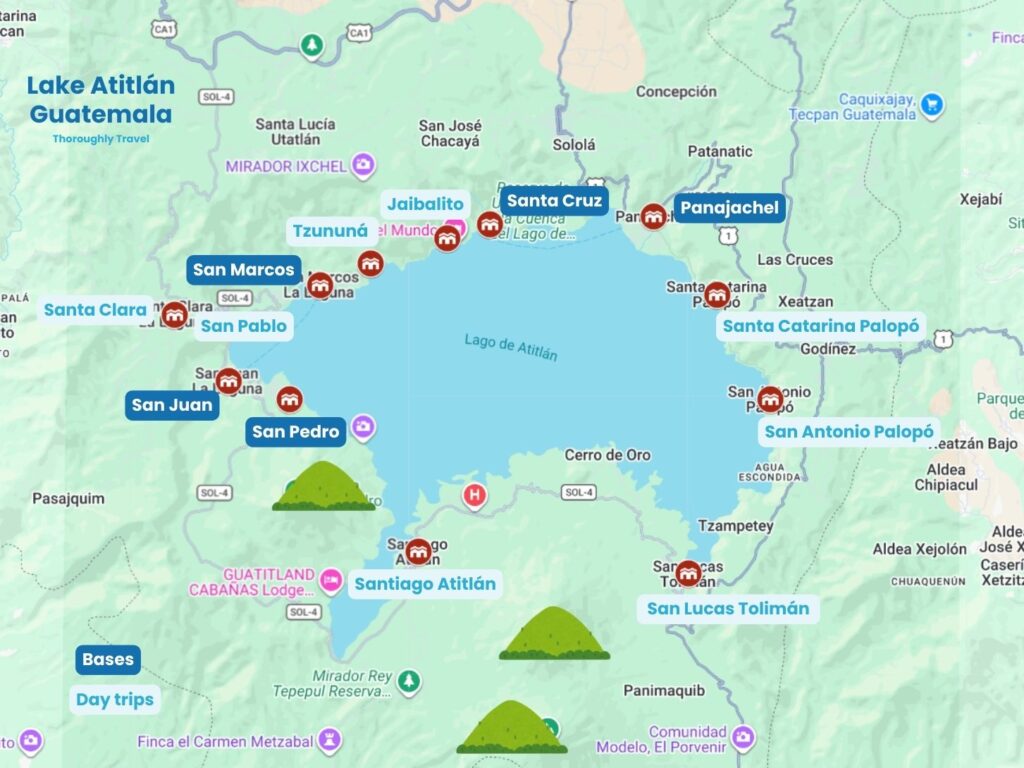
San Juan La Laguna is located on the southwest shore of Lake Atitlán, immediately west of San Pedro La Laguna, the closest major hub. The two towns are so close that they’re often linked – you can walk between them in around 45 minutes, or take a 10-minute tuk-tuk ride, which is faster and safer.
The town sits slightly higher above the lake than San Pedro, with a compact centre that rises gently uphill from the waterfront. Its position gives it a quieter lakeshore and a more residential feel, with fewer boats docking directly in the centre.
San Juan is easily reached by lancha (small motorboat) from Panajachel, San Pedro, and Santiago Atitlán, making it an easy stop on a lake-hopping itinerary or a relaxed base if you want to be close to the action without being in it, so it’s worth considering when planning a trip to Guatemala.

San Juan La Laguna Map
You can see the locations of San Juan La Laguna and other towns on the map of Lake Atitlán below.
Why visit San Juan La Laguna?
San Juan appeals to travellers who want a genuinely Guatemalan experience – its Mayan heritage was exactly what drew us to the town. It’s ideal if you’re interested in indigenous culture, traditional crafts, ethical tourism, and a slower pace of travel. People come here to learn about local culture, from weaving and natural dyeing to coffee production and Maya worldviews, rather than to party or tick off adrenaline activities.
While San Juan doesn’t have the nightlife, as many language schools, or the sheer variety of San Pedro, it offers something rarer on Lake Atitlán – authenticity. Experiencing the culture here is one of the best things to do in Guatemala. Plus, it doesn’t hurt that it’s utterly stunning and for sure the most beautiful town on Lake Atitlán.

The best things to do in San Juan La Laguna
San Juan is a town best experienced slowly, by wandering, observing, and participating. Many of the best things to do here revolve around culture, craft, and everyday life, with activities that invite you to learn, but there are still lots of outdoor activities and fun attractions on offer. Here are the top things to do in San Juan La Laguna.
1. Spot stunning street art
San Juan La Laguna is one of the most visually striking towns on Lake Atitlán, thanks to its extensive street art. Murals cover walls, staircases, and alleyways, depicting everything from Maya spirituality and agricultural life to women’s cooperatives, wildlife, and environmental protection.
Wandering the colourful calles (streets) with no set route is one of the best things to do on Lake Atitlán, allowing the artwork to unfold organically as you move through neighbourhoods. The most beautiful streets are:

2. Explore the town centre
San Juan’s compact town centre (San Juan de la Laguna Park) is the heart of daily life. Here you’ll find the small but beautiful church (Iglesia Católica San Juan La Laguna), which is backed by stunning views of the misty mountains.
Around the plaza, there are art shops, local eateries, and Calle de los Hexágonos (The Street of Hexagons), decorated with beautiful suspended artworks (hexagonal as the name suggests).
The main square of a town is always a good place to orientate yourself when you first arrive, and you’ll find the main tuk-tuk rank here, too. Take a walking tour of San Juan to learn more about the town and get local recommendations.

3. Wander down the Street of Umbrellas
One of San Juan’s most photographed streets, La Calle de las Sombrillas (The Street of Umbrellas) is decorated with colourful umbrellas suspended overhead, casting shifting patterns of light and shade onto the cobblestones below.
The buildings are painted in different colours, too, and it’s a beautiful place to do some photography. While undeniably photogenic, it’s also a working street lined with small artisan spaces and homes.
Because this is the main street into the town from the dock, and it’s so pretty, it can get pretty busy during the day – try to arrive early to get good photos. By midday, it’ll be crawling with tour groups, and we even saw people with full-on ballgowns and camera equipment doing photoshoots.

4. Photograph the Street of Hats
Another playful visual feature of San Juan is the La Calle de los Sombreros (Street of Hats), where traditional sombreros hang overhead in neat rows. The buildings here are also painted in bright colours, with murals littering the walls and even painted along the floor.
We thought this street was arguably more beautiful than the Umbrella Street, and it’s quieter too, as it requires walking into the town. Again, if you arrive early, you could have it all to yourself, which is perfect for photographing the artworks.

5. Hike to Mirador Kaqasiiwaan
This hilly hike to a viewpoint called Mirador Kaqasiiwaan or Cerro de la Cruz (Hill of the Cross, not to be confused with Antigua’s Cerro de la Cruz) offers sweeping views over Lake Atitlán and the surrounding volcanoes.
The trail climbs over 300 steps, through farmland and forested areas, giving you glimpses of the surrounding mountains and the town itself. It’s a moderate hike and takes about 20-30 minutes each way, depending on your pace.
The top is also home to a popular and vibrantly painted wooden observation deck, where vendors sell water and snacks like taki crisps (chips) and habas fritas (roasted broad beans). The hike is best done in clear weather, when the volcanoes are unobstructed by cloud, and you can see the neighbouring towns of San Pedro and San Marcos.
There’s a small entrance fee, which is paid at the Mirador Kaqasiiwaan trailhead before ascent.

6. See the sunrise from the Indian Nose hike
If you continued on from Mirador Kaqasiiwaan, you’d be following one of the trails to the Indian Nose (Nariz de Indio), also called the Maya Face (Rostro Maya). San Juan is one of the main starting points (although not the recommended one) for the famous sunrise Rostro Maya hike, one of the best hikes in Lake Atitlán.
Setting out before dawn (3:30-4:00 AM), you climb to a viewpoint overlooking the lake just as the sun rises behind the volcanoes. Watching the light spill across the water and surrounding villages is unforgettable, especially on clear mornings when mist hangs low over the lake, and you can see for miles. You might even see the erupting Fuego Volcano near Antigua on a clear day.
For safety reasons, El Rostro Maya hike is best done as part of a tour with a local guide. Most tours include pickup from San Juan, San Pedro, and San Marcos, including transportation to the trailhead in the mountain town of Santa Clara La Laguna, which sits above San Juan. This route is shorter than the San Juan trail, taking about 25-40 minutes one-way to scale the 0.8-mile (1.2 km) path to the viewpoint up a short but steep hill.
The trail that starts from San Juan La Laguna is 5 miles (8 km) return, taking around 1.5-2 hours one-way, and is very steep. The final stretch includes stone steps and some scrambling over exposed rock, so it’s much more difficult than the Santa Clara route.
Here are our top picks for Indian Nose hike tours:

7. Witness traditional Maya weaving
San Juan La Laguna is one of the best places on Lake Atitlán to see traditional Maya weaving practised as a living craft rather than a performance. Most weavers here use backstrap looms, a technique that dates back centuries, where one end of the loom is tied to a post or tree and the other wrapped around the weaver’s waist to control tension.
At cooperatives like Casa Flor Ixcaco Weaving Cooperative, you can see the entire process, from spinning raw cotton to dyeing threads with natural materials. Each textile pattern carries symbolic meaning, often representing nature, ancestry, or elements of Maya cosmology.

8. Shop for sustainable souvenirs
San Juan has built a strong reputation for ethical, community-led tourism, and it’s one of the best places on Lake Atitlán to buy souvenirs with a clear origin story. Many shops are run by women’s cooperatives or family collectives selling items they’ve made themselves, including woven textiles, clothing, bags, artwork, coffee, honey, and chocolate.
The Umbrella Street from the dock is lined with art galleries, and you’ll find smaller studios in the town centre, too. Our local guide recommended Joselyn Cholotío to us – apparently, she was the first woman artist in San Juan. Antonio Vásquez Yojcóm is another talented local artist and owner of Arte Maya Xocomeel.

9. Try a traditional temazcal
A temazcal is a traditional Maya sweat lodge used for physical cleansing, spiritual renewal, and healing. In San Juan, several hotels have these dome-shaped structures made of stone or earth, heated with volcanic rocks that are infused with water and medicinal herbs. We loved using the temazcal at Eco-Hotel MayAchik’, which was perfect for relaxing after a long day of exploring the towns around the lake.
You can also find temazcal ceremonies, where you’re guided through a 60-90 minute session by a local practitioner who leads breathing exercises, prayers, and rituals tied to Maya cosmology.

10. Try Guatemalan coffee
The volcanic slopes above San Juan La Laguna are ideal for growing high-quality Arabica coffee, and coffee production remains an important part of the local economy. Beans are typically shade-grown at altitude, allowing them to mature slowly and develop complex flavours.
You shouldn’t miss trying locally-grown Guatemalan coffee, and experiences here focus on education as much as tasting, explaining the harvesting seasons, processing methods, and roasting techniques used by local families. Flavour profiles often include chocolatey, nutty, and occasionally fruity notes.
Head to El Tata Café, a small family-run operation with tasting sessions and tours that focus on coffee and sustainability, or take a tour of a local coffee farm (finca) to learn more about the production process, from picking and drying beans to roasting and brewing.
If you’re keen to drink coffee without a tour (which we did lots in Antigua’s coffee shops), there are some great local cafés serving fresh brews. Café San Juan, Café Las Marias, and La Voz Café were our faves, and the latter also offers tours.

11. Sample artisanal Guatemalan chocolate
Cacao has deep roots in Maya history, where it was used not only as food but also in rituals and ceremonies. In San Juan, small producers still make chocolate using traditional techniques, grinding roasted cacao beans by hand and mixing them with minimal ingredients.
Visit Xocolatl, an artisanal chocolate shop near the waterfront, while the Chocolate Factory (Licor Marron Chocolate) offer tastings, workshops, and full explanations of Maya chocolate traditions.
Chocolate tastings walk you through the full process, from raw cacao bean to finished product, while explaining cacao’s cultural significance. The resulting chocolate is typically richer and less sweet than commercial varieties, allowing the natural bitterness and depth of flavour to shine through.

12. See Mayan Stingless Bees
San Juan is one of the few towns around Lake Atitlán where you can learn about Melipona bees, a native stingless species that has been cultivated by the Maya for centuries. These bees produce very small quantities of honey, prized more for its medicinal properties than for its sweetness.
At Abejas Nativas (aptly named Native Bees), you can see traditional wooden hives and learn how the bees are protected, harvested, and used in natural remedies. The experience highlights ancient ecological knowledge and the deep relationship between Maya culture and the natural environment.

13. Learn about medicinal plants
Traditional plant medicine is still widely practised in San Juan, with knowledge passed down through generations of healers. Guided walks introduce visitors to plants used to treat common ailments such as digestive issues, inflammation, anxiety, and respiratory problems.
Plantas Medicinales Mayab is the place to go to learn about natural medicine, how plants are harvested, prepared, and administered, and the spiritual beliefs that often accompany physical healing.

14. Learn to speak Spanish
San Juan offers a calmer, more immersive environment for learning Spanish compared to busier towns like San Pedro. Although it doesn’t have the same variety of schools, you can enrol in a course at San Juan Eco Spanish School or San Juan Spanish School.
These local schools offer group classes and one-on-one instruction, flexible schedules, and community immersion with homestay options. Because tourism is lower-key here, you’re more likely to practice Spanish in real-life situations, whether ordering food, shopping, or chatting with locals.

15. Hop between nearby towns
San Juan’s location makes it easy to explore neighbouring villages around Lake Atitlán. Each town has a distinct vibe, so you’ll probably like some more than others, but all are worth a day trip. Here are some of the closest and easiest to access towns from San Juan:

Where to stay in San Juan La Laguna
Choosing where to stay on Lake Atitlán can be tricky, but San Juan La Laguna is our top pick if you want an authentic insight into Mayan life. It’s not as large or busy as other towns, and it doesn’t have the volcano views or boutique lakeside resorts that other towns have, but it’s a quieter base with closer contact to the local community and easy access to cultural experiences, while still being well connected to neighbouring towns.
Accommodation in San Juan La Laguna is smaller-scale and more locally run than in larger towns like San Pedro or Panajachel. Most places are guesthouses, eco-lodges, or small hotels rather than large resorts, often located either near the lakefront or slightly uphill within the town itself. While not luxury-focused, we found accommodation to be really affordable, so it’s still a good option for budget backpackers.
Unfortunately, as the town has become more popular, it’s got busier. You’ll now find heaps of tour groups in the town, especially in peak season. But that’s exactly why staying in San Juan is such a smart choice, because you can experience it in the early morning and late evening when the crowds have gone. Here are our top picks for where to stay in San Juan La Laguna.
San Juan La Laguna Hotels

Where to eat in San Juan La Laguna
San Juan La Laguna doesn’t have the same range of restaurants as other towns, but it does have some of the most authentic, local Guatemalan restaurants and cafés on the lake. Restaurants and cafés here tend to be small, family-run, and focused on quality rather than volume, with menus that include traditional Guatemalan dishes alongside coffee, light meals, and international staples. Many places are clustered around the town centre and along the road toward the lake, making it easy to eat well without venturing far.

San Juan La Laguna Restaurants
Here are our fave spots to eat in San Juan.

How to get to San Juan La Laguna
Getting to Lake Atitlán is simple. San Juan La Laguna is most easily reached by lancha (water taxi). The most common route is from Panajachel, the lake’s main transport hub, with boat journeys taking around 30-45 minutes, depending on lake conditions and how many other stops are made.
If you’re arriving in Guatemala from elsewhere, the easiest way to reach San Juan is to take a tourist shuttle. Most go to Panajachel from destinations like Guatemala City (where the international airport is located), Antigua, and Quetzaltenango (Xela). A handful also run routes from El Paredón and Semuc Champey, but for Flores and Río Dulce, you’ll need to change in Guatemala City.
From Panajachel, you’ll transfer to a lancha to San Juan. The route usually stops at: Panajachel – Santa Cruz – Jaibalito – Tzununá – San Marcos – San Juan – San Pedro (and vice versa).
Some shuttles also run directly to San Pedro La Laguna, which is just next door to San Juan. From San Pedro, you can take a 10-minute tuk-tuk or a short lancha ride to reach San Juan. A few tourist shuttles also stop at San Juan – we got one from the town to Antigua, so it’s best to book a direct route if you’re staying in the town itself.
Chicken buses (camionetas) are a cheaper option to reach Panajachel, but they are crowded, slow, and require multiple changes, making them less convenient if you’re travelling with luggage. Shuttles typically cost $35-45 USD per person, depending on distance and provider, so they’re quite affordable.
San Juan is also well connected by boat to nearby towns, including San Pedro, San Marcos, Santa Cruz, and Santiago Atitlán, making it easy to include as part of a wider Lake Atitlán itinerary. If you’re visiting San Juan on a day trip, lanchas are the main form of transport. Boats arrive into and depart from San Juan’s dock regularly, with fares depending on distance. From nearby towns like San Pedro, fares are typically 10-20Q (~$1.50-2.50 USD), while longer routes around the lake (like from Panajachel) cost around 25Q (~$3.50 USD) .

How to get around San Juan La Laguna
San Juan is a small and very walkable town, and most visitors explore entirely on foot, which is what we did. The town centre, cooperatives, cafés, and accommodation are clustered close together, with gently sloping streets rather than the steep staircases found in San Pedro.
For slightly longer distances, tuk-tuks operate throughout the town and between San Juan and San Pedro, making it easy to move between the two villages. Tuk-tuk rides within town are inexpensive and convenient, too, especially if you’re heading uphill or carrying bags. If we were feeling lazy, we’d hop in a tuk-tuk to shorten the walk to Eco-Hotel MayAchik’, which sits on the town’s outskirts.

When to visit San Juan La Laguna
The best time to visit San Juan La Laguna is during the dry season from November to April, when the days are warm, rainfall is minimal, and views of the surrounding volcanoes are at their clearest. Mornings are often calm and bright, making this the best time for walking, hiking, and boat trips.
The wet season runs from May to October, bringing lusher landscapes and greener hillsides, but also more frequent afternoon rain and windier lake conditions. Morning hours are usually dry, with rain rolling in later in the day. While clouds can obscure volcano views, the town is noticeably quieter during this period. We visited in June, during the off-season, and often felt like the only tourists in the whole town!
Bar day-trippers, San Juan is less affected by crowds than towns like Panajachel or San Pedro, even during peak season, making it a good choice year-round. If you value tranquillity, community experiences, and photography, the shoulder months at the start and end of the rainy season can be a particularly good choice.

How long to spend in San Juan La Laguna
Some people only visit on a day trip, but we think San Juan is best enjoyed at a slower pace. 1-2 nights is enough to explore the town centre, see the street art, visit cooperatives, and enjoy the cafés.
Spending 3-4 nights allows time for deeper cultural experiences, like weaving demonstrations, a temazcal, coffee and chocolate tastings, and a sunrise hike like Indian Nose. It also gives you space to wander without a fixed schedule and appreciate the town’s vibe. This is how long we stayed, and we thought it was perfect.
Longer stays of 5+ nights suit travellers interested in learning Spanish, participating in community-based workshops, or using San Juan as a calm base while day-tripping to other towns around Lake Atitlán. If you’re visiting but think San Juan is too small for a longer stay, you could pair San Juan with a few nights in a livelier town like San Pedro or a lakeside getaway base like Santa Cruz.

Is San Juan La Laguna worth visiting?
For most travellers, San Juan La Laguna is absolutely worth visiting. It’s one of the smallest yet most community-focused towns on Lake Atitlán, known for its indigenous Tz’utujil identity, cooperative-run businesses, and slower pace compared to its neighbours.
We generally think San Juan La Laguna is the best town on Lake Atitlán, and it’s quite clearly the prettiest.
But San Juan has grown in popularity over the past few years, especially as travellers look for alternatives to the party scene in San Pedro. Its colourful murals, weaving workshops, and art galleries are widely photographed, and during the middle of the day, it can feel busy with crowds of visitors arriving by boat.
That said, the difference here from other towns is ownership and atmosphere. Much of the tourism infrastructure is locally run rather than dominated by large external operators, and the town still feels residential. After day-trippers leave, the streets empty out and the evenings are quiet. Early mornings are also great for exploring, with lovely light and no one around.
We’re biased because San Juan La Laguna is the town we fell most in love with. It probably helped that we visited during the rainy season, as it was so quiet that we often felt like the only gringos in town. We’re so glad we included it in our Guatemala itinerary and would absolutely say San Juan La Laguna is worth visiting, whether you choose to stay here or just visit for the day.

What to pack to visit San Juan La Laguna
To ensure an enjoyable experience in San Juan La Laguna, it’s important to pack the right things. Don’t forget to pack your:

San Juan La Laguna FAQs
To help you plan your trip to San Juan La Laguna on Lake Atitlán, we have answered some frequently asked questions below.
What is San Juan La Laguna known for?
San Juan La Laguna is known for its vibrant art scene, traditional Maya weaving, and eco-conscious tourism. It’s a small lakeside village where visitors can experience sustainable projects, local coffee and chocolate farms, and community-driven workshops.
What to see in San Juan La Laguna?
In San Juan La Laguna, you can see colourful street murals, visit local weaving cooperatives, explore the Xocomil windswept hills, and wander the small streets lined with cafés, gardens, and craft shops. The village is also a gateway to hikes at viewpoints like Mirador Kaqasiiwaan and El Rostro Maya with dramatic lake and volcano views.
Can you swim at San Juan la Laguna?
Yes, you can swim in Lake Atitlán from San Juan, but access is limited to certain docks or small beaches, and it’s not as catered to swimming as other towns like San Marcos or Santa Cruz. The water is generally calm, though it can be chilly, and always check for currents or sudden weather changes before heading in.
What is the best town to stay in on Lake Atitlan?
There’s no single best town on Lake Atitlán, but San Juan La Laguna is our favourite. Its small size, artistic character, eco-friendly accommodations, and community-driven initiatives make it a peaceful and authentic base for exploring the lake.

Read next:
A Traveller’s Guide to Lake Atitlán: Itinerary & Essential Travel Information
Where to Stay in Lake Atitlán: 12 Towns & Top Hotels
25 Amazing Things to Do on Lake Atitlán
How to Get to Lake Atitlán & Getting Around by Boat + More
A Succinct Guide to San Pedro La Laguna: Lake Atitlán’s Backpacker Town
A Short Guide to San Marcos La Laguna: Lake Atitlán’s Hippie Town
10+ Best Lake Atitlán Hikes & Trails From Easy to Expert
How to Hike to Mirador Kaqasiiwaan & El Rostro Maya (Indian Nose)
Our Eco-Hotel MayAchik’ Review: Sustainable Hotel in Lake Atitlán
Our Guatemala Destination Guides:
Our Guatemala Travel Guides:
