A Practical Guide to the Acatenango Overnight Hike to See Fuego Volcano: What You Need to Know

What we wish we knew before climbing Acatenango Volcano, and what you need to know before you visit Fuego Volcano, plus how difficult the trail is and if it’s even worth it.

This post may contain affiliate links, which means we might earn a small commission on anything purchased through these links at no extra cost to you. Learn more on our disclaimer page.
One of 37 official volcanoes in Guatemala, Acatenango is a stratovolcano near Antigua. Climbing it is not only one of the best things to do in Guatemala, but it’s also heralded as one of the top attractions in Central America, offering hikers the chance to sleep on the side of Acatenango Volcano with views of the erupting Fuego Volcano. We’d even go so far as to say it’s one of the most incredible experiences you can have in the entire world, so there’s no doubt it belongs on your bucket list.
Consisting of a 5-hour, steep ascent through farmland, cloud forest, and volcanic scree to the base camp near the summit, the Acatenango Volcano overnight hike is a challenging but truly rewarding trek that really tests your mental endurance as much as your physical fitness. But for such a world-famous hike, there’s so much outdated information out there. And with steep climbs, changing weather, and cold nights, it’s important to be properly prepared.
We recently did the overnight Acatenango Volcano hike and have collated all the most up-to-date information you need to know before you go. In this post, we’re going to be sharing a detailed breakdown of everything you need to know about hiking Acatenango, from preparing and packing to tours, timings, and safety. We also delve into whether you’ll even see lava on Fuego Volcano since its eruptions have become less predictable, and if the hike is even worth it anymore.
Acatenango Volcano Overnight Hike at a glance

More from Acatenango Volcano
Is Acatenango worth it?
For many travellers, the Acatenango overnight hike becomes the defining moment not just of their Antigua itinerary but of their Guatemala trip. Watching an active volcano erupt from across a valley, surrounded by stars, is something few places on Earth can offer. The journey is difficult, but the result is so rewarding, with panoramic views stretching from Lake Atitlán to the Pacific Ocean on a clear day, and sunset and sunrises that feel almost otherworldly.
While most people would respond with a quick “YES, the Acatenango hike is worth it”, there are some factors to consider before embarking on the trek yourself.
The Acatenango hike is absolutely worth it if you’re interested in:
But there are some components no one talks about, too, including:

Fuego’s Eruptions
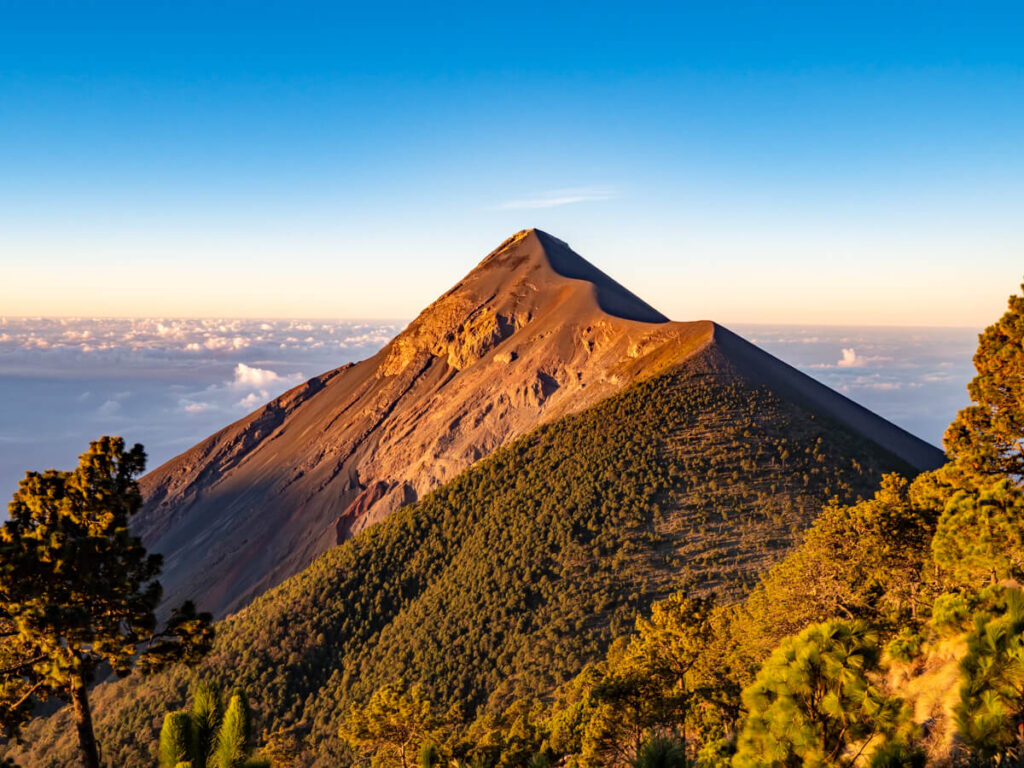
Volcán de Fuego, Acatenango’s fiery twin, is one of the most active volcanoes in Central America. The volcano’s name means “Fire” in Spanish, and if you see its glowing lava fountains at night, you’ll understand why.
For over 20 years, Fuego has produced small, Strombolian-style explosions about every 15 to 20 minutes. From the Acatenango basecamp, you can safely watch its spectacular explosions of ash, smoke, and glowing lava from about a kilometre away. The sound is incredible – a deep rumble that rolls through the valley like thunder.
Eruptions are usually small, although larger eruptions have occurred every 4 to 5 years. There have been frequent eruptions since the Spanish first recorded activity in 1524, with major eruptions in 1717, 1751, and 1773 damaging many historical sites and leading to the abandonment of the city as the country’s capital (moving to modern-day Guatemala City), which is why there are so many ruins in Antigua.
An eruption in 1932 caused significant ash fall across the region, while the June 2018 eruption was far more devastating, killing nearly 200 people and displacing thousands in nearby communities. Another notable eruption happened in May 2023, when Fuego sent ash plumes over 6,000 metres (19,685 ft) high, briefly closing La Aurora International Airport in Guatemala City.

Is Fuego erupting now?
No one predicted that in February 2025, Fuego Volcano’s lava activity would cease altogether. This change was unprecedented, and it was incredibly difficult to find honest and up-to-date information about the situation – if Fuego was erupting, if you’d see lava on the hike, and whether it was even worth doing the hike anymore.
Then, in June 2025, Fuego produced an eruption that led to evacuations of over 700 people, with ash plumes, lava flows, and seismic activity recorded, putting a temporary halt to the overnight hikes.
Things resumed as normal – apparently. But the nature of the Acatenango hike has completely changed – it’s less predictable now, and you never know if the explosions might go quiet again or if this is a sign of something big coming in the future. We hope you get to see the spewing lava spectacle that’s advertised. But you might just get a faint red glow or little puffs of smoke and ash – and you might not see any activity at all.
You can check the status of Fuego’s eruptions here:
We missed the Acatenango volcano hike on our first visit to Antigua and immediately knew we’d made a massive mistake. So when we planned our second trip to Central America, seeing Fuego erupting from the Acatenango base camp was top of our list. In a cruel twist of fate, we perfectly timed our second visit with Fuego going quiet! For the first time in decades, eruptions of lava completely ceased.
As we got closer and closer to visiting Antigua, we were so overwhelmed by the question: Is hiking Acatenango even worth it if there’s no lava from Fuego? We went backwards and forwards on whether to even do the hike, eventually booking it at the last minute – and it was the best decision for us – but it might not be for you. So in this post, we’ve included everything you need to know about the Acatenango overnight hike – with and without lava – how to do the trek, who to book with, and whether it’s even worth it anymore.

Is the Acatenango hike difficult?
Frankly, yes, the Acatenango hike is hard, and you need to know if you’ll be able to complete it before researching any further. But it’s achievable for most people with moderate fitness and determination.
Let’s look at the stats:
The hike gains roughly 1,500 metres (5,000 feet) in elevation over ~5 miles (8-9 km). It’s not steep the entire way up – the trail starts gently through farmland but soon becomes a relentless uphill climb through forest and volcanic gravel, then it flattens out again with more gentle rolling hills. The altitude can make everything feel much harder, especially above 3,000 metres, so taking it slow and steady is key.
Guides pace the group well and take regular breaks, often stopping for snacks and views, and many operators split up into several smaller groups to match varying fitness levels. Operators with several guides or private tours provide a higher level of care, so you’ll feel less rushed and better cared for, being able to go as slowly as you need, which highlights the importance of knowing what to expect when hiking Acatenango before you go.
We’re not pro-hikers, but we did try to train with shorter hikes in the weeks leading up to Acatenango, including trails in Belize’s beautiful national parks, the steep mirador trail in Semuc Champey, and loads of stairs at Mayan ruins like Tikal. We personally found the hike challenging, but not because of the walking, but because of the altitude, which makes everything difficult.
We’d highly recommend doing the much easier hike at Pacaya Volcano first, partly as training and partly to ensure you’ll even be fit enough to complete the Acatenango hike.

Where is Acatenango Volcano?
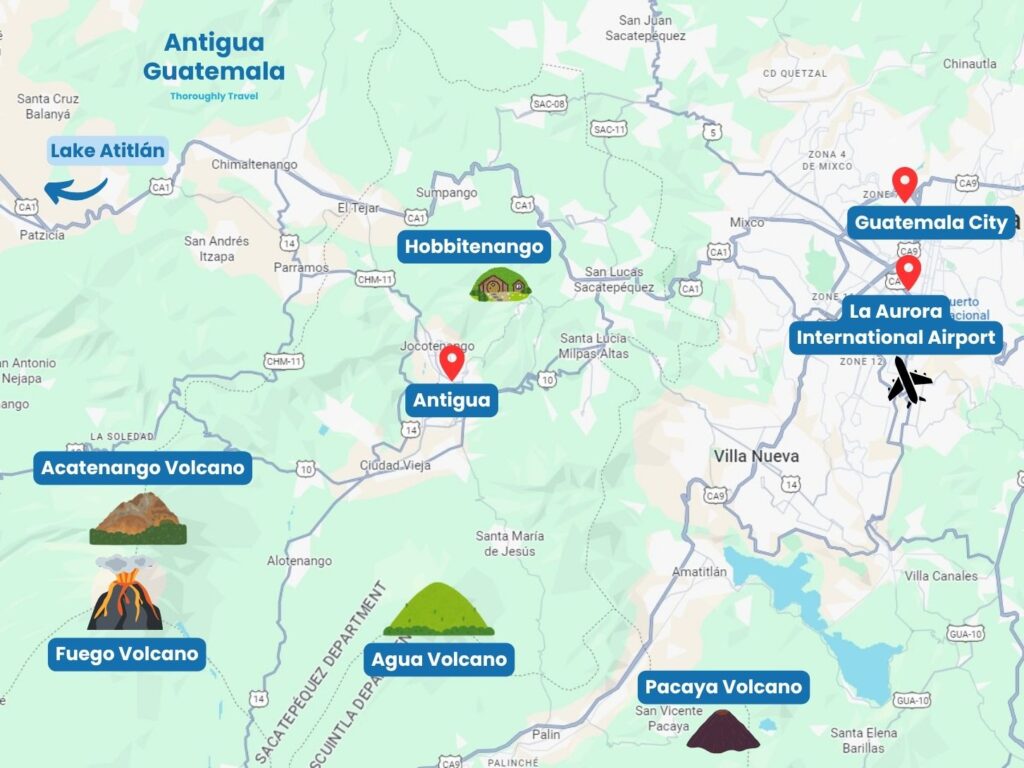
Acatenango Volcano lies just outside Antigua in Southern Guatemala, about an hour’s drive from the town centre. It’s part of the Sierra Madre mountain range, standing at 3,976 metres (13,045 feet), making it the third-highest volcano in Central America.
Acatenango has two peaks: Yepocapa, the northern summit, is 3,800 metres(12,467 ft) tall, while Pico Central, the southern summit, is 3,976 metres (13,044 ft) tall. The latter is the summit visited on the overnight hike.
The trailhead starts in the small village of La Soledad, where most guided tours begin after a very early morning pickup from Antigua.

Where is Fuego Volcano?
Volcán de Fuego is directly adjacent to Acatenango, connected by a saddle ridge that many hikers cross on the optional Fuego trek.
It sits about 10 miles (16 km) southwest of Antigua, rises to 3,763 metres (12,346 feet), and is one of the best places to visit in Guatemala.
Fuego’s near-constant eruptions can be seen and heard across the region, even from Antigua on clear days. Despite its activity, hiking Acatenango’s side remains safe, as the campsites and main trails are well outside the danger zone.

Acatenango Volcano Map
You can see the locations of Acatenango and Fuego Volcanoes on the map of Antigua below.
How to do the Acatenango Volcano hike
The Acatenango hike is typically done as a two-day, one-night trek, giving you time to watch neighbouring Fuego erupt from across the valley, get closer at sunset, and summit before sunrise.
Most hikers start in Antigua, where tours provide transport to the trailhead near La Soledad village, around an hour away. The trail climbs steeply through farmland, cloud forest, and volcanic scree, gaining about 1,600 metres (5,250ft) of elevation to reach the base camp.
You’ll spend the night at around 3,750 metres (12,300 feet), huddled by the campfire with spectacular views of Fuego’s glowing crater (if it’s active). There are optional hikes, one to get closer to Fuego at sunset (with alternatives if there’s no activity) and one to summit Acatenango for views of the surrounding volcanoes at sunrise.
While there are operators offering 1-day hikes of Acatenango, we don’t personally think it’s worth it. It would be a bit insane taking one of the tours from the trailhead to the summit and back in a day – it’s hard enough in two! With many of these tours, you start at a higher elevation, reaching the summit for lunch before descent. You might see activity from Fuego, but you really need to stay overnight, as you can’t properly see the lava until it’s dark.
There’s also a 4×4 jeep option, which takes you up the volcano in a vehicle. While it’s more expensive than the hike, it’s a great option for those who don’t think they’ll be able to complete all the walking.

Can you ride a horse up Acatenango?
Yes, you can ride a horse up Acatenango, but please don’t! The trail is steep, narrow, and rough at times, and conditions can be harsh for the animals. We dread to think what their fate is if they get injured, which is likely with the load they carry and the uneven terrain. There’s no guarantee how well the horses are looked after, either, and they all looked a bit sad and skinny.
Many tour companies discourage using horses, and responsible travellers choose to walk instead to reduce animal suffering. Some outfitters do offer human porters to carry heavier bags, which is a far better option than using horses, so we’d encourage you to check this when choosing your operator.
If you’re worried about the fitness challenge, focus on preparing properly with a few practice hikes and renting a good-quality backpack to distribute weight evenly. And if you don’t think you’ll be able to walk up, you can opt for a 4×4 Acatenango tour, where you’re driven up in a Jeep!

The best Acatenango Volcano hike tours
Your experience will vary greatly depending on which Acatenango tour company you choose. Gear quality, safety standards, group sizes, and attentiveness are all important things to consider when booking. We were totally overwhelmed by the options, so we’ve put together a full comparison of operators based on all our research and experience to help you choose who to go with.
There are a couple of different options for the hike:
You can hike Acatenango independently, but most travellers join a guided overnight Acatenango tour, which includes meals, camping gear, and a local guide who knows the mountains well.
Reputable companies provide everything from high-quality tents or cabins and warm sleeping bags to freshly cooked meals and hot chocolate. Some tours offer private base camps with sheltered cabins and even small group sizes for a more comfortable experience.
The guides are usually locals who can share stories about the volcano and keep everyone safe, especially if the weather changes suddenly. You might have English-speaking guides, depending on who you book with – the cheaper tours tend to only have Spanish-speaking guides.
Some of the most popular tour operators include:

Our experience hiking Acatenango Volcano
We took a tour up Acatenango with Wicho & Charlie’s, one of the most popular operators, but the process is pretty similar for all the other operators, too.
While most tours start in Antigua, not all tours include direct pick-up from your hotel in Antigua. You’ll usually meet at a central point – for us, we met at the office at 6:30 AM. Here, we had a briefing on what to expect over the next two days and met the other travellers in our group. We were also provided with breakfast, as well as gear like water bottles and warm clothing. Because we were travelling light through Central America, we didn’t have warm weather gear with us, but we could also rent extras like thick socks, thermal trousers (pants), and hiking poles (which were absolutely necessary).
After the shuttle ride to the trailhead, where there are restrooms, we were off! The trail climbs steeply from around 2,400 metres (7,800 ft) at the base to 3,976 metres (13,044 ft) at the summit, passing through a series of dramatically different landscapes, including farmland, cloud forest, and volcanic gravel.
The first part of the hike is physically the hardest, consisting of a steep and dusty trail through farmland. Then, it opens out into a beautiful cloud forest. This part is gentler, with ups and downs, and misty clouds hanging in the tree tops. Your group might split into sub-groups if paces differ – we were pretty much in the middle, but kept falling back as we stopped to take photos.
As you climb, you’ll stop every 30 minutes or so at small rest areas, where groups of vendors gather selling snacks and drinks. There are several stops with compost toilets, too (bring toilet paper and hand sanitiser). We were guided by several stray doggies, who kept us company and were great for morale, acting like our spirit guides. We shared our water with them and wished we’d brought some treats with us.
The section before lunch was more difficult – not because it was steep, but because of the altitude. The air got thinner, and everything felt harder. The trekking poles came in handy here. Lunch was a welcome break, as I was starting to feel lightheaded.

After lunch, you’re met with the most beautiful views of Agua Volcano and the city. It gets harder and harder to keep going, but soon enough, you reach the base camp area and can celebrate!
We were so lucky and immediately arrived at the base camp to clear views of Fuego Volcano! It was such a rewarding sight – although we were glad we snapped some pictures, because it was obscured by clouds 20 minutes later.
The fumes from Fuego were too toxic to do the evening ridge hike closer to the crater, and there was no lava activity during our visit, so there wouldn’t have been much point anyway. Instead, we enjoyed a shorter walk to a viewpoint where we had clear views of Fuego at sunset and could see the sun dip below the horizon.
Back at base camp, we enjoyed a dinner of vegan Guatemalan cuisine and hot chocolate by the fire. We’d booked last-minute and ended up splurging on a private cabin to celebrate our anniversary as the dorms were full, but it was the best decision. We could see Fuego through the window from our sleeping bags!
Although we’d intended to do the sunrise hike, the altitude really messed with us – we struggled to sleep, felt nauseous, and had to stop to rest halfway up a flight of steps. So we got up and watched the sunrise from base camp, which was incredible with clear views of Fuego. Most of our group did this, and the views didn’t look that different from the few hikers who did make it to the summit.
Then, after breakfast burritos, it was time to descend all too soon. We felt better as we got lower, but were grateful for the trekking poles as it was a bit of a treacherous slip and slide down. After a shuttle journey back to Antigua, we paid for our extra hikes and gear in the office, returned our gear, and headed out to one of Antigua’s restaurants to celebrate.
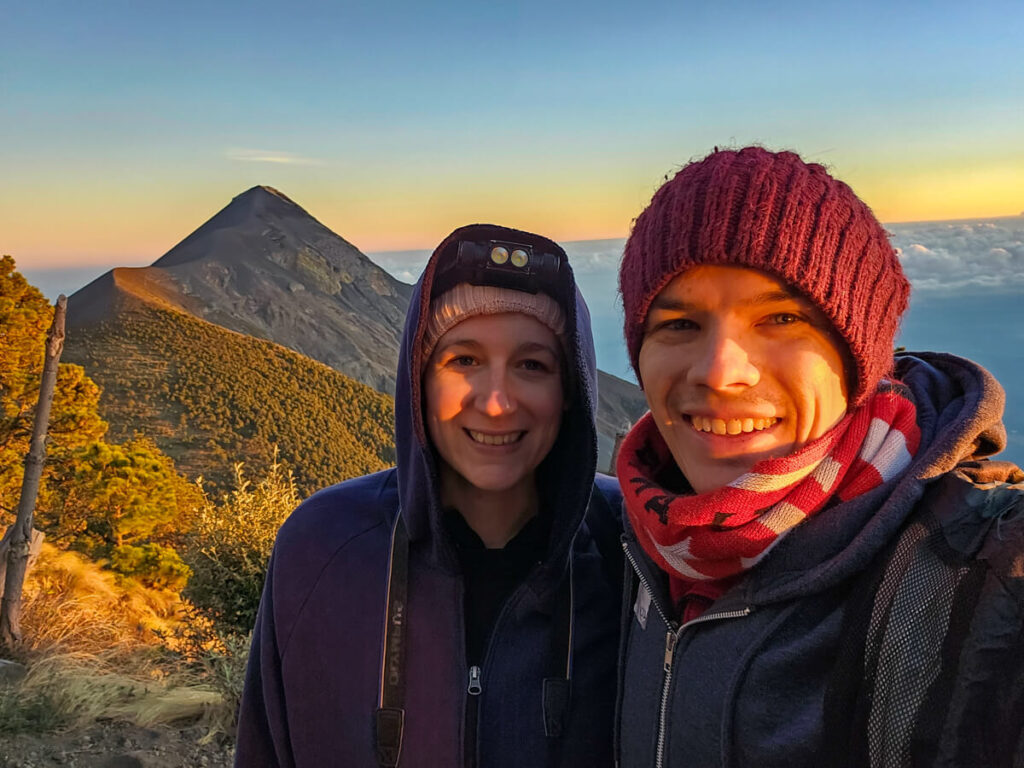
Hiking Acatenango was an incredible experience, and one we’d highly recommend. Even though there was no lava, we did see some plumes of smoke from Fuego – but the crystal clear views of the volcano at sunrise were incredible and seeing the sun rise over the region’s volcanic peaks will stay with us forever. You can read our more in-depth post on what it’s really like hiking Acatenango to get more details about each stage of the hike and what the two days look like.
When to do the Acatenango Volcano hike
The best time to hike Acatenango is during Guatemala’s dry season, from November to April, when you’re more likely to have clear skies and stable weather. Nights are cold year-round, and temperatures can drop below freezing at the summit, so pack warm layers even in the dry season.
The rainy season (May to October) can make the trail muddy and visibility poor, but the silver lining is fewer crowds and greener landscapes.
Weekends tend to be busier, so if you prefer solitude, consider going midweek and avoiding holidays.

How much does it cost to hike Acatenango?
Prices for the overnight Acatenango Volcano hike typically range from 350Q to 700Q ($45-90 USD) depending on gear and inclusions, and it’s worth paying more for good equipment and safety standards. This typically includes round-trip transport from Antigua, guides, park entry fees, meals, camping gear, and basic equipment like sleeping bags and mats. Some operators like Wicho & Charlie’s may be slightly more expensive (around 750Q / $100 USD), but they have better equipment, English-speaking guides, and more inclusions like warm clothing.
If you want a more comfortable experience, with upgraded gear, private tents, or meals cooked by a chef, expect to pay closer to 800Q-1000Q ($100-130 USD). A private cabin is around 2,700Q ($350 USD), but it’s for two people.
There’s also a national park entrance fee of around 50Q ($6 USD), which is sometimes not included in cheaper tours, so check before you book.
Optional add-ons, like hiking to Fuego’s ridge or taking a sunrise summit hike, cost an extra 100Q-250Q ($13-32 USD) depending on your operator.
If you’re missing warm clothing or hiking poles, you can rent them in Antigua for just a few quetzales per item – most agencies offer everything from gloves and jackets to water bottles and backpacks.

What you need to know before hiking Acatenango Volcano
Hiking Acatenango isn’t just about endurance – it’s also about preparation. This is a tough, high-altitude trek where being properly equipped makes all the difference between an unforgettable adventure and a miserable slog. Here’s what you need to know before you go.
Water
The recommendation for how much water to take on the Acatenango hike is 4 litres, but we don’t think that’s enough.
We took 10.5 litres of water between 2 people, plus two 625ml Electrolyte drinks (which were incredible fuel for the final portion of the ascent – highly recommend). We drank about 3.5 litres each on Day 1 and finished our water on Day 2.
Besides what you plan to drink, you also need to carry an additional 1 litre per person, which your chef will use to cook dinner. Wicho & Charlie’s provided us with huge water bottles and drinking water at their office before setting off, and we already had our insulated, reusable water bottles with us.
One of the best things that helped us combat our altitude symptoms was staying hydrated, so we drank a lot. We were also so glad we had a little extra to share with the doggies.
There is nowhere to fill up your bottles on the hike or at base camp, so what you take with you will be what you have for the whole hike. We think it’s better to take too much than too little (but bear in mind you need to carry it).

Snacks
There are stalls with vendors selling drinks on the hike, where you can buy extra drinks on the way up or down. Bring cash in small denominations, as they don’t accept card.
You can even get beers and vodka from these stalls, but we don’t recommend it. Alcohol can make altitude symptoms and dehydration much worse, and it won’t help you on the hike.
They also sell snacks, which is handy if you haven’t packed your own or need a little pick-me-up. High-energy snacks like nuts, chocolate, or granola bars are the best fuel for the long climb.

Trekking poles
You NEED to use trekking poles in the Acatenango hike. We wouldn’t even say they’re recommended, but necessary.
The steep, ashy slopes can be brutal on your knees, especially during the descent, and the volcanic ash is so slippery and dangerous. The poles really helped with grip on the way up and when we were getting tired towards the summit, and were life-saving on the way down, stopping us from falling over many times.
You can rent sticks at the trailhead if you haven’t arranged poles with your operator, which are better than nothing.

Bathrooms
There are flushing toilets at the trailhead, which you can use for a small fee (~5-10Q) – bring cash.
On the trail, there are several compost toilets, too. Bring your own toilet paper, compostable baby wipes, and hand sanitiser.
Toilets at your base camp will depend on your operator – some don’t have any. Wicho & Charlie’s had a couple of toilet blocks with composting toilets near each level of cabins.

Stray dogs
Don’t be surprised if you meet a few friendly stray dogs along the trail – some of them follow hikers all the way to camp in hopes of food and warmth, becoming unofficial mascots of the mountain.
We’d highly recommend packing some treats and extra water to share with them if you can.

Is it safe to hike Acatenango Volcano?
For the most part, hiking Acatenango is considered safe, as long as you go with an experienced, licensed tour operator and follow their guidance.
Local guides estimate that 200 to 400 people visit Acatenango and Fuego Volcanoes every day, with as many as 1,000 people visiting a day a busy Friday or Saturday (BBC). Most of these visits are completely fine.
The volcano itself is dormant, and while its neighbour, Fuego, is active, most eruptions are small and monitored closely by local authorities. If you’re with a reputable company, they’ll also be monitoring its activity and will adapt your experience to be the safest possible.
If conditions ever become unsafe, tours are cancelled – guides stay in regular contact with local monitoring agencies and are quick to adapt plans if needed. It’s worth leaving a little flexibility in your Guatemala itinerary if the experience is important to you, in case you need to reschedule your hike.
The biggest risks on the trail usually come from altitude, cold, and fatigue, rather than volcanic activity. Temperatures can drop below freezing overnight, so warm layers are essential, and taking it slow helps prevent altitude sickness.
Weather hazards can also make the hike tricky – heavy rain or wind can turn the trail muddy and difficult, while toxic fumes and volcanic ash can make hiking near Fuego dangerous. The ridge near the summit is fully exposed, and strong winds can make it hard to stay balanced. If ash, fumes, or dust are present, cover your mouth and nose with a buff or mask and avoid standing directly downwind of the plume.

Is Fuego Volcano safe?
Fuego’s eruptions are the largest appeal of the hike, and getting up close on the sunset ridge trail is a highlight of the experience.
The eruptions are carefully monitored, and most are small and pose no threat, but guides maintain radio contact with local authorities and will alter plans if conditions change.
But no one can categorically say that hiking near Fuego is safe – in fact, experts are actually warning that it’s dangerous. INSIVUMEH, a government agency that monitors the volcanoes, has warned against operators taking tours near the summit of Fuego, with some getting as close as 100 metres from the summit (BBC). Conditions can change rapidly, and Fuego’s eruptions are still a force of nature.
You can always observe Fuego from the safety of the Acatenango base camp, where you’ll still have incredible views without taking unnecessary risks, saving your energy for the morning summit hike.
When viewing eruptions, always follow safety guidelines, stay within designated viewing zones, and never attempt to hike closer to Fuego without a certified guide.
In the rare event of an emergency, tour companies carry first aid kits and maintain evacuation protocols, and rescue services from Antigua are on standby if needed.
Overall, with proper preparation, a reputable guide, and a bit of mountain respect, the Acatenango hike is challenging but safe.
Don’t forget travel insurance!
While hiking Acatenango is generally safe with the right preparation and a reputable tour company, accidents and unexpected events can still happen, from altitude sickness and twisted ankles to lost gear or sudden weather changes. That’s why having comprehensive travel insurance is absolutely essential. Here are our top providers:
Compare Policies: 6 Best Travel Insurance Companies for Every Kind of Trip

How to prepare for the Acatenango Volcano overnight hike
Preparing for the Acatenango Volcano hike is all about pacing yourself and packing smart.
Get your fitness levels up
The climb is steep, high-altitude, and unpredictable. You don’t need to be an athlete, but you do need basic endurance. Regular walking, hiking, or even taking the stairs instead of the lift in the weeks before your trip will make a noticeable difference. The first section of the hike is often the hardest, so building up leg strength and stamina helps immensely.
Prepare for the altitude
Altitude sickness is the most common issue, as you’ll climb to nearly 4,000 metres (13,000 ft) above sea level. Symptoms like headaches, dizziness, or nausea can appear quickly, even in otherwise fit hikers. Pace yourself, drink plenty of water, and avoid alcohol the day before the hike. We also found that Ibuprofen helped with our symptoms, and antacid tablets were good for nausea. Listen to your body and don’t push through severe discomfort.
Acclimatise in Antigua
It’s best to spend a couple of nights in Antigua before the hike to acclimatise. Explore the city and enjoy a couple of the best things to do in Antigua while you get used to the elevation – the city itself sits at around 1,545 to 1,578 metres (5,069 to 5,177 feet) above sea level, so it’s the perfect place to acclimatise while exploring the town’s cobbled streets, cafés, and markets.
Pack and dress accordingly
Check out our Acatenango packing list for exactly what you do (and don’t) need to take with you, and try not to pack too much weight – you’ll have to carry it! Lightweight layering is key, as temperatures can range from humid and warm at the base to below freezing at the summit. If you’re joining a guided tour, ask what’s included, as most companies provide tents, sleeping bags, and some warm gear, but you’ll need your own base layers and gloves (or to rent them if you aren’t travelling with them). We’ve also broken down all the clothing you need to pack, and what to wear to do the hike.
Test your gear before the hike
If you’re bringing your own boots, backpack, or trekking poles, make sure they’re broken in and comfortable. Blisters or poorly fitting packs can make the hike miserable. A small test hike around the highlands or even on a day trip from Antigua, like to Hobbitenango or Cerro de la Cruz, can help you adjust your fit and gear before committing to the big climb.
Get mentally ready
Finally, remember – this hike is as much about mental strength as physical ability. The steep inclines and thin air can feel brutal, especially near the top, but take it one step at a time. We made sure we were well rested and came with an aggressively positive attitude, which helped us reach the top. The moment you look across and see Fuego Volcano, it’s completely worth it.

Tips for hiking Acatenango Volcano
To help you plan a smooth and enjoyable Acatenango volcano overnight hike, here are some of our top tips:

Acatenango Overnight Hike to Fuego Volcano FAQs
To finish off this Acatenango Volcano travel guide, we’ve answered some frequently asked questions.
What is the hardest volcano hike in Central America?
Acatenango is widely regarded as one of the hardest accessible volcano hikes in Central America due to its steep ascent, high altitude, and overnight camping. It’s harder than other volcano hikes in the region, like Pacaya, as well as the famous Inca Trail to Machu Picchu, but easier than famous mountain treks like Kilimanjaro and Everest.
What is the difference between Acatenango and Fuego?
Acatenango is the dormant volcano you climb and sleep on, while Fuego is the active neighbouring volcano that provides spectacular eruptions visible from the Acatenango summit and base camp.
Can anyone do the Acatenango hike?
Most healthy adults can attempt the Acatenango hike, but it requires stamina, good footwear, and proper preparation. Young children, older adults, or those with health conditions may struggle. We’ve heard of people giving it a go and having to turn back, so it’s best to ensure you’re fit enough before attempting it.
How fit do you need to be to hike Acatenango?
A moderate to high level of fitness is recommended for the Acatenango overnight hike, as the trail is steep and sustained over 4-6 hours of walking to base camp, with additional effort to reach the summit on an extra trail.
How hard is the Acatenango overnight hike?
It’s challenging due to the combination of steep slopes, altitude (nearly 4,000 metres), cold temperatures, and carrying your gear overnight, but manageable with pacing and a tour guide with a licensed operator.
How hard is the Fuego hike
Optional side hikes to Fuego’s ridge or other nearby peaks can be more difficult due to loose volcanic rock, exposure, and minimal infrastructure. Hiking Fuego is much shorter and lower in altitude than Acatenango, but it’s only permitted in organised tours due to safety hazards, including lava and toxic fumes. It’s often offered as an additional hike and can be considered harder than the main Acatenango hike, due to it taking place partly in the dark and after the gruelling hike to the Acatenango base camp.
How long does an Acatenango hike take?
Most overnight hikes take around 24 hours from the start of the hike at the trailhead to reaching the bottom again, with around 10-14 hours total walking: 4-6 hours ascending to base camp, 4-5 hours optional Fuego sunset hike, camping overnight, sunrise summit push (~1-2 hours), and 2-3 hours descending.
Can you camp in Acatenango?
Yes, overnight tours provide tents, sleeping mats, and sleeping bags, allowing you to spend the night near the summit for sunrise views. Some operators even have cabins for extra comfort.
Do you need a porter for the Acatenango hike?
No, you don’t need a porter to carry your bags, but they can carry your heavy gear if you prefer a lighter load. Ensure the service is ethical and fairly paid before arranging it, and avoid tours that use horses, as they’re unethical. Some operators like Wicho & Charlie’s take your heavy backpack 80% of the way in a 4×4, so you only need ot carry it for the last stretch.
How cold is it at the top of Acatenango?
Temperatures often drop below freezing at the acatenango base camp, especially overnight, so thermal layers, hats, and gloves are necessary.
Does Acatenango erupt?
No, Acatenango is dormant, though it shows minor fumaroles. Its last eruption was in 1972. The active volcano nearby is Fuego.
Does Fuego erupt every day?
Fuego erupts frequently, often multiple times per day, but activity can vary. Lava flows are not guaranteed on any given night, and eruptions have become less predictable, with some nights seeing no lava activity at all.
Can you see lava at Acatenango?
During active periods, lava bursts from Fuego are visible from base camp or the summit of Acatenango, but it’s unpredictable and not guaranteed. The main reason we wanted to visit was the lava, so we were really disappointed there was no activity during our visit (the volcano actually exploded after months of dormancy the night AFTER our hike!). But we’d be lying if we said no lava ruined the experience – the hike was still a total highlight of our trip – it was challenging but so rewarding with some of the most insane volcano views we’ve ever seen.
Is Fuego worth it?
If conditions are safe, the Fuego add-on hike is one of the most thrilling parts of the Acatenango overnight trek. It’s a tough extra climb, but the reward is standing closer to Volcán de Fuego’s active crater, where you can sometimes feel the ground vibrate as it rumbles and spits glowing ash into the night sky. However, eruptions vary – there’s no guarantee of visible lava, and weather or safety restrictions can sometimes close the route.
Because the lava was the attraction for us, we’d have wanted to stay up all night getting photos of Fuego erupting. If lava is your priority, we’d recommend skipping the additional hikes and just focusing on observation and photography of the eruptions from base camp. With no lava, the experience becomes more about the hiking and the landscapes, with the sunset and sunrise being real highlights. The extra hikes are so worth it for different angles of Fuego and Antigua’s other volcanoes in the constantly changing light, even without lava.
Do I need altitude sickness pills for Acatenango?
Altitude sickness pills for Acatenango are not required, but can help prevent headaches or nausea. Acclimatising in Antigua and pacing yourself is usually sufficient for healthy hikers.

Read next:
12 Best Acatenango Volcano Tour Companies Compared
What it’s Really Like Hiking Acatenango Volcano + Wicho & Charlie’s Review
Our Ultimate Acatenango Volcano Packing List
How to Visit Pacaya Volcano + Is it Even Worth it?
A Traveller’s Guide to Antigua: Guatemala’s Colourful Colonial Town
2-10 Day Antigua Itinerary + DIY Free Self-Guided Walking Tour
10 Top Day Trips from Antigua + 4 Tours to Avoid
28 Amazing & Unique Things to Do in Antigua
Our Guatemala Destination Guides:
Our Guatemala Travel Guides:
