A Detailed Guide to Visiting Tikal National Park & Majestic Mayan Ruins

Is Tikal worth it? Discover everything you need to know about Guatemala’s most famous Mayan ruins and national park in this complete guide.

This post may contain affiliate links, which means we might earn a small commission on anything purchased through these links at no extra cost to you. Learn more on our disclaimer page.
Hidden deep in the Guatemalan jungle, the ancient city of Tikal rises above the canopy like a lost kingdom frozen in time. If you’ve ever dreamed of wandering in the footsteps of Mayan kings while a cacophony of calls from monkeys and toucans echoes through the canopy, this guide is for you.
We’ve visited a LOT of Mayan ruins throughout Latin America, so we weren’t sure if Tikal was going to be worth the trip. It may be heralded as a world-famous historic site and one of the best places to visit in Guatemala, but with that, we were expecting crowds of tourists and swathes of scams. Having visited this world-renowned historic site and sprawling national park ourselves, exploring its many plazas and climbing towering temples, we fell in love with it and can safely say it lives up to the hype.
In this travel guide, we’ll share how to visit Tikal National Park, including getting tickets through the new system, the best way to get there, the top temples to climb, tips to avoid the crowds, and the secrets that make Tikal a once-in-a-lifetime adventure.
Tikal National Park at a glance

About Tikal National Park
As Guatemala’s only natural and historical protected national park, Tikal is totally unique. Home to some of the best-preserved Mayan ruins in the world, Tikal is categorically the best archaeological site in Central America. Nestled deep in the rainforest, it’s a UNESCO World Heritage site (the first site in the world to be accredited as a Mix World Heritage site in both the cultural and natural categories) and home to towering Mayan temples, ancient plazas, and palaces that date back over 1,500 years.
Chichén Itzá, an actual Wonder of the World, doesn’t come close to Tikal’s grandeur. Even Caracol, our favourite of Belize’s Mayan ruins, sits in second place for us. Tikal is home to some of the most impressive Mayan ruins we saw in Latin America and totally deserves a spot on your Guatemala itinerary.
Here you’ll find Mayan ruins like sprawling plazas, temple tops towering above the rainforest canopy, and crumbling pyramids being reclaimed by the jungle. But as wildlife lovers, it was the animal spotting opportunities beside the cultural heritage that sold us on Tikal – spider monkeys swinging through the trees, the sounds of howler monkeys echoing throughout the valley, agoutis running across your path, and coatis running around on the forest floor. Add in the misty morning clouds giving way to the blazing colours of sunrise or the golden light of sunset at the end of the day, and there’s no doubt Tikal is one of the top things to do in Guatemala.
Top Tikal Tours
Don’t have time to read the whole post? Here are our top picks for Tikal tours:

Tikal National Park History
Tikal was once one of the most powerful city-states of the ancient Maya civilisation. The city dates back to the 4th century BCE, but flourished between 200 and 900 CE.
At its peak, Tikal had an estimated 100,000 inhabitants and served as a major political, economic, and military hub. It’s thought the site was once called ‘Yax Mutal’, meaning Blue/Green or First Mutal (the name for the royal dynasty). Archaeologists have uncovered hieroglyphic texts that reveal alliances, rivalries, and even wars with other Mayan cities like Calakmul in Mexico and Caracol in Belize.
Like many other Mayan sites in the region, the city was eventually abandoned, likely due to political decline and regional instability. After the city’s decline in the 10th century, the jungle slowly overtook the temples, and the site was forgotten.
Tikal was rediscovered in the 19th century, although it’s said locals knew of its existence before then. Excavations began in the mid-20th century and continue today, revealing more and more of the site’s secrets.

More from Flores
Where is Tikal National Park?
Tikal is located in northern Guatemala, within the Petén region. It sits inside the vast Maya Biosphere Reserve, which protects both the ruins and the surrounding rainforest and is home to incredible biodiversity.
The park is about 40 miles (64 km) from Flores, the nearest city and main tourist hub. Flores is where most travellers base themselves before visiting Tikal, as it has hotels, restaurants, and transportation links, but other smaller locations like El Remate are also popular.
The park’s remote location means you’ll be driving through lush jungle landscapes to reach it. Despite being off the beaten track, it’s surprisingly accessible from both Guatemala and Belize. Day trips from San Ignacio in Belize are possible, while some people travel from as far as Antigua to see the ruins.

Tikal National Park Map
You can see the layout of Tikal on the map below.

Why visit Tikal National Park?
Tikal is more than just another set of Mayan ruins – it’s an unforgettable travel experience to one of the top archaeological reserves in the world. We were a bit worried we would be templed out after visiting 14 Mayan sites in Latin America, but Tikal still blew us away with the sheer scale of the temples, some towering above the jungle canopy, standing over 70 metres (230 feet) tall.
Unlike other archaeological sites that can feel made for tourists, Tikal retains an authentic, remote feel. History buffs will love the detailed hieroglyphs, intricate carvings, and incredible architecture, while photographers should absolutely visit at sunrise or sunset for views from the temple tops. Wildlife sightings are common too, from spider monkeys swinging in the trees to toucans flying overhead, which had us excitedly looking up at the tree tops all day. It’s absolutely one of the best things to do near Flores.

Tikal Mayan Ruins
The site of Tikal covers more than 6 square miles (16 square km), though only a fraction has been excavated. The highlights include Temple I (the Temple of the Great Jaguar), Temple II (the Temple of the Masks), and Temple IV, the tallest structure in the ancient Mayan world.
Uniquely, you can actually climb several of the temples, giving you panoramic views of the jungle stretching endlessly in every direction. We’ve detailed more about all the structures you need to see later in this post.

Tikal Wildlife
A visit to Tikal is as much about nature as it is about archaeology. The surrounding rainforest is teeming with life, and it’s common to see Guatemalan wildlife, like howler monkeys, spider monkeys, and colourful birds like toucans, parrots, and scarlet macaws. Birdwatchers are particularly drawn to Tikal, with over 300 species recorded here.
You’ll probably see coatis and agoutis running around between the pyramids, and if you’re super lucky, you might even see one of the elusive jaguars that still roam the reserve. We saw several animals on our Central America wildlife bucket list here in just one day!

Tikal in Star Wars
Tikal may look familiar even if you’ve never been there, thanks to its cameo in Star Wars: A New Hope. The view from Temple IV was used as the Rebel base on Yavin 4, one of the film’s most famous scenes. Standing on the temple’s wooden viewing platform, you’ll recognise the sweeping jungle canopy with temple tops poking through. While it might not be the main draw to Tikal, it’s a pretty cool fun fact, and, as a fan, Dan was loving it.

How to Visit Tikal
When planning a trip to Guatemala, it’s worth considering how to reach Tikal. Most travellers choose to visit Tikal as a day trip, but it can be visited over multiple days if you want to explore more in-depth.
Many people (including us) base themselves in Flores, which has frequent tours and shuttles to Tikal every day. You’ll also find accommodation near the park entrance, which is ideal for sunrise or sunset visits and staying for more than one day.
There are a variety of ways to reach Tikal – and which you choose will depend on your itinerary, budget, and preferences – including:

How to get to Tikal National Park
From Flores, the drive is about 90 minutes, and most visitors arrange transportation from here through hotels or tour operators. If you’re coming from Belize, you can cross the border at San Ignacio and continue by shuttle or car. If you’re arriving from further afield in Guatemala, it’s a good idea to spend at least a night in Flores or Tikal to make the most of your time – you can fly into Flores from Guatemala City, cutting down on travel time.
Here are the most popular ways to reach Tikal:
By tour
Tikal tours are the most popular way to visit Tikal, especially for first-time travellers. They typically include round-trip transportation, a knowledgeable guide, and entrance coordination.
Tours often leave early in the morning to beat the crowds and heat, but some also leave in the afternoon for sunset experiences. Options range from group tours to private, customisable experiences, with pricing heavily reflecting the type of experience you choose.
Many tours also include meals or side stops at restaurants, viewpoints, and museums, so be sure to check what’s included before booking.
There are loads of Tikal tour options, and it can be really confusing to choose between them, so we’ve put together a whole guide to choosing a Tikal Tour separately to help you choose.
By shuttle
Shuttles to Tikal are a cost-effective and reliable option for getting to Tikal. They run daily between Flores and the park, with set departure and return times.
Shuttles are usually shared vans, so they’re budget-friendly but still somewhat comfortable. Booking is easy through hotels, hostels, or tour companies in Flores. Los Amigos Hostel from Flores runs one for 100Q ($13 USD) at:
The downside of booking a Tikal shuttle is that they don’t include a guide. You’ll be able to explore the ruins on your own, but you won’t learn much about what you’re seeing, and you may miss key structures or animals local guides know how to find. It’s also worth noting that you need a guide for sunrise and sunset slots, so this option is only really feasible if you’re on a budget, not a big history fan, and are going during the main daytime slot.
By bus
Taking the local bus (minivan), known as a colectivo, is the cheapest way to reach Tikal. Buses leave from Santa Elena, near Flores, and take a bit longer as they stop for passengers along the way. While inexpensive, these options can be crowded and less comfortable compared to shuttles.
Beware that it’s a common scam in Santa Elena for touts to redirect tourists from local transport options to more expensive tourist shuttles.
It’s also important to check if the colectivo drops off at the ticket booth or the visitor’s centre, as they’re a 25-minute drive apart from each other. If it goes all the way to the entrance without stopping at the ticket booth, you’ll need to arrange your tickets in advance (more on this below). If it doesn’t go all the way to the entrance, you might be stuck.
By car
Renting a car gives you the most flexibility for visiting Tikal and exploring Petén, but it’s not a common option for tourists. The roads are paved and generally in good condition, but driving in Guatemala is pretty mental – although we’ve driven all over the world, we wouldn’t feel comfortable here, having seen some truly terrible driving habits.
Parking is available at the entrance to the park, and the drive from Flores takes around 1.5 hours. Having your own car also allows side trips to other ruins like Yaxhá or Uaxactún, and is great if you want to stay in the park itself.
By taxi
Taxis are available in Flores and can take you directly to Tikal, though this is usually way more expensive than a shuttle. Some drivers offer round-trip services, waiting for you at the park while you explore – if you don’t arrange this ahead, you might have trouble getting a lift back.
Prices should always be agreed upon in advance to avoid surprises – expect to pay around 250-400Q (~$30-50 USD) each way. While it’s not a cheap option, it can work out if you’re in a group and value comfort.

Tikal National Park Opening Hours
The standard opening hours for Tikal National Park are between 6:00 AM-6:00 PM.
A special sunrise entry slot allows entry with a guide from 4:00 AM, where you can enter before the park officially opens. There’s also a guided sunset entry slot that allows you to stay in the park from 6:00 PM to 8:00 PM, after it officially closes.
It’s also worth noting that the rule where tickets purchased after 3:00 PM are valid for the next day no longer exists. If you plan to enter Tikal on a second day, you need to purchase a second ticket.

Tikal National Park Entrance Fee
You must have a standard ticket for any time you choose to visit. An additional ticket is required for sunrise and sunset tours.
The standard entry ticket price for Tikal costs 150Q (~$20 USD).
If you want to book a sunrise or sunset ticket, it’s an additional 100Q (~$13 USD), making the total 250Q (~$32 USD). This does not include a guide, which is mandatory for these tickets.
Children under 12 can enter Tikal free of charge.
There’s an additional charge of 30Q (~$4 USD) to enter the Tikal Museums.
You can also purchase entrance to Uaxactún at the same time for 50Q (~$6.50 USD).

Tikal National Park Tickets
The rules for buying tickets to Tikal have changed a few times in recent years, making the process a bit convoluted, and many websites still have outdated information, so here’s what you need to know before you go.
As a tourist, you now have four options:
As with many archaeological sites in Central America, once you show your ticket, you’ll be given a colourful wristband. This indicates which type of entrance you’ve paid for (standard, sunrise, or sunset), and allows entry for the rest of the day or your allocated time slot.
The absolute easiest way to visit Tikal would be to book a tour that includes your entrance ticket. Private options might arrange this for you, but it’s standard practice for most tours not to include an entrance ticket. So here’s how to get tickets for Tikal.

Buying tickets for Tikal online
In 2023, online ticket sales opened, meaning you could buy tickets in advance. For some reason, this was discontinued, meaning only those with a Guatemalan credit card could buy tickets online.
However, online ticket sales have reopened, so you can once again buy tickets on: https://boletos.culturaguate.com/. There’s a portal for Guatemalan Nationals and one for Foreigners, so be sure to choose the right one (click ‘extranjeros’ for foreigners).
The checkout process is pretty straightforward. You can create an account or check out as a guest, adding your contact details, and your tickets will be emailed to you as PDFs, so you can print them off or just show a digital copy on your phone. Remember to add a sunrise or sunset ticket as well as a standard ticket to your basket if you want one of these slots. Mobile signal is pretty patchy in the park, so try to buy tickets online before you arrive.
The website is in Spanish, but you can use Google Translate to put it into your spoken language.

Buying tickets for Tikal at the ticket office
Another way to get tickets for Tikal is to purchase them in person at the ticket office. While this sounds like a simple process, it’s not. The booth is located about 10.5 miles (17 km) from the entrance to the archaeological site – they’re about a 25-minute drive apart.
This can be an issue if you’re relying on public transportation like local colectivos, as it often doesn’t stop at the ticket booth at all (meaning you don’t have a ticket), or it drops you off here and leaves – and then you’re a 4-hour walk from the site! We’d recommend arranging your ticket online if this is your mode of transport.
If you have your own rental car, you can simply stop at the ticket office on your way to the main car park.
If you’ve booked onto a Tikal day tour, most tours stop here on the way in to allow you to buy your ticket, which means you don’t need to buy one online. For sunset tours, you can also stop at the ticket office before it closes at 6:00 PM.
But sunrise tickets are more complicated. You can’t pay at the entrance as the ticket office doesn’t open until 6:00 AM (after sunrise). Instead, you need to buy the standard and sunrise tickets the day before. You can do this at the entrance if you’re staying in Tikal and have your own rental car. If you’re staying in Flores (which most people do), it’s not worth going to Tikal the day before just to buy tickets – your only option is to buy online or through a local bank, which we’ve detailed below.
You must show your passport to buy Tikal tickets in person, so be sure to carry it with you. Bring cash too, in case the card terminals are not working.

Buying tickets for Tikal from a bank
As of 2025, you can no longer buy Tikal National Park tickets from Banrural Bank. The only branch that still sells tickets is Banco De Los Trabajadores (BANTRAB).
Bring your passport, as you may be asked to provide it to buy tickets.
If you’re staying in Flores, there’s a BANTRAB opposite the Mundo Maya International Airport. You can get your entrance tickets here the day before your visit, which is especially handy if you’re booking a sunrise tour.

Tikal National Park Tours
Guided tours are one of the best ways to experience Tikal, as they bring the ruins to life with history and stories. There are three main types of Tikal tours: sunrise, daytime, and sunset.
Being the closest base, most tours leave for Tikal from Flores, often picking up at places like El Remate on the way. Of course, you can also take Tikal tours from other locations around Guatemala. Some leave from as far away as Antigua or Guatemala City. While these may seem appealing, they’re honestly not really worth it, as they include long travel times and you won’t get nearly enough time in the park.
You can also take a Tikal tour from San Ignacio in Belize. This option is popular with people who want to see Tikal and are staying in Belize but not travelling to Guatemala. The travel time is much shorter than from Antigua and Guatemala City, so it’s a feasible day trip.
There’s so much to factor in when choosing a tour, from the time slots and ticket types to departure points and group sizes, so we’ve written a whole other post just about taking a tour in Tikal.

Tikal Shuttles
If you’re just doing a daytime tour and aren’t fussed about a guide (although we’d highly recommend one), you can opt for a Tikal shuttle service. This is similar to a tour in that you arrive by tourist shuttle, but you’ll be allowed to roam freely within the park, instead of going around with a tour group.
Honestly, we don’t think you’ll have half the experience without a guide. Having guided ourselves around ruins like Xunantunich in Belize and Uxmal in Mexico, we’re usually the first people to try and save some money, avoid the tour groups, and go it alone. But in Tikal, it’s a different story.
Having a guide can really shape your experience. Instead of just wandering around looking at stuff, you’ll actually learn about the Maya civilisation that lived here and what the city looked like over 1,500 years ago. We also learned loads about the Maya’s beliefs, ritual, and their connection to the environment, as well as about indigenous animals and plants, like the sacred Ceiba tree.
Most guided tours will also give you some free time at each of the plazas to climb the pyramids and explore the complexes, so you don’t have to always stick as a group.

When to visit Tikal National Park
The best time to visit Tikal is during the dry season, which runs from November to April, when the weather is cooler and trails are less muddy. This is also the busiest period, so expect larger crowds at the most famous temples.
The rainy season from May to October has fewer tourists, lusher jungle, and more active wildlife, but also daily downpours that can make exploring tricky.
The weather in the Petén region is hot and humid, with high average temperatures. Daily highs of around 30°C (86°F) are normal year-round.
For the most magical experience, sunrise and sunset tours are highly recommended, as the soft light over the canopy is unforgettable. Wildlife is also more active in the early morning, making dawn visits extra rewarding.
If you want the quietest experience, aim for late afternoon when most day-trippers have already left. This is a great way for those staying nearby to have complexes and temples all to themselves. Try to avoid weekends and national holidays, and Guatemalan citizens can enter the park for free on Sundays, so you might wish to avoid this day, too, as it can be busier.

How long to spend in Tikal National Park
There’s no way you can see every corner of Tikal National Park in one day, but many people don’t mind. Most visitors spend between 5 to 7 hours exploring Tikal, which is enough time to see the major temples, plazas, and wildlife. If you’re taking a day trip, this is typically the amount of time included before returning to town. Leave a full day free to include transportation and any other stops, like restaurants, too.
However, if you’re staying overnight near the park, you can explore at a slower pace or join both sunrise and sunset tours. This allows you to see the park in multiple different lights, as well as being able to get away from the busier plazas and see some of the more remote parts of the park.
Ultimately, the time you need depends on whether you want a highlights tour or a deeper, immersive experience.

Can you climb the temples at Tikal?
You can climb several of the temples at Tikal, though access is restricted on some to protect the structures. The structures you can climb include:
Other temples, like Temples I and V, are closed from climbing to preserve their delicate stonework.
There are wooden staircases provided to make climbing the pyramids safe, though they can be steep and tiring. You might need to stop to catch your breath on some of them, but reaching the top huffing and puffing is absolutely worth it for the panoramic views and to see other temples peeking over the tops of the trees.

Hiking in Tikal
Getting around Tikal is done entirely on foot, as the ruins and jungle paths are connected by well-marked walking trails. Most are flat and gravelly, but some are compact dirt paths with some inclines.
The site is vast, so expect to walk several miles during your visit, with distances between major temples sometimes taking 10-15 minutes. Many trails are mostly shaded by jungle canopy, but they can still be exposed in the plazas, so carrying plenty of water is essential. Comfortable walking shoes are also a must, as the terrain includes uneven stones and dirt trails.
Maps are available at the entrance and are scattered throughout the site, and there are signposts at key junctions to help you navigate between complexes. Guided tours usually follow a set route that highlights the most important plazas and temples, so you don’t miss anything important.

What to see in Tikal National Park: Temples & Wildlife
There’s loads to see in Tikal, from the temples to the wildlife, and you won’t want to miss anything and find out later you didn’t notice it. Here’s what to look out for on your visit.

Temple I
Temple I, also known as the Temple of the Great Jaguar, is the most iconic structure in Tikal. Standing at 47 metres (154 feet) high, it dominates the Great Plaza and was built as a funerary monument for a Maya ruler.
Visitors can admire its steep pyramid shape and detailed carvings, though climbing it is no longer allowed. The temple directly faces Temple II, creating a striking symmetry in the plaza, and can be viewed from the North and Central Acropolises.

Temple II
Temple II, also called the Temple of the Masks, sits opposite Temple I on the Great Plaza. Unlike Temple I, it is open for climbing via wooden stairs attached to the side. From the top, you get a spectacular view of Temple I and the surrounding plaza. The temple is slightly shorter than others, standing at 38 metres (125 feet), but it’s no less impressive.

Temple II Carvings
The Temple of the Masks’ name comes from carved stone masks that decorate its façade – you can see them clearly from the viewing platform at the top. It was built in the 8th century by Jasaw Chan K’awiil I (also known as Ah Cacao) and is believed to have been dedicated to his wife, Lady Kalajuun Une’ Mo’. The large stucco masks represented deities or spiritual guardians and would have been painted in bright colours, making the temple even more striking in its prime.

Temple III
Temple III, known as the Temple of the Jaguar Priest, is one of the lesser-visited structures in the park. It stands 55 metres (180 feet) tall, behind Temple II, though it remains partly covered by jungle growth.
Unlike Temples I and II, Temple III is not fully excavated. It’s located slightly off the main route, so fewer crowds make it here, but that means it’s quieter than other structures. While you can’t climb this temple, you can see it from the top of several other temples, including those in the Mundo Perdido Complex.

Temple IV
Temple IV, named the Temple of the Two-Headed Serpent, is the tallest structure in Tikal and the entire Mayan world, reaching 70 meters (230 feet). This is the spot made famous by Star Wars, where you can see the temple tops used as the rebel base on Yavin 4.
While Temple IV is known for its views, the best view of Temple IV is from the top of the Great Pyramid in the Mundo Perdido Complex.

The view from Temple IV
A wooden staircase leads to a viewing platform near the top of Temple IV, offering one of the most breathtaking views in Guatemala. From here, you can see other temples poking through the jungle canopy, with endless rainforest stretching to the horizon. This is the place where visitors can watch the sunrise or sunset over the jungle.

Temple V
Temple V stands 57 metres (187 feet) tall and is the second-highest structure in Tikal. It’s located near the South Acropolis and is easily recognised by its steep sides and towering height. Archaeologists believe this temple was built around 700 CE, possibly as a funerary monument.
Due to being one of the newest structures in the park, it’s still being excavated and cannot be climbed. This is also why it doesn’t have another name.

Great Plaza
The Great Plaza (Gran Plaza) is the ceremonial heart of Tikal. A grassy square, it’s framed by Temples I and II, along with various palaces and altars in the North and Central Acropolises.
This was once the main gathering space of the ancient city, where rituals, markets, and public events took place. In its centre, you’ll find carved stelae, stone monuments carved with hieroglyphs and depictions of rulers. Today, it’s the busiest part of the park, with tourists often lingering to take the picture-postcard snap of Tikal. The best view of the plaza is from the top of Temple II, but you also get great views from the North and Central Acropolises.

North Acropolis
The North Acropolis is one of the oldest and most archaeologically significant parts of Tikal. It consists of layers of temples and structures built over centuries, as successive rulers added new monuments. This area was used primarily as a royal burial ground, with tombs discovered beneath its platforms.
The Acropolis sits right next to the Great Plaza, making it easy to explore as part of the main circuit. Our tour allowed free time to explore here. While the Great Plaza is one of the busiest parts of Tikal, we found people barely leave the square, and we had most of the temples to ourselves here.

Central Acropolis
The Central Acropolis was a residential and administrative complex for Tikal’s elite. Archaeologists believe nobles and scribes lived and worked here, overseeing the city’s affairs.
Unlike the towering temples, this area consists of interconnected palaces, courtyards, and stairways. Some rooms still have stone benches and doorways, giving you a sense of how they were once used.
The layout is almost maze-like, with passageways that lead to views of the Great Plaza. If you have limited time, the North Acropolis is definitely more impressive, but we really loved how quiet the Central Acropolis was. It also has a couple of passageways that lead to incredible views of the side of Temple I.

South Acropolis
The South Acropolis is a lesser-visited section of Tikal, located near Temple V. It features several smaller structures and platforms, many of which are still partly covered in jungle. Archaeologists suggest this area may have served as an administrative or residential district.
The setting, with trees growing over walls, is more like other Mayan sites we’ve visited in the region. Because it attracts fewer crowds, the South Acropolis is a peaceful spot to explore and imagine daily life in ancient Tikal.

Mundo Perdido Complex
The Mundo Perdido Complex, or Lost World Complex, is one of the most intriguing parts of Tikal. Its central Great Pyramid is one of the oldest in the city, dating back to around 500 BCE. The pyramid was later expanded into a massive structure that towers over the surrounding plaza.
You can climb to the top for sweeping views, including a direct line of sight to Temple IV. The complex also features smaller pyramids and platforms used for astronomical observations.

Plaza of the Seven Temples
The Plaza of the Seven Temples is exactly what its name suggests: a courtyard surrounded by seven small temples. Built during the Late Classic period, it features a ball court, where ceremonial games were played. While the temples are smaller than the giants of Tikal, the symmetry and setting make them interesting to see, and this area is often quieter than the main plazas.

Tikal Museums
There are two small museums near the entrance to Tikal that are worth visiting. One focuses on artefacts found at the site, including ceramics, masks, and stelae that provide insight into Mayan life. The other features a replica of Temple I’s carved lintel, which is now preserved in Switzerland for conservation.

What animals can you see in Tikal National Park?
Tikal’s unique location in the Maya Biosphere Reserve means it is incredibly biodiverse, with many species of animals being sighted within the park. Over 300 bird species, several species of cats, and lots of mammals can be seen here.
1. Monkeys
Tikal is home to both howler monkeys and spider monkeys. The howlers are especially well known, as their calls echo through the jungle, particularly at sunrise and sunset, where you can hear the roaring from the top of Temple IV. Spider monkeys, on the other hand, are agile and playful, often seen swinging through the trees – we spotted a troop from the top of Temple II.

2. Coatis
Coatis are brown, raccoon-like animals often seen scurrying along the ground in search of food. They have long snouts and tails, and frequently travel in groups. They’re adorable and were one of the animals we were most keen to see in Tikal – and we saw a lot!
In Tikal, coatis are most commonly spotted near the entrance (we saw them in the parking lot and in trees by the museums) and around plazas like Temple V. They’re unbothered by human presence, but please give them plenty of space and observe respectfully from a distance.

3. Agoutis
Agoutis are shy, rabbit-sized rodents that dart across trails or forage near temple edges. Their reddish-brown fur makes them easy to recognise once you spot one. They play an important role in the ecosystem by spreading seeds throughout the forest.
Agoutis are more skittish than coatis, so you’ll need to be very quiet and observant to see them up close. We’d seen a couple before in other parts of Central America, but this was the first time one stayed still long enough to get a photo! We saw a couple along the main path from the entrance.

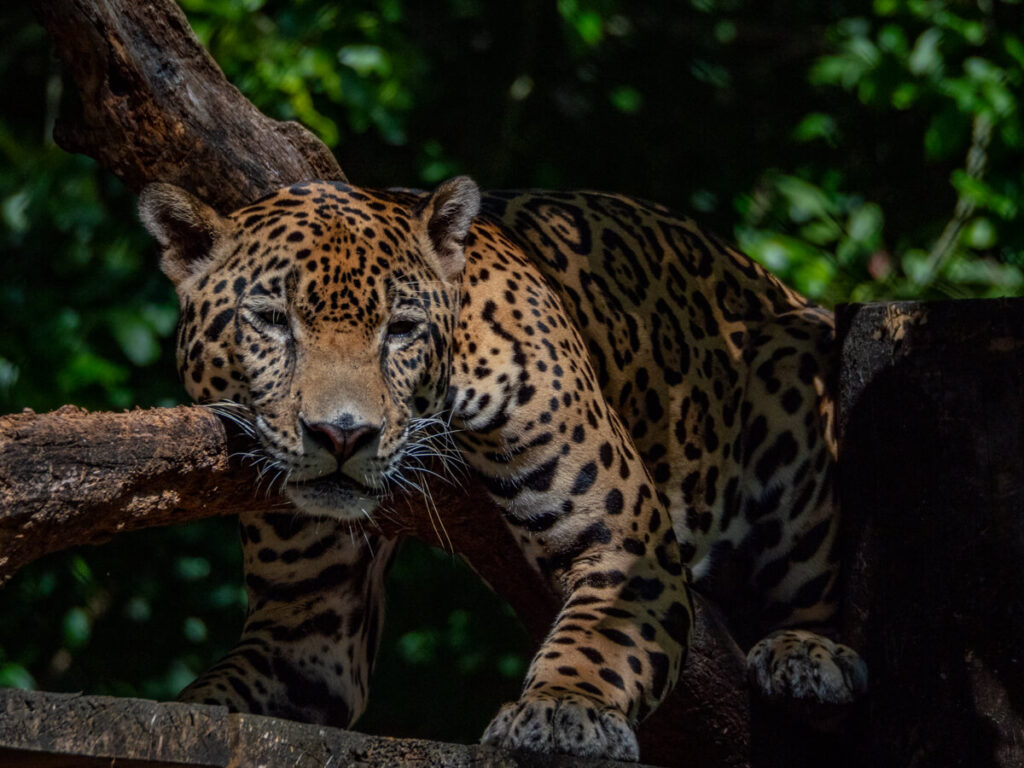
4. Jaguars
Jaguars live in the forests around Tikal, though sightings are extremely rare. They are elusive nocturnal predators, symbolically important to Maya culture, symbolising strength, fertility, and a connection to the underworld.
While you’re unlikely to see one, knowing that they roam the jungle adds an extra element to your visit. If you’re incredibly lucky, you might spot one, especially at dawn or dusk. We got so lucky with a jaguar sighting at Belize’s Cockscomb Basin Wildlife Sanctuary just a week before our Tikal visit, so never say never!
5. Toucans
Toucans are one of the most colourful birds you can see in Tikal, but there are actually three kinds here: the Keel-billed Toucan (iconic for its yellow beak), the Emerald Toucanet (a smaller, mostly green bird), and the Collared Aracari (a small toucan with a red, black, and yellow front). Their rainbow colours and unique bills make them quite distinctive, and you might spot them as they perch in the canopy. They’re often heard before they’re seen, with croaking calls that echo through the forest.

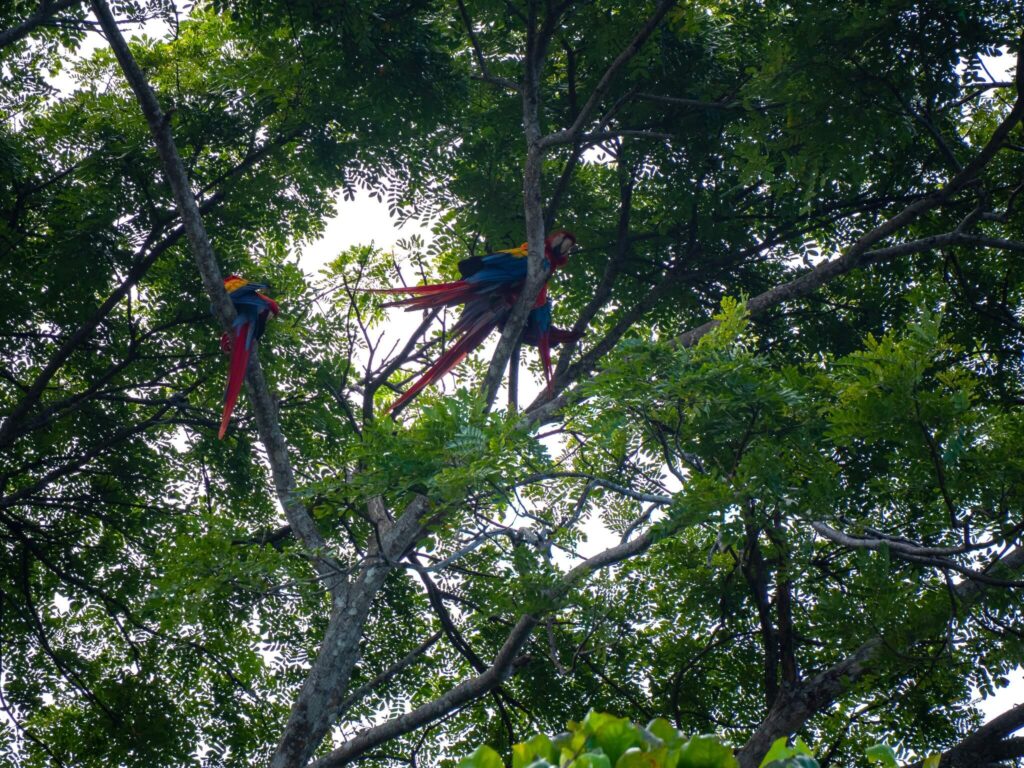
6. Scarlett macaws
Scarlet macaws are another colourful species found in the Tikal area, though they are less common than toucans. These large parrots are striking with their red, yellow, and blue plumage and can sometimes be seen flying in pairs. While they’re not as abundant here as in Copán Mayan Ruins in Honduras, you might hear their loud calls or spot them in the canopy.
7. Ocellated turkeys
Ocellated turkeys are unique to the Yucatán region and are commonly seen in Tikal. Their iridescent feathers shimmer with blue and green, making them far more striking than ordinary turkeys. You might see them strolling calmly around plazas and trails – we spotted one at the park entrance.

8. Tarantulas
Tarantulas are a common sight in Tikal, especially during the rainy season. These large but harmless spiders can sometimes be seen crossing trails or hiding near tree roots. Guides often point them out to visitors who might otherwise miss them, but as an aracnaphobe, there was no way I was going to go out of my way looking for one!

9. Snakes
Several snake species live in Tikal, ranging from harmless varieties to the occasional venomous one. They are rarely seen, as most prefer to stay hidden in the undergrowth, but guides sometimes point out tree snakes or shed skins left along the trails. While the thought of snakes may worry some travellers, encounters are uncommon, especially if you stay on the marked trails as you should, and snakes usually avoid humans.

10. Crocodiles
Crocodiles inhabit the lakes and lagoons around Tikal, including areas just outside the main ruins. There’s even a lake right by the park entrance that’s home to the occasional crocodile sighting. They’re usually spotted basking on the banks or gliding silently through the water. While they keep their distance, it’s important to be cautious near bodies of water.

Where to stay in Tikal National Park
If you want to maximise your time at Tikal Mayan ruins, you can actually stay inside the national park itself. A handful of lodges and hostels are set just a short walk from the entrance, making it easy to join sunrise or sunset tours without worrying about long drives.
Staying inside the park means you’ll hear howler monkeys calling at night and wake up to the sounds of the jungle. The accommodations are rustic compared to city hotels, but the trade-off is the unbeatable location. You’ll also find fewer crowds early in the morning when you’re already inside.
Tikal National Park Hotels

Where to stay in Flores to visit Tikal National Park
If you prefer more comfort and amenities, most visitors base themselves in Flores and take a shuttle to Tikal. The town is only about an hour and a half from the park, and there is a wide range of hotels in Flores, from hostels to boutique stays. You’ll find lakeside hotels with beautiful views, as well as budget-friendly hostels for backpackers. Staying in Flores also gives you access to great restaurants, bars, and cafés – something you won’t find inside the park.
Flores Hotels

Camping in Tikal National Park
For the most adventurous travellers, camping inside Tikal National Park is an option. There’s a designated campground near the park entrance where you can set up a tent for 50Q (~$6.50 USD) a night. This is the cheapest way to spend the night in Tikal, though it’s not for everyone. You can rent a hammock with a mosquito net under a thatched palapa (+50Q) and sleep under the canopy, but it gets very cold and isn’t very comfortable.
Facilities are very simple, with cold showers and pit toilets, but the experience is unbeatable. At night, you’ll fall asleep to the calls of howler monkeys and wake up to coatis running in front of temples at sunrise.

Where to eat near Tikal National Park
No food is allowed within the park, but there are a couple of vendors inside selling Champurradas, Guatemalan cookies.
Dining options inside Tikal are limited, but there are a few comedores (restaurants) and snack bars near the entrance. Many tours stop at one for breakfast or lunch. You can expect simple but hearty food like chicken with rice, beans, and vegetables, or pasta and grilled meats. Prices are higher than in Flores, since everything has to be transported into the park, so some travellers bring their own snacks or pack a lunch to save money.
The park lodges also serve set meals, often included in package deals, with a mix of Guatemalan and international dishes, which is a good option if you’re staying nearby. Several food vendors set up in the car park, too, if you’re after a snack or cheap street food.

Our experience in Tikal National Park
We had the best time in Tikal National Park, and it was a highlight of our trip to Guatemala. Having visited a lot of Mayan sites in Central America, we weren’t sure if it was going to live up to the hype, but it definitely did. The temples were the tallest that we’ve ever seen, and being able to climb up them for panoramic views over the jungle was really special.
The site was incredibly extensive, and in hindsight, we wish we had spent a few days staying near the park so we could have explored every corner. But the tour we did was very good at covering all the main temples and plazas, and our guide was fantastic, sharing so much knowledge about local history, flora, and fauna.
We absolutely loved how many animals there are, too, and saw monkeys, toucans, coatis, and agoutis. We saw many similar animals to those we saw in Manuel Antonio National Park in Costa Rica, which was one of our best wildlife watching days in Central America.

Is Tikal National Park worth it?
Tikal is one of the most impressive archaeological sites in the entire Mayan world and is absolutely worth visiting. The national park is home to towering temples, sprawling plazas, and ancient palaces hidden within the rainforest, but beyond the ruins, the setting itself is breathtaking, with howler monkeys calling from the canopy, toucans flying overhead, and the sheer scale of the jungle all around you.
Sunrise or sunset tours are especially magical, as the mist rolls over the treetops and the temples emerge above the canopy. For many travellers, Tikal is the highlight of a trip to Guatemala and one of those once-in-a-lifetime experiences. If you’re anywhere near the region, it’s absolutely worth carving out a day or two to see Tikal.

Is Tikal National Park safe?
Tikal National Park is considered safe for visitors, especially during the day when the ruins are filled with other travellers and guides. The park is well-staffed with rangers, and tours are highly organised, which adds an extra layer of security. While petty theft can happen in any tourist destination, it’s rare inside the park – just keep an eye on your belongings and avoid leaving valuables unattended.
If you’re travelling independently, stick to the main paths, since the jungle is vast and easy to get lost in. Most shuttles and tours also arrange return trips in the afternoon, so you won’t be wandering in the dark. As long as you take standard travel precautions, visiting Tikal is a safe and unforgettable adventure.

What to pack for Tikal National Park
To ensure an enjoyable and safe experience in Tikal National Park, it’s important to pack the right things. Don’t forget to pack your:

Things you need to know before visiting Tikal National Park
To protect both the cultural and natural environment of Tikal, certain rules must be followed by visitors, including:

Tikal National Park FAQs
To help you plan a smooth and stress-free trip to Tikal National Park, we’ve answered these frequently asked questions.
Why is Tikal so famous?
Tikal is one of the most important archaeological sites of the ancient Mayan civilisation, once a thriving city that reached its peak between 200-900 CE. It’s renowned for its towering temples, some rising more than 60 metres (200 ft) above the jungle canopy, and for its role as a major political, cultural, and military centre. It’s also a national park and unique for being protected both for its cultural heritage and natural abundance.
What can you do at Tikal?
There’s plenty to see and do in Tikal. You can explore dozens of ancient pyramids, palaces, and plazas, many of which are partially restored, while others remain engulfed in the jungle. Select pyramids offer sweeping views of the forest canopy, where howler monkeys and toucans can be spotted. Taking a guided tour brings the ruins to life with stories of Maya rulers, rituals, and battles. While birdwatchers and wildlife enthusiasts also love Tikal for its biodiversity, with hundreds of species inhabiting the park.
Can you buy Tikal tickets at the gate?
You can buy tickets at the park’s boundary, but it’s not technically at the entrance to the Mayan site, meaning you need to be on a shuttle or have your own transport to stop there. The official process is to purchase tickets in advance online or at banks in Flores or Santa Elena. Sunrise and sunset tickets almost always need to be bought the day before, as the ticket office is closed during these time slots.
Do you need your passport to enter Tikal?
Yes, foreign visitors must show their passports when purchasing and presenting their ticket to Tikal. The passport number is printed on the ticket, so carrying it is essential.
How to dress for Tikal?
Comfort is key since you’ll be walking a lot under hot and humid conditions. Lightweight, breathable clothing is best, ideally with long sleeves and pants (trousers) to protect against mosquitoes. Sturdy walking shoes or hiking sandals are highly recommended because some paths can be uneven or muddy. A wide-brimmed hat or cap, sunglasses, and eco-friendly sunscreen will help against the tropical sun. Don’t forget natural insect repellent, especially during the rainy season.
How much walking is needed for Tikal?
Exploring the main temples and plazas usually involves walking 2.5-4 miles (4-6 km). The trails are mostly flat but can feel long in the heat, and climbing temples adds a lot of stairs to your day. If you want to see more remote complexes like Mundo Perdido or the Plaza of the Seven Temples, expect to add a few extra miles.
Can you hire a guide at Tikal?
Guides are normally available at the entrance and can be hired on the spot, but their presence isn’t always guaranteed, so it’s best to arrange one in advance. Prices vary depending on whether you’re in a group or want a private tour, but expect around $25-40 USD in the daytime and more for sunrise or sunset.
What is the difference between Machu Picchu and Tikal?
While both Tikal and Machu Picchu are UNESCO World Heritage sites and iconic archaeological wonders, they represent very different civilisations. Machu Picchu in Peru was built by the Inca in the 15th century and sits high in the Andes Mountains, while Tikal dates back to as early as 400 BCE and is hidden deep in the Guatemalan rainforest. Machu Picchu is more compact but perched dramatically on a mountain ridge, while Tikal is sprawling, with temples spread across a vast jungle park. Machu Picchu has tighter visitor controls, while Tikal feels wilder and more open to exploration.

Read next:
The Top Tikal Tours: Sunrise vs Sunset vs Daytime
Travel Guide to Flores: Guatemala’s Rainbow Island with Rainforests & Ruins
20 Fantastic Things to Do in Flores
Where to Stay in Flores: 18 Best Hotels For Every Budget & Traveller Type
12 Best Cafés, Bars, and Restaurants in Flores
How to Visit ARCAS: Guatemala’s First Wildlife Rescue & Rehabilitation Centre
Our Guatemala Destination Guides:
Our Guatemala Travel Guides:
