What it’s Really Like Hiking Acatenango Volcano: Our Experience + Wicho & Charlie’s Review

A step-by-step itinerary of exactly what to expect on the Acatenango Volcano hike, plus our honest Wicho & Charlie’s review.

This post may contain affiliate links, which means we might earn a small commission on anything purchased through these links at no extra cost to you. Learn more on our disclaimer page.
Hiking Acatenango Volcano is one of the best things to do in Antigua, and we’re pleased to report it’s also one of those travel experiences that truly lives up to the hype. From the first steep steps through farmland to watching Fuego Volcano erupt under a blanket of stars, it’s an adventure that tests your limits and rewards you with some of the most dramatic views in Central America.
We recently joined the Acatenango overnight hike with Wicho & Charlie’s, one of the most popular tour companies in Antigua, to see what the experience is really like. In this post, we share our honest account of the Acatenango hike – what to expect on the overnight tour, what it’s like staying at base camp, and whether Wicho & Charlie’s lives up to its reputation. We’ve also broken down the Acatenango hike itinerary, with step-by-step descriptions about each stage of the hike, to help you gauge how tough it really is and exactly what it’s like to hike the third-highest volcano in Central America.
More from Acatenango Volcano
Acatenango Volcano Hike Summary
Consisting of a 5-hour, steep ascent through farmland, cloud forest, and volcanic scree to the base camp near the summit, the guided overnight Acatenango tour is a challenging but rewarding experience near Antigua, Guatemala.
It’s considered one of the best things to do in Guatemala, but it’s not for everyone. To give you an idea of the difficulty level of hiking Acatenango Volcano, regardless of your operator, we’ve popped some stats below.

Acatenango Overnight Hike Itinerary
While the guided overnight Acatenango Volcano tour experience can vary depending on your operator, most companies roughly follow the same schedule. If you’re thinking of doing the trek on your Guatemala trip, to give you an idea of what it’s like hiking Acatenango Volcano, here’s the itinerary most tours follow:
Day 1
Day 2

What to expect hiking Acatenango Volcano
The Acatenango hike is one of the best day trips from Antigua, but it’s usually done in two days. The trail climbs steeply from around 2,400 metres (7,800 ft) at the base to 3,976 metres (13,044 ft) at the summit, passing through a series of dramatically different landscapes.
Most operators break the hike into four main stages, reaching base camp where you sleep in about 4 to 6 hours, depending on your pace:
Most tours also offer an optional sunset hike to Fuego Ridge, where you can get even closer to Fuego’s crater, sometimes within a kilometre of the eruptions. It’s one of the best places in Guatemala to see lava. But it’s an extra 4-5 hours round-trip from base camp and is only recommended for experienced hikers or when volcanic activity is deemed safe (although most people do it and many operators go out there despite safety warnings, too).
Other companies might take you on shorter walks to nearby viewpoints, especially if there’s no Fuego activity or if the gases are too toxic to get up close.
Some travellers choose to skip the sunset hike and save energy for the Acatenango sunrise summit. This is a challenging stretch that climbs to the top of the volcano for panoramic views at sunrise.
Obviously, you’ve also got to descend the volcano on Day 2 as well.
We’ve done a full breakdown of the hike below, hour by hour, so you know what to expect.

Day 1 of the Acatenango Overnight Hike
To give you a realistic idea of what it’s actually like to do the guided overnight Acatenango tour, we made loads of notes on our trip and have written it all up into a detailed itinerary. We took a tour up Acatenango with Wicho & Charlie’s, but the process is pretty similar for all the other operators, too.
Meeting our tour operator
On the morning of your tour, you’ll meet your operator. Not all tours include direct pick-up from your hotel in Antigua, so you’ll usually meet at their office in Antigua at around 6.30 AM. Some may have a pre-hike briefing the evening before.
When we arrived at Wicho & Charlie’s, we were given name tags, met with tea, coffee, and an energy juice shot, provided a light breakfast (bread rolls with jam or Nutella, bananas, etc.), and we milled about, meeting others in our group. Then, we were given a briefing on the hike, what to expect, and what the next two days would be like.

Acatenango Volcano hike briefing
A big part of preparing for the hike is getting your bags in order, sorting out rental gear, and packing. Wicho & Charlie’s are great because they provide so much equipment for free, with lots of extra options to rent.
The price of the hike includes the rental of warm clothing like jackets, fleeces, gloves, woolly hats, buffs, and scarves. You can also rent hiking poles (absolutely necessary), a headlamp (recommended), thick socks (also needed), backpacks (if you don’t have your own), water bottles (carry as many as you can), and other equipment if needed. It is a bit of a free-for-all, working on a first-come, first-served basis as you sift through the racks, so get in there quickly.
Wicho & Charlie’s also provide a DIY trail mix bar, where you can make up a snack bag of pretzels, nuts, fruits, and chocolate chips. After you’ve got all your gear and packed it, you hand it in, and it’s packed into the truck.

Transfer to Acatenango Volcano
You’ll hop in the shuttle for the drive to La Soledad, a small village about an hour from Antigua. This is where the trail starts.
On the drive, you’ll pass Mayan villages and see the volcano looming in the distance on clear days. At the trailhead, there are restrooms (bring cash as they’re about 5-10Q) and stick rental (get trekking poles with your operator instead).
The sun is strong, so suncream is a must, but you’re already at an elevation of 2,400 metres (7,874 feet), so the air temperature may feel cooler. We had luckily included layers on our Acatenango packing list and were in jumpers until we started the hike.

Hiking Acatenango Volcano
The first part of the Acatenango hike starts with a dusty trail, cutting through farmland and open slopes.
Guides usually take it slow here to help everyone acclimatise. Farmers still work these plots, growing corn and beans in the volcanic soil, and you’ll often see locals carrying heavy loads with ease, which puts you to shame a little.

The path starts to climb, becoming a steeper ascent, and you’ll likely be sweating within the first 20 minutes. This is arguably the hardest part of the whole hike – physically.
You pass through farm fields on the same trail used by local villagers each morning to access their corn, snow pea, and lily fields. It’s steep and slippy, but you get great views back to the village.

Not too long after, you’ll start to see lush vegetation that marks the start of the forest area. Depending on the time of year you hike, you might see mist drifting through the trees, colourful wildflowers, or even fresh green shoots after the rainy season. But the dry season is the best time to visit Guatemala for good hiking conditions.
As you go on, you might start splitting into two or more sub-groups if paces differ. Typically, there will be a fast group who want to get up as soon as possible, a slower set of people finding it more challenging, and then a whole host of hikers in between. We kept falling back a bit as we stopped so much to take photos.

After about an hour of hiking, you’ll enter a tropical cloud forest, where tall trees and hanging moss create a cool, misty canopy. This is one of the most beautiful parts of the hike, with birds chirping, filtered sunlight, and a noticeable drop in temperature.
The path becomes more up and down here, and the air starts to get thinner as you get higher, but the shade makes it more manageable, as you’re out of the scorching sun.
In this environmental zone, you’ll see some of Acatenango’s oldest trees and floral biodiversity. There is plenty of wildlife, although it’s elusive, so you might not see many Guatemalan animals. This type of high-alpine cloud forest is home to the iconic resplendent quetzal, although we didn’t see one until we reached Costa Rica later in our trip.

One thing we were really surprised by was how many stray dogs we met on the trail. They’ve clearly learned to associate the climbers with food and water and will accompany you the whole way up the volcano! They’re super cute and really help with morale as the climb gets tougher. We thought they were like our spirit guides.
We wish we’d known so we could have brought some dog treats with us, but they seemed thirstier than they were hungry. We tried to share as much of our water with them as possible, and we would highly recommend you bring a little extra to share with them. It was the least we could do to say thank you for accompanying us. By day 2, we’d fashioned a bowl out of a water bottle, so we could stop for every stray we came across and offer them some water.

As you climb, you’ll stop every 30 minutes or so at small rest areas, where groups of vendors gather selling snacks and drinks. There are several stops with compost toilets, too (bring toilet paper and hand sanitiser).
As you keep going, the pace gets slower, and hiking poles become more and more useful. The trail in the middle here gets flatter, with more gentle ups and downs, but it’s harder due to the altitude.
You’ll also start to get views opening up through the trees – or you might just see fields of rolling, fluffy clouds.

Lunch on Acatenango Volcano
Just before lunch was the hardest part for me, although Dan suffered the most after. While it’s technically easier than the first section, as it’s not as steep, I was really starting to feel the altitude, making me lightheaded.
Luckily, lunch is your longest break, with some nice shady forest areas to sit in (try to sit out of the sun). The temperature was really weird – the sun was super strong, but we got a little chilly and put our hoodies back on.
Wicho & Charlie’s had prepped us with a delicious and nutritious pasta with lots of veggies and dressing (vegan), which was exactly the fuel we needed to keep going.

After lunch, you get the best views of the hike so far. The trail navigates the edge of the volcano, and you get clear views across the highlands to other volcanoes, including Atitlan, Toliman, San Pedro, Santa Maria, Santo Tomas, and Tajamulco, along with glimpses of the Cuchumatanes Mountain chain.
It was at this point that we started to think, “yeah, this hike is probably worth it for these views alone!”. Honestly, they’re some of the most stunning hiking views we’ve ever seen.

Altitude sickness when climbing Acatenango Volcano
Hiking at altitude affects everybody differently, and we think we feel it particularly badly. You’re more likely to get altitude sickness if you previously had it, and we knew that we’d suffered some effects in Mexico City, which is only at an elevation of 2,240 metres (7,350 ft), so we were expecting it on this hike.
I started to feel lightheaded, which progressed to mild dizziness, and Dan started to feel it in his lungs (he’s got mild asthma) with an increased heart rate. It wasn’t too bad, but it meant we were walking a lot slower than we would usually and had to stop much more frequently than normal, to catch our breath, allow our heart rates to decrease, and to summon the will to keep putting one foot in front of the other.
Physically, it wasn’t too bad. I felt some soreness in my calves and rubbed through my thick socks on the toes, and Dan struggled a bit with his knees, especially on downhill portions. But the altitude became more of a challenge than the walking.

Carrying our backpacks up Acatenango Volcano
At about 80% of the way to basecamp, we met the 4x4s that had driven our backpacks up the volcano. From here, Dan carried our large backpack, and I carried the two day rucksacks.
The landscapes are really beautiful at this point. You pass temperate coniferous forests and tropical dry forests. This is the final phase of the ascent before the storm-beaten tree line of the volcano that leads to base camp.

Acatenango Volcano Base Camp
Soon enough, we were met by the ‘Bienvenidos!’ welcome sign that marks the entrance to the Acatenango base camp! It was a very happy sight with lots of people cheering and celebrating.
This point marks the boundary of the protected area referred to as the ‘vista tres volcanoes’ (three volcanoes view). There’s an entrance fee (which will have been included in your tour price), and you can’t enter without a guide (but you’ll be with one in your group anyway).
From here, there’s still a little walk to your base camp – each operator has a different plot of land – but it’s not too far now.

Including walking, stopping, and lunch, we were hiking for about 4 hours and 40 minutes and were in our cabins within 5 hours of leaving the trailhead.
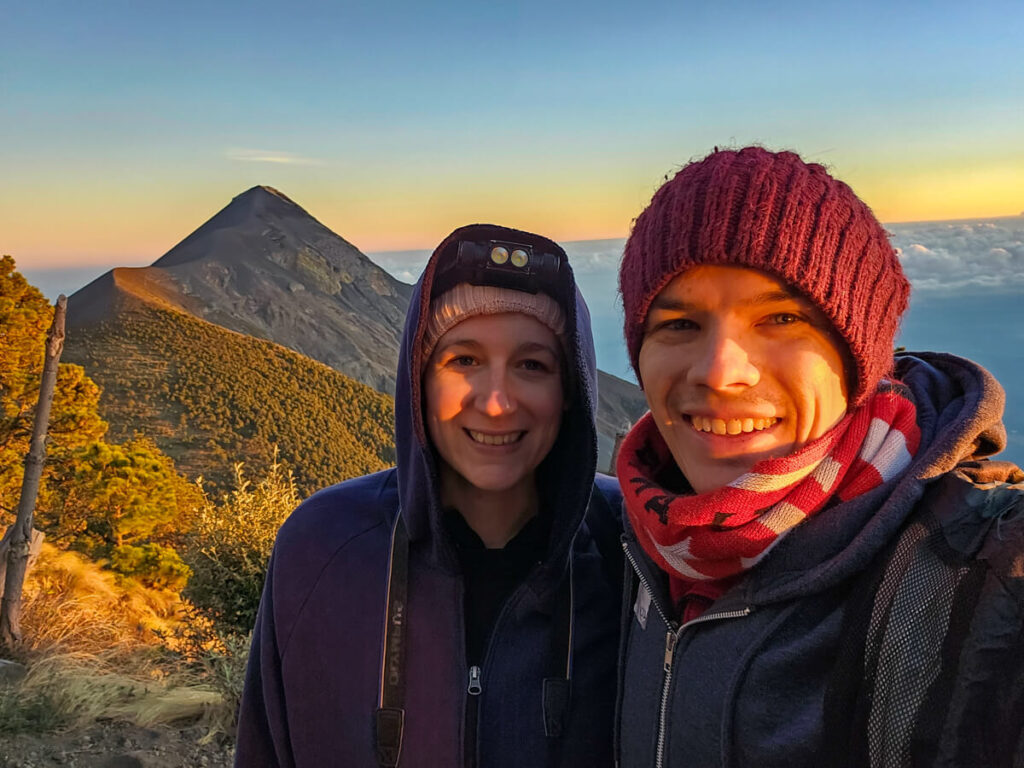
No written words can describe the feeling of reaching base camp. We were so lucky and immediately arrived to views of Fuego Volcano! It was majestically sticking out of the clouds, and we could see it right from base camp, where seats were scattered around with direct views.
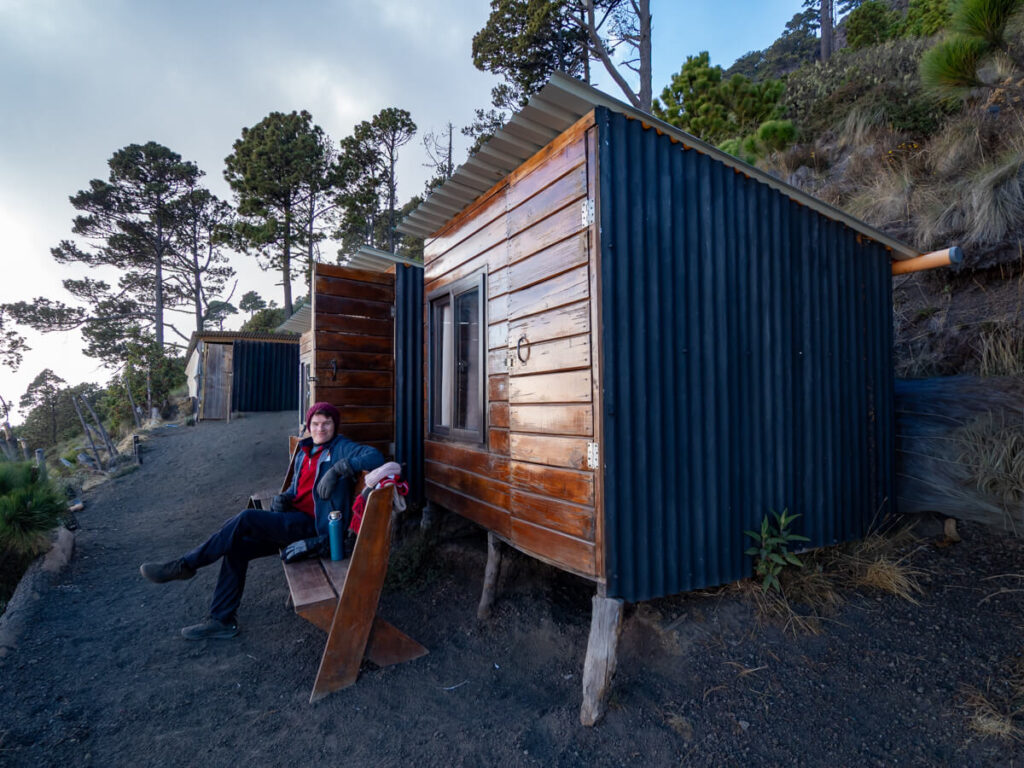
After everyone arrived, we were led to our cabins – dorms were lower down the slope, while private cabins required a few flights of stairs (which was so hard with the altitude sucking out all our energy, but the excitement of seeing Fuego carried us through).
Within 20 minutes, Fuego was completely obscured by clouds. The weather can change so quickly, so you really have to seize the opportunity when it comes along – get those photos when it’s clear!

Base camp is colder than the trail in the beating sun, so make sure you bring lots of warm layers.
Because we’d booked so last-minute, our only option had been a private cabin. It was more money than we’d anticipated spending on the hike, but it ended up being so worth it, and we’d highly recommend splurging on one if you can. It had roll mats, blankets, and sleeping bags in it and was so cosy. We had our own little bench outside, and we had direct views of Fuego through the window from our beds! It was such an awesome way to spend our anniversary, and a great option for couples.
Acatenango Volcano Sunset Hikes
You get a little time to rest and explore before the sunset hike option.
The guides determine who is eligible to do the sunset hike based on the time it took you to complete the main hike. Almost everyone in our group made it up within the time window, meaning nearly all of us could do the sunset hike.
There are actually two options for sunset. The main one is the one everyone knows – climbing the ridge of Fuego Volcano to get closer to the summit to see lava erupt. Another option is closer to base camp, taking you to a viewpoint where you can see the sun go down in the west, bathing Fuego in golden light.
Almost all tours do the Fuego option, which is a highlight of the Acatenango hike, but the second option is good for occasions when the gases on Fuego are too toxic or when Fuego just isn’t erupting. Most tour companies charge extra for these hikes, but you pay when you get back to the office, so you don’t need to decide if you’re doing them until you’re there.

The Fuego Ridge Hike
The classic Fuego Volcano hike starts at around 4:30 PM. Because not everyone does it, it’s an additional 250Q (~$32 USD) per person (paid at the office on return to Antigua).
You actually start with a descent, climbing back down Acatenango along the trail to Fuego. Then, you start an even steeper ascent. It gets dark as you walk, so having a headtorch is absolutely imperative – a phone torch won’t cut it. Hiking in the dark is pretty risky, so you need to be careful and leave your hands free.
If your visit coincides with volcanic activity, you’ll see lava spewing from the summit. It’s a once-in-a-lifetime sight. It’s also insanely cold, so you’ll need to wrap up warm and wear proper thermal gloves. The hike is about 5 hours round-trip, with about an hour at the top, so you’ll get back to base camp around 9:30 PM for dinner.
We need to highlight the importance of choosing a reputable Acatenango tour company here, as the gases were deemed too unsafe to do the Fuego hike on our visit, so our group did the viewpoint hike for sunset. But we still saw several other groups climbing down Fuego in the dark, meaning other operators had taken their groups up Fuego, despite the toxic fumes warning.

What if Fuego’s not active?
If Fuego’s not active, or the activity is too strong or gases are too toxic to get close, you can do an alternative sunset hike. The shorter sunset hike we did is an additional 100Q (~$13 USD) per person.
Our guides said it’s easy – easy by Guatemalan standards, maybe, because it wasn’t what we’d call easy! This is a 45-minute round-trip trail (but it took us about 3 hours, with lots of time at the lookout) and much easier than the Fuego route, but we’d still call it an intermediate hike, as it was quite slippery with ups and downs. We did get the most beautiful views, watching the sun sink into the clouds, eruptions of gas and ash coming off Fuego, and bright oranges, purples, and pinks blazing across the sky.

Can you see Fuego from Acatenango base camp?
If you don’t have the energy or want to spend extra, several camps have a view of Fuego, so you can see the show without having to do any more hiking. We had the clearest view of Fuego from our camp with Wicho & Charlie’s, and could even see it from the window of our cabin!
We’ve heard of people doing the Fuego hike just to have a cloudy view and missing eruptions on their return to base camp, so you’re not necessarily guaranteed the best view just by doing the additional hikes.

Dinner on Acatenango Volcano
When we arrived back at base camp, we were met with mugs of hot chocolate made with Mayan cacao around a crackling log fire – exactly what we needed.
Most tour companies serve a simple but hearty hot meal for dinner – ours was traditional Guatemalan cuisine of rice, beans, sweetcorn, totopos (tortilla chips), soy mince, chirmol (like salsa), and hot sauce (salsa verde) – delicious.
As temperatures drop sharply after sunset (often below freezing), everyone gathers around the campfire in hats and gloves, swapping stories and deciding whether or not to do the sunrise hike the next day while toasting marshmallows on the fire.

Sleeping on Acatenango Volcano
On active nights, you’ll see bright bursts of lava shoot into the sky from Fuego every few minutes, followed by a deep rumble that echoes through the valley. You might even spot lava flows snaking down its sides in the darkness. If you have a clear night, you’ll see the most amazing display of stars in the sky, too.
Sleeping on Acatenango is challenging. Most groups camp in shared tents already set up at base camp, with basic foam mats and thick sleeping bags provided. You need to wrap up warmly in your sleeping bag (we’d recommend one blanket underneath you and one on top) and wear a woollly hat.
It’s not exactly a restful sleep, between the cold, the altitude, and the occasional boom from Fuego. Sleeping at altitude is hard anyway, thanks to the lack of oxygen, and you’ve not had a lot of time to adjust. Expect your brain to be awake and to drift in and out rather than sleep deeply.
We also found that our altitude sickness symptoms worsened at night. Even climbing a flight of stairs to the toilet block was difficult, requiring me to stop and catch my breath halfway up. We both also started to feel nauseous.

Day 2 of the Acatenango Overnight Hike
Neither of us got much sleep, so it was with bleary eyes that we heralded the dawn of Day 2 of our Acatenango overnight hike.

Acatenango Volcano Sunrise Hike
The Acatenango sunrise hike leaves at around 4:00 AM and is included in the price of the tour, so it’s free (although some other companies do charge for it).
We set our alarms for 3:30 AM, fully intending to join the sunrise hike, having major FOMO about missing what’s supposed to be the most spectacular view of the volcanoes. But we simply felt too crappy to do it – and we weren’t the only ones.

Despite most people in our group wanting to do the sunrise hike, only 4 people actually did it – everyone else had felt as shoddy as we did and skipped it too.
Those who did the hike told us it was incredible watching the sunrise over the volcanoes, but that it was much harder than any of the trails we’d done so far. It took them about 1 and a half hours to climb up, but only 20 minutes to get back down. The trail is super steep scree, and for every two steps up, you slide one step back down. The path is super slippery, and your feet sink into the volcanic ash with every step.
Instead, we stayed in bed, resetting our alarms around 5:45 AM for sunrise from base camp.

In the end, we knew we’d made the right decision not to do the sunrise hike. But even better, we didn’t feel like we missed out!
The view from the Wicho & Charlie’s camp when we got up was so clear, we had the most insane views of Fuego without a cloud in sight. We could even see Pacaya Volcano, Agua Volcano, and Antigua, with the sun popping up on the horizon.
Our photos of the view were VERY similar to the photos we saw from the guys who had done the sunrise hike, just slightly lower down without views to Atitlán (but we did see that on the hike later) – and we hadn’t even had to leave base camp. Controversially, unless you really want to do the sunrise hike, we don’t think you need to.

Breakfast on Acatenango Volcano
Breakfast is served as the sunrise hike group returns at about 6:30-7:00 AM. We had tea and coffee alongside delicious breakfast burritos, but I was still feeling a bit too nauseous to enjoy it all. Herbal tea helped, though.
To be honest, I was more keen to sit outside and soak up the views of the first light spilling over the volcanic peaks with our doggie friends. The Acatenango Volcano hike is worth it without lava from Fuego, just for those views at sunrise.

Descending Acatenango Volcano
Soon enough, it was time to say a sad goodbye to base camp and descend Acatenango. It’s a bit of a slip and slide on the way down and truly treacherous in some parts. People were falling over, cutting themselves on sharp volcanic rocks, and one guy in sneakers (trainers) was really struggling to get any grip at all. You’ll find yourself half-sliding, half-jogging down the steep sections, using trekking poles (an absolute necessity) for balance.
But, as you get lower, the air thickens and altitude symptoms lift, and you start to feel human again! The air warms up, and you get the most incredible views of the surrounding volcanoes. It was one of the most incredible parts of the hike with some of the best views we’ve ever seen.
Towards the bottom, the trail gives way to the ashy slopes you started the climb on. A buff is necessary here, as it gets incredibly dusty.

Returning to Antigua
Far too soon, you’re at the bottom of the volcano, where your shuttle will be waiting to whisk you back to Antigua.
You’ll go back to the office, where you can unpack your bags, pick up anything you stored with the company, and pay your final bill for the extra hikes and gear rental.
It’s a weird feeling being back in a city, knowing just hours before you were on top of an active volcano. We’d recommend heading to one of Antigua’s restaurants and bars for a celebratory dinner.

Don’t forget travel insurance!
While hiking Acatenango is generally safe with the right preparation and a reputable tour company, accidents and unexpected events can still happen, from altitude sickness and twisted ankles to lost gear or sudden weather changes. That’s why having comprehensive travel insurance is absolutely essential. Here are our top providers:
Compare Policies: 6 Best Travel Insurance Companies for Every Kind of Trip
Our Wicho & Charlie’s review
Wicho & Charlie’s is one of the most popular and professional tour operators for the Acatenango hike, known for their excellent organisation and sustainable travel approach. They offer well-maintained gear, warm sleeping bags, and cosy cabins with some of the best volcano views from camp.
Their English-speaking guides are highly experienced, with a strong focus on safety and altitude management, ensuring hikers are properly acclimatised and supported. We had enough guides with our group that we could split up into smaller groups to accommodate everyone’s pace. They were also really good at encouraging us to keep going when it got tough.
Meals are surprisingly good for a mountain trek, being nutritious, filling, and completely vegan. Not having to worry about what we were eating and if it had meat in it was a huge plus for us. We also loved the evening hot chocolate, which we managed to find in Ek Chuah while shopping in Antigua, so we could bring some home.
The accommodation is one of the best in the mountains. We ended up booking a private cabin, as the dorms were fully booked, but actually, we’d recommend that option if you can splurge. Having our own cabin with views of Fuego was absolutely dreamy and helped us manage the altitude symptoms, too.
Wicho & Charlie’s also have an office in Antigua, where you can rent high-quality hiking gear, like warm clothing and trekking poles. This was really useful for us, as we were halfway through our second Central America backpacking trip and didn’t have any warm clothing or serious hiking gear in our small backpacks.
The only thing we’d note is that we didn’t really receive any commentary on the volcanoes or their history, and it would have been nice to learn a bit about what we were seeing.
But we really love that they’re Guatemalan-owned, currently employ 98% Guatemalan staff, and pride themselves on giving back to their community.
Overall, we had a really great time on the overnight Acatenango hike with Wicho & Charlie’s, and we’d highly recommend booking with them when planning your Guatemala itinerary.

Hiking Acatenango Volcano Video
We made a little Instagram Reel of our experience hiking Acatenango Volcano, along with some lessons we learned, which you can watch below.
Be sure to follow our Instagram Account for real-time travel tips and advice, as well as handy destination mini-guides, before we get around to publishing our thorough posts on here.
Useful information for hiking Acatenango
Prepare for your Acatenango trip with our travel guides:

Read next:
How to Get to Antigua + How to Get Around
Where to Stay in Antigua: 18 Best Hotels From Budget to Boujee
28 Best Restaurants in Antigua
7 Gorgeous Cafés and Coffee Shops in Antigua
18 Churches, Convents, Colonial Landmarks & Ruins in Antigua
How to Visit Pacaya Volcano + Is it Even Worth it?
How to Hike to Cerro de La Cruz in Antigua
A Complete Guide to Visiting Hobbitenango
Our Guatemala Destination Guides:
Our Guatemala Travel Guides:
