Where to see Quetzals in Costa Rica: Monteverde and More

Everything you need to know about spotting Costa Rica’s Resplendent Quetzal in Monteverde Cloud Forest and beyond.

This post may contain affiliate links, which means we might earn a small commission on anything purchased through these links at no extra cost to you. Learn more on our disclaimer page.
Seeing quetzals in Costa Rica is on many travellers’ bucket lists, but it is hard to accomplish. Nicknamed the jewel of the forest, these brightly coloured birds are elusive and seeing one is rare. Despite their emerald and ruby colouring, quetzals blend in well with the forest around them. We had the pleasure of seeing a resplendent quetzal in Monteverde on a guided birdwatching tour. It’s hard to know where to look for one, so we’ve put this quetzal spotting guide together to give you all the information you need to know so you too can see a quetzal in Monteverde or further afield on your next trip to Costa Rica. Discover the top 10 places to see a quetzal in Costa Rica, how to maximise your chances of a sighting, and which tours to book in this complete guide.
Costa Rica’s quetzals at a glance

More from Montezuma
What is a quetzal?
A quetzal is a small, brightly coloured bird that is found in mountainous cloud forests. They are usually between 36 to 40 cm (14-16 in) tall and are known for having very long tail feathers.
Quetzals are famous for their iridescent plumage, which has led to them being nicknamed the ‘jewel of the forest’. The colour of a quetzal depends on its sex. Males have iridescent green plumes, a red lower breast and belly, black innerwings and a white undertail. While females are duller with grey lower breasts, bellies and bills, along with bronze-green heads, and a shorter tail.
Quetzals belong to the trogon family. There are 6 types of quetzal:
The colour of a quetzal’s tail is caused by melanin. Their feathers are actually a brown translucent colour, and the melanin traps and reflects the colours of the rainforest that we then see. You can see this in the photo below, where one feather appears blue-green and the other brown.

Where is the quetzal mainly found?
Quetzals are found throughout Central America, from southern Mexico to northwestern Panama. Countries where you can see quetzals include Mexico, Guatemala, Honduras, El Salvador, Nicaragua, and Costa Rica.
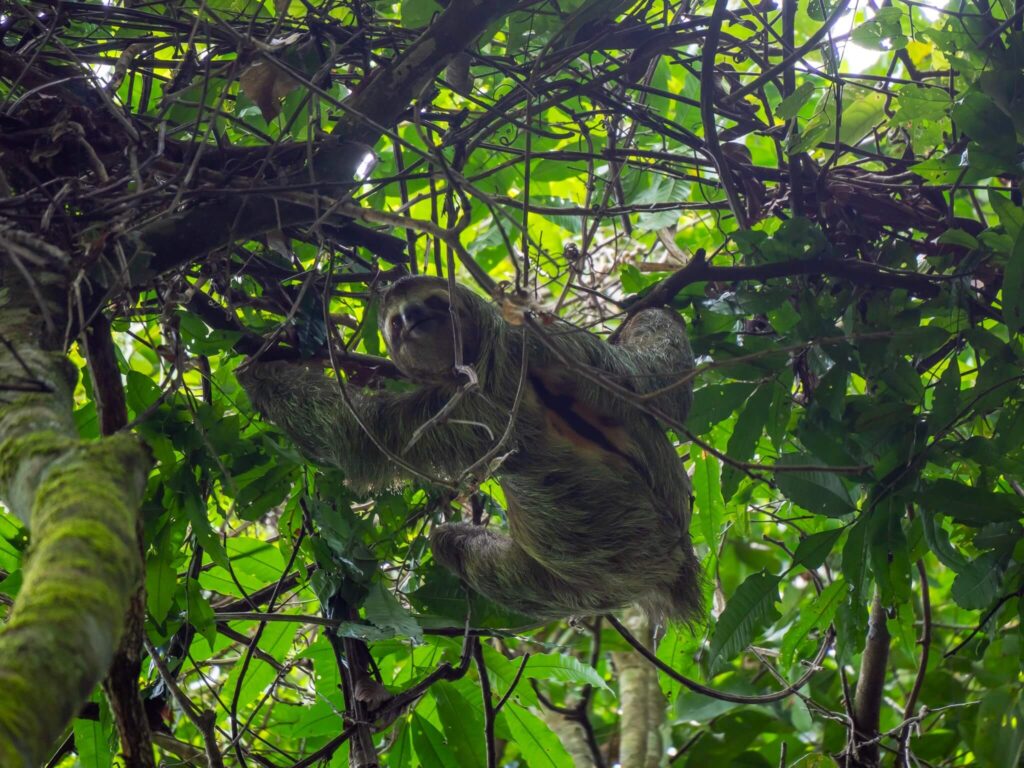
Costa Rica is one of the best places in the world to see the resplendent quetzal. The Resplendent Quetzal (simply Quetzal or Feníx del Bosque in Spanish) is a unique subspecies found mainly in cloud forests. Other species are also found in these biologically rich habitats, including sloths and monkeys.

Are there quetzals in Costa Rica?
Costa Rica is a popular ecotourism destination due to its many areas of protected habitat, which means Costa Rica has a large population of quetzals.
Quetzals rear their babies in hollow holes or decaying trees. Costa Rica quetzals make their nests over 60 metres (200 ft) up in the air, often in dense cloud forests. These holes are often second-hand homes, which quetzals enlarge from woodpecker and toucan nests.
Due to being one of the most biodiverse areas on the planet, Costa Rica has several areas that are perfect quetzal habitats.

The best Costa Rica quetzal tours
The best places to see quetzals in Costa Rica
Resplendent quetzals are altitudinal migrants, meaning they move from the slopes to the canopy of the forest annually. This migration occurs during the breeding season. Quetzals require certain conditions for nesting and foraging, so they are only found in very specific kinds of forested areas. Resplendent quetzals are found at altitudes between 900-3200 m (3000-10,500 ft) of elevation. They are most frequently found in humid highlands that have a moist climate and cloud-laden forests.
Resplendent quetzals also inhabit areas that are incredibly biodiverse and rich in unique plants and animals. Because of this, Monteverde is one of the best places to see quetzals in Costa Rica.
Don’t have time to read the list?

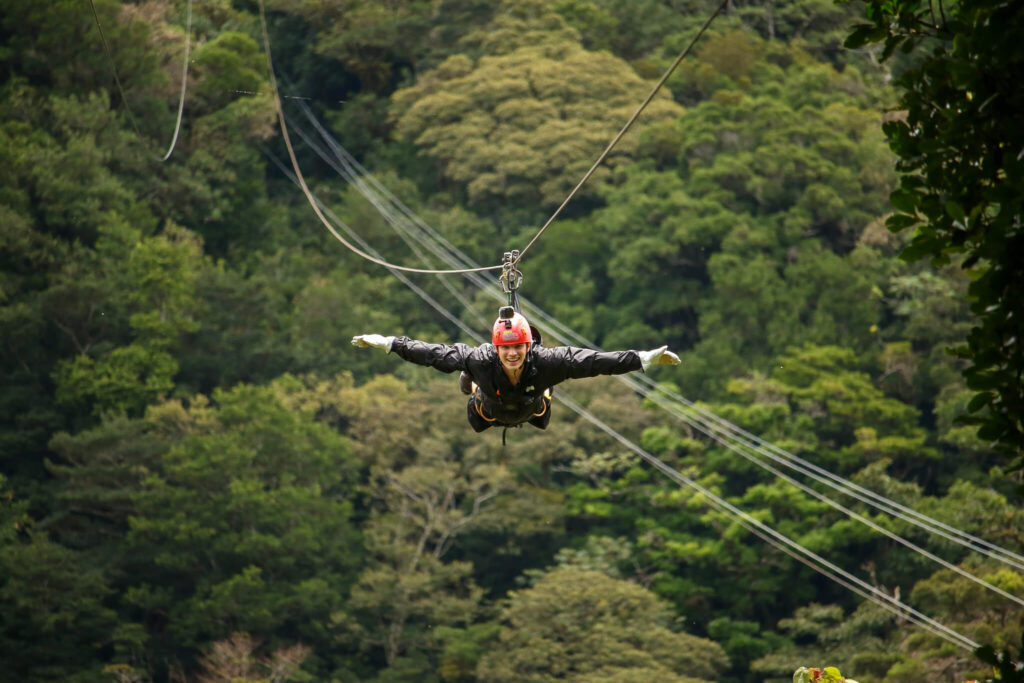
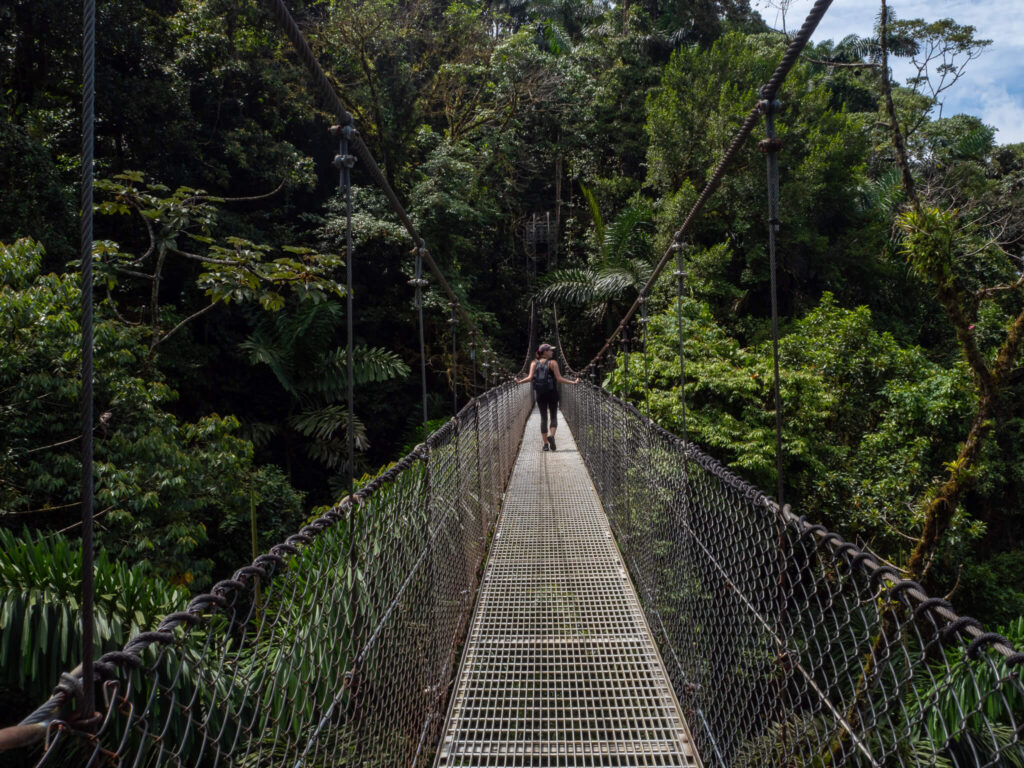
The best places in Costa Rica to see quetzals are in high-altitude rainforests. These can be found all over the country, and we’ve compiled a list of the best spots below. Typically, national parks and protected reserves are best for seeing quetzals. But several hanging bridges parks in Costa Rica not only offer adrenaline activities like ziplining but also the chance to see a quetzal in their protected reserves. Often, these adventure parks have hanging bridges (suspension bridges that allow you to look into the canopy at eye level), which is a great way to see birds like quetzals in the canopy. Here are the top 10 places in Costa Rica to see quetzals.
1. Monteverde Cloud Forest
Renowned for its biodiversity, Monteverde is one of the best places to see quetzals in Costa Rica. A popular ecotourism and adventure activity destination, there are several areas of cloud forest in Monteverde where quetzals can be found. The Monteverde Cloud Forest Biological Preserve‘s dense canopy and high-altitude climate make it a prime habitat for these elusive birds.
2. Santa Elena Cloud Forest
Less crowded than Monteverde, Santa Elena Cloud Forest Reserve provides a quieter, equally lush and misty environment where quetzals are often spotted among the moss-draped trees.
3. The Children’s Eternal Rainforest
This vast protected area, dedicated to conservation and education, is home to diverse wildlife, including quetzals that thrive in its rich rainforest ecosystem. The Children’s Eternal Rainforest is about halfway between Monteverde and La Fortuna.
4. Curi-Cancha Reserve
Known as a birdwatcher’s paradise, Curi-Cancha Reserve offers well-maintained trails through cloud forest and open areas where quetzals can often be seen feeding on wild avocados.
5. Los Quetzales National Park
True to its name, Los Quetzales National Park (Parque Nacional Los Quetzales) is a reliable spot for seeing quetzals and is conveniently located within 2 hours of San José, making it perfect for a day trip from the capital.
6. San Gerardo de Dota
Nestled in the Talamanca Mountains, this quiet village is a top birding destination where quetzals are frequently sighted, especially during their breeding season. San Gerardo de Dota National Park is a tropical cloud forest and one of the best places to see quetzals in Costa Rica.
7. Savegre River Valley
This scenic valley offers cool, misty cloud forests and is a favourite among birding enthusiasts searching for quetzals among the ancient oak trees.
8. Sky Adventures
Sky Adventures offers canopy tours and hanging bridges that let you explore the treetops, increasing your chances of spotting quetzals in their natural habitat. The park also has a zipline course and an Aerial Sky Tram.
9. Selvatura
Selvatura Adventure Park’s hanging bridges and private cloud forest reserve allow visitors to observe quetzals while walking high above the forest floor, making it a unique birdwatching experience. They also have a fun canopy ziplining course.
10. 100% Aventura
While best known for adrenaline-filled ziplines, 100% Aventura also provides access to cloud forest trails where lucky visitors may catch a glimpse of a quetzal.
Other locations
Other places in Costa Rica where you could see a quetzal include Cerro de la Muerte, the Poas area, Bajos del Toro, and various other sites in the Talamanca mountain range.
When to see quetzals in Costa Rica
The best way to see a resplendent quetzal is during the quetzal breeding season. At this time, quetzals are active, mating, nesting, incubating eggs and raising chicks. The time of year this happens varies depending on location. Breeding season typically lasts from March to April in Mexico, May to June in El Salvador, and March to May in Guatemala. In Costa Rica, the quetzal breeding season takes place between February to July each year.
The best time to see quetzals in Costa Rica is in the middle of this season, which coincides with wild avocado and fig fruiting (some of quetzals’ favourite foods), between February and May. Outside of mating season, quetzals live on their own.
When can you see quetzals in Monteverde?
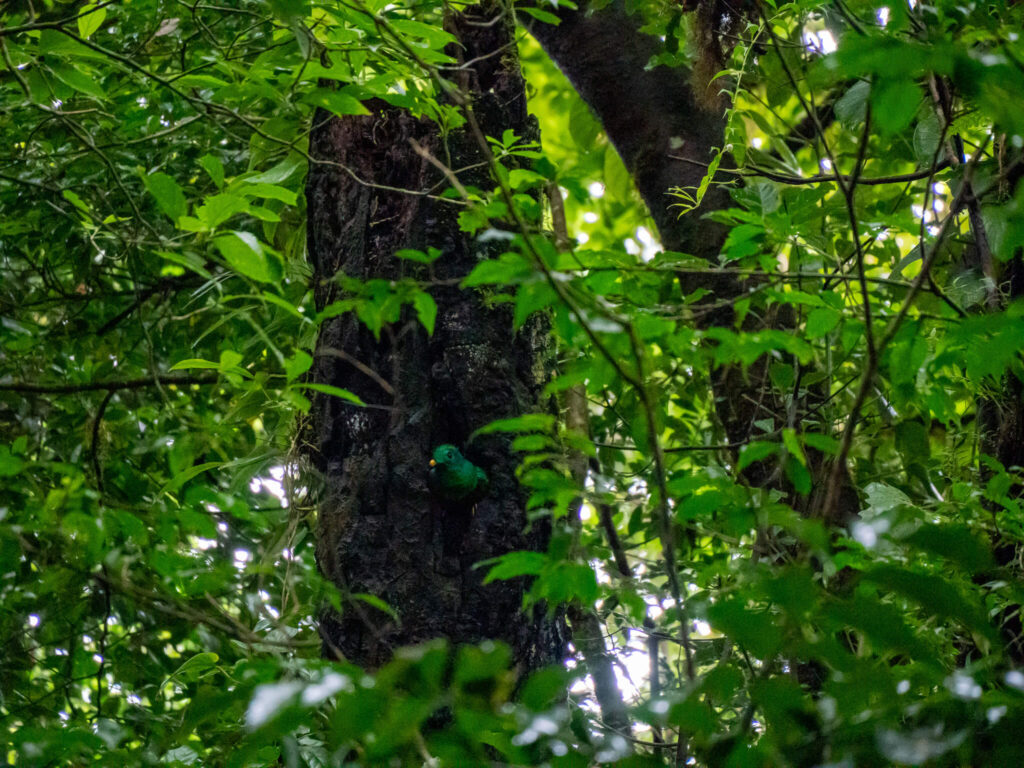
The best time to see a quetzal in Monteverde is between mid-February and May, although they can be seen as late as early July. We visited Monteverde Cloud Forest in June, which was towards the end of the season. We saw one male quetzal on our birdwatching trip and felt very lucky. We also passed an empty nest and several others who hadn’t managed to see one at all.
Resplendent quetzals take turns incubating their eggs. Males sit on the nest throughout the day, and females take on the duty at night. The female usually lays one to three pale blue eggs, which hatch around 17 to 19 days later. There’s a small window of opportunity throughout the year to see a quetzal in Monteverde, so we’d recommend trying to time your visit in the middle of the season if you can.

What is the best time of day to see the quetzal?
The best time to see a quetzal in Costa Rica is when the male and female switch incubating duties. Timing your birdwatching so you are standing near their nest at the time the male and female switch is the best way to guarantee seeing a quetzal. However, this can take a lot of patience and really only gives you two opportunities a day to see a quetzal bird out of the nest.
Quetzals feed in the midday hours. Timing your birdwatching between 10:00 AM-2:00 PM can give you a better chance of seeing the changeover of incubation duties, as the female quetzal comes out to forage for food and the male quetzal heads home to incubate the eggs.
Birds are typically more active in the morning between 6:00 AM-10:00 PM. This is usually the quietest time in reserves and protected areas, as it is before many tourists are out and about. Getting out early can maximise your chances of seeing a quetzal as they’re less likely to be scared off by other tourists making noise, and you won’t miss the changeover if the male quetzal heads back early.
The best time of day to see quetzals in Costa Rica is between mid-morning to midday, but it doesn’t hurt to be out earlier. This is the most likely time a bird will emerge from the nest. We’d recommend starting the day at about 08:00 AM and being by the nest site by 09:00 AM. You may have to wait a while, as we did (we waited over an hour for our quetzal to emerge!), but the wait is worth it.
How to find quetzals in Monteverde
We’ve listed lots of places to see quetzals in Costa Rica in this post, but the most popular spot is Monteverde. We’ve expanded on what to expect when birdwatching in Monteverde in this section.

Can you find quetzals without a tour guide in Monteverde?
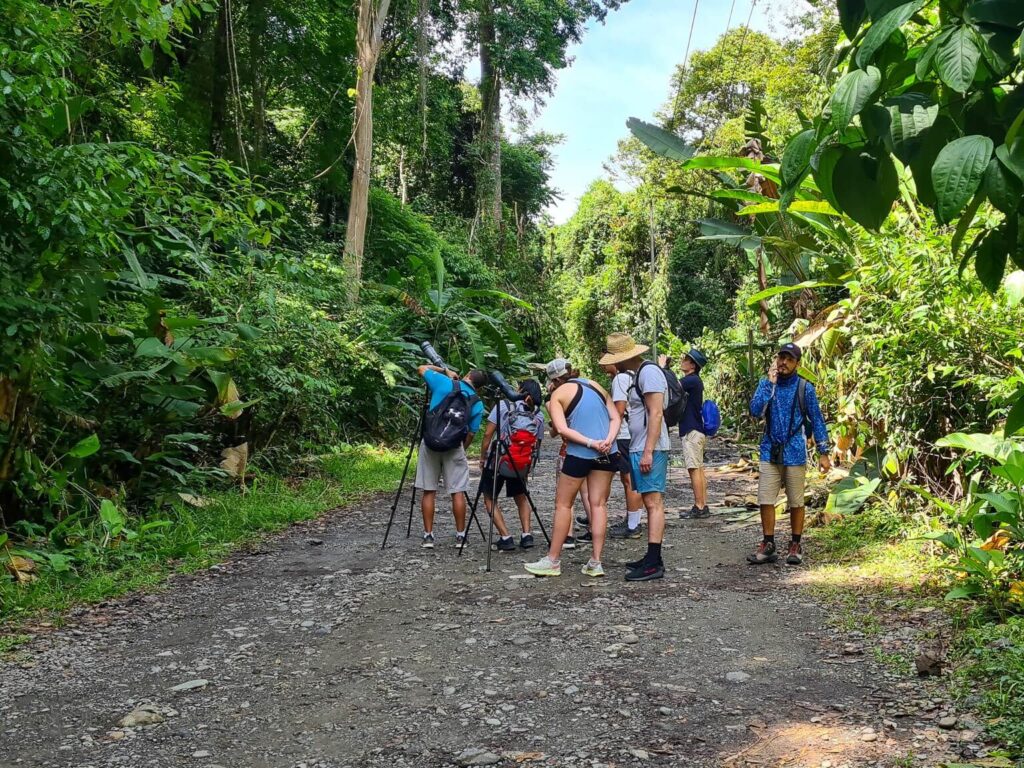
Monteverde quetzal guides are professional birdwatchers and wildlife guides and know all about quetzals’ habits. Taking a Guided Birdwatching Tour in Monteverde will give you a better chance of spotting one, and you’ll also learn a lot about the species, as well as about the cloud forest and local flora and fauna.
During breeding, quetzals use six specific vocal calls. Unless you’re an avid birder, you’re unlikely to be able to distinguish them from the other 200+ species of Costa Rican birds. Our guide immediately recognised the quetzal call, so we knew when there was one close by.
The advantage of taking a tour to see quetzals is that the guide usually works for the whole nesting season, which means they know where the birds have been most commonly seen, where their nests are and when they typically come out. This maximises your chances of seeing a quetzal as you can go right to these hotspots and see if there’s anything around.
The first nest our guide checked on our tour was empty, so we went straight to site two, where we could see a quetzal tail and a lot of other birders waiting. If we’d been alone, there’s no guarantee we’d have stumbled upon this site or known what to look for at all.
Most guides also provide a telescope or scope to see the birds better. This is a super important piece of equipment, as you’d be surprised how far away from the path a nest can be. Although quetzal photos may look close, they’ve often been taken on a long zoom lens or on a phone pointing through a telescope (known as digiscoping).
It is not impossible to see a quetzal in Monteverde without a guide, but it’s going to be much harder, and you’re less likely to see one. Your only real hope is that you’ll get lucky and stumble upon a quetzal, or that you come across someone who has already found one.
When there is a quetzal nest nearby, you’ll likely know from the group of birders with huge cameras and telescopes set up pointing at the nest site. It’s very plausible you could find a group like this without a guide and see a quetzal for yourself. However, if you don’t come across a group that has found a quetzal nest, you’d have to be very lucky to see one on your own.
If you are really keen to see a quetzal in Monteverde, we’d highly recommend you book a Guided Quetzal Birdwatching Tour.
How much do nature tours cost to find quetzals in Monteverde?
Most quetzal birdwatching tours in Costa Rica range from $50 to $100 USD. This can be just for the guide, or include your entrance fee and often transportation from your accommodation too. Guided Tours usually take around 2.5 to 3 hours.
Guided Quetzal Tours in Monteverde start at around $30 USD for a few hours’ walk. These tours usually exclude your entrance fee to the reserve. This is a great option if you have your own transport and would only like a guide for a few hours to show you where quetzals are in the cloud forest. Monteverde Quetzal Tours that include transport and your entry fee cost around $75 USD.

What are some tips for spotting the quetzal?
We’ve told you where to see quetzals, but how do you spot a quetzal in Monteverde? It can be hard to see quetzals, even if there’s one close by. A mixture of quiet behaviour, camouflaged feathers and scarcity in numbers makes them very elusive. Here are some top tips for spotting a quetzal in Costa Rica, with or without a guide:

How to photograph quetzals
If spotting a quetzal in Monteverde is tricky, photographing one is even harder. Cloud forests are home to thick layers of dense forest, which means very little light trickles down to the forest floor. It’s recommended to have a camera that handles low-light conditions. Additionally, quetzals are small birds and may be far away from the trail. Having a camera with a long or zoom lens is preferable for getting close shots.
Don’t worry if you don’t have a camera, it’s still possible to take quetzalphotos on your phone, too. You can hold your phone camera lens to the lens of a telescope and take a photo through the pinhole this way – a technique known as digiscoping. Taking a guided tour is the best way to ensure you get a physical memento of your quetzal sighting. Not only will a guide normally provide a telescope or spotting scope on the tour, but they can also help you set up your shots, too. This 5-hour Birdwatching and Photography Tour is perfect if you’re keen to get a photo of a quetzal in Monteverde.
Even with equipment, patience is key. Even with a tour guide, we had to wait over an hour for a quetzal to emerge from its hollow. And then we had about 60 seconds before it was off again, so you really do need to be ready with your finger over that shutter button. Try to find a spot facing the nest that is unobstructed by branches, so you have a clear shot. Nothing would be worse than waiting over an hour for a one-minute glimpse of a quetzal and getting home to find your photos are all out of focus! A good autofocus can be really helpful and save you time when the bird emerges.

Is the resplendent quetzal endangered?
The resplendent quetzal is listed as Near Threatened by the International Union for Conservation of Nature (IUCN). There are several reasons they are threatened. Loss and degradation of habitat caused by deforestation and global warming play a large role in the decline of quetzal populations.
Additionally, resplendent quetzals only lay two clutches of three eggs a year and have a high nest failure rate, meaning very few chicks survive to adulthood. Quetzals are also poached illegally for their beautiful tail feathers, which are seen as artefacts or souvenirs, or used for medicines and rituals.

How many quetzals are left in the world?
There are only about 20-50,000 resplendent quetzals left in the world. Resplendent quetzals help to disseminate the seeds of at least 32 tree species. They play an important ecological role within cloud forest habitats, and their extinction would have a catastrophic knock-on effect. It makes you feel even luckier to see a quetzal in Monteverde.

How does the resplendent quetzal protect itself?
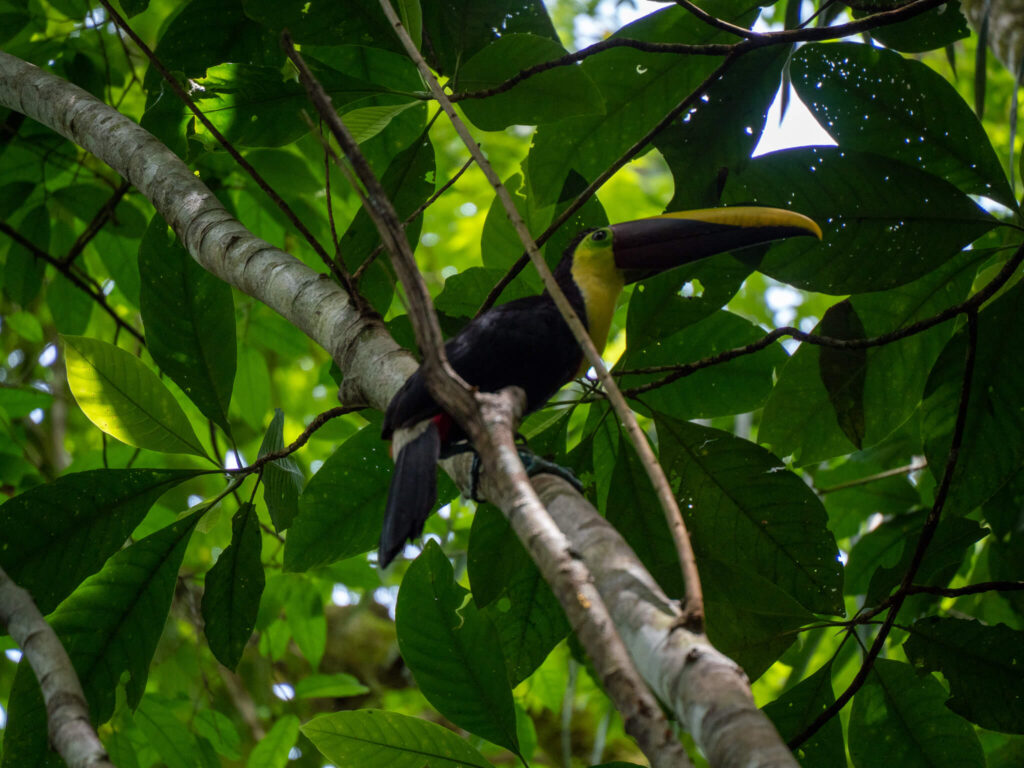
Quetzals are shy birds and exhibit quiet behaviour to elude predators. Predators of the quetzal include hawks (the ornate hawk-eagle, golden eagle and others) and owls, along with emerald toucanets, brown jays, long-tailed weasels, squirrels, and kinkajous. However, during the mating season, males can be very vocal in order to attract a mate, a behaviour which is in contrast to their quiet nature and survival instincts.
Costa Rica Quetzals FAQ
We hope this article has helped you plan your trip to see quetzals in Costa Rica. To finish off, here are some fun facts and frequently asked questions, answered.
Where can you find a quetzal in Costa Rica?
The best place to see quetzals in Costa Rica is in Monteverde. Choose between Monteverde Cloud Forest, Santa Elena Cloud Forest, the Children’s Eternal Rainforest, and Curi-Cancha Reserve and take a guided birdwatching tour. Quetzals can also be found in other locations, including Los Quetzales National Park (Parque Nacional Los Quetzales), San Gerardo de Dota National Park, and the Savegre River Valley, as well as adventure parks like Sky Adventures, Selvatura and 100% Aventura.
How long is the tail of a resplendent quetzal?
Quetzal tail feathers are between 31 cm (12 in) and 100.5 cm (39.6 in) long, with the average male tail feather being 75 cm (30 in).
How many tail feathers does a resplendent quetzal have?
Typically, males have two long tail feathers, called twin feathers. The males grow these feathers during mating season to impress females.
How many babies do resplendent quetzals have?
Resplendent quetzals are monogamous, meaning they mate with one bird at a time. Females usually lay between one and three pale blue eggs up to twice a year.
What is the lifespan of a quetzal?
The average lifespan of a quetzal is 3 to 10 years in the wild.
What do quetzals eat?
Quetzals are omnivores, meaning they eat plants and animals. The diet of a resplendent quetzal is mostly made up of fruits of plants in the laurel family. Quetzals are known to feed on 41 to 43 species of fruit, with the wild avocado being their favourite. Quetzals do occasionally also eat insects, lizards, frogs and snails, especially when they are young.
What animals eat quetzals?
Birds, including hawks, owls, emerald toucanets, and brown jays, are known to prey on quetzals. Larger predators include long-tailed weasels, squirrels and kinkajous.
Is a quetzal rare?
Quetzals are threatened, and few remain in the wild, meaning it is rare to see one. Due to this rarity, seeing a quetzal is a highly coveted experience by birdwatchers and animal lovers.
Why is the quetzal going extinct?
Threats facing quetzals include degradation and loss of habitats, global warming, development of infrastructure, illegal poaching and high nesting failure rates.
Is quetzal Mayan or Aztec?
Quetzals were important in both Mayan and Aztec cultures. Quetzal tail feathers were used ceremoniously, as well as a form of currency.
Why is the quetzal sacred?
In Mesoamerican mythology, quetzals were closely associated with Quetzalcoatl, a deity in Aztec culture. Known as the Feathered Serpent, Quetzalcoatl was associated with wind, Venus, the Sun, merchants, arts, crafts, knowledge and learning. The name Quetzalcoatl comes from Nahuatl (a language used by the Aztec/Mexica in central America in the Mesoamerican period) and means ‘Precious Serpent’ or ‘Quetzal-feathered Serpent’.
Why is it called quetzal?
The name quetzal comes from Nahuatl and means ‘large brilliant tail feather’, in reference to the long twin feather grown by the male birds.
What does the quetzal symbolise?
The Aztecs considered the quetzal a sacred bird and spirit animal that symbolised freedom and nobility. The notion that a quetzal could help guide the path to riches may be because of their fruit-rich diet – it’s likely that following a quetzal could lead you to some tasty fruits.
Is it good luck to see a quetzal?
Considering quetzals are threatened, and they are such elusive birds, we’d certainly say you’re lucky to see one. The amount of time we spent looking for and waiting for our quetzal sighting, we definitely felt lucky, too.
What is the national animal in Guatemala?
The national animal of Guatemala is the resplendent quetzal. It is pictured on the flag and coat of arms, as well as being the namesake for the local currency.
Why is Guatemala money called quetzal?
Guatemalan money is named after the national bird of Guatemala, the resplendent quetzal. It is said that, in ancient Mayan culture, a quetzal’s tail feathers were used as a form of currency. Today, Guatemalan money is coins and notes with beautiful pictures on, but it keeps the name quetzal.
What other birds can you see birdwatching in Monteverde?
There are over 900 species of birds in Costa Rica, and over 400 species can be found in Monteverde alone. Other species you might see when looking for a quetzal include Hummingbird, Toucan, Motmot, Three-wattled bellbird, Golden-Browed Chlorophonia and Magenta-Throated Woodstar.
What other animals can you see in Monteverde?
Monteverde is incredibly diverse and is home to a range of mammals, insects, reptiles and amphibians. Five species of wild cat can be found in Monteverde: ocelot, margay, oncilla, puma, jaguar and jaguarundi. The Two-Toed Sloth, white-faced and howler monkeys, agouti pacas, Kinkajou, porcupines, armadillo and deer can also be found in Monteverde, as well as snakes, spiders, frogs and various insects.