18 Charming Churches, Convents, Colonial Landmarks & Ruins in Antigua

Discover the most beautiful ruined convents and churches in Antigua, from ornate façades to intricate interiors.
This post may contain affiliate links, which means we might earn a small commission on anything purchased through these links at no extra cost to you. Learn more on our disclaimer page.
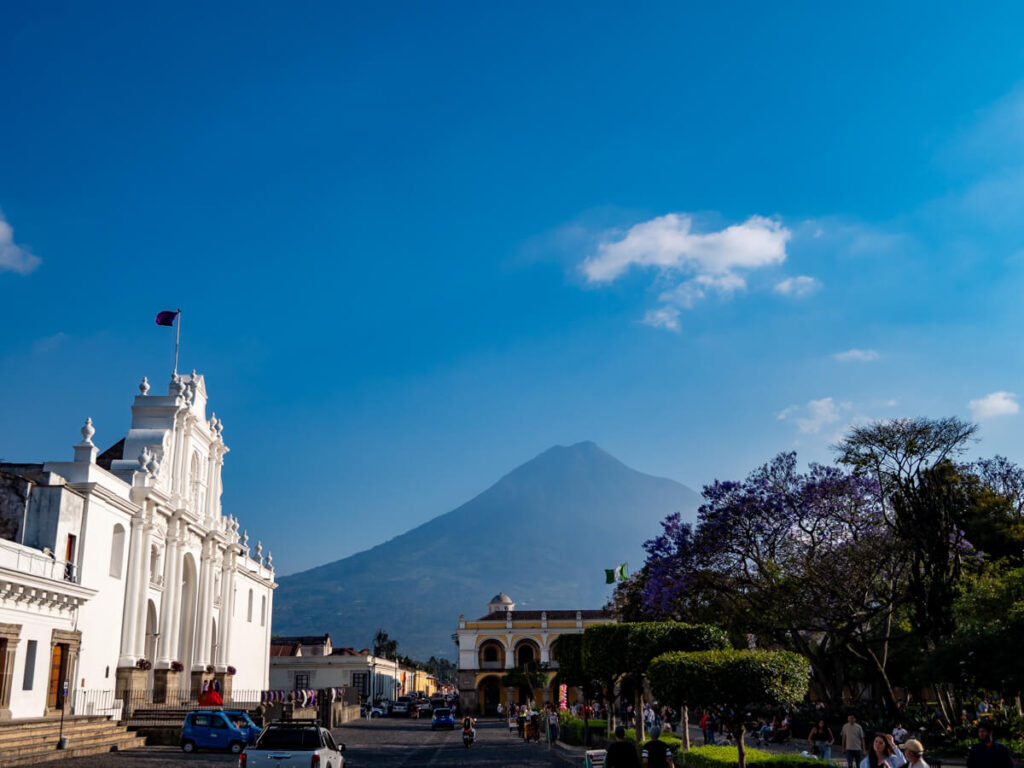
A colourful city with a network of cobblestone streets that house colonial buildings, collapsed churches, and crumbling convents, Antigua is Guatemala’s most charming historic town. In its UNESCO-listed old town, there are countless ruins marking the remnants of Spanish rule, when it was one of the most important cities in Central America.
While taking a guided walking tour of Antigua can be a great introduction to the city and helps support the local community, you can still see the sights and learn plenty about the city’s history on your own by simply wandering the quaint streets. Some buildings have been painstakingly restored, yet others are nothing more than a façade. Yes, at first glance, many of the churches and convents look very similar, but each one reflects a different piece of history that you can discover as you explore.
We spent days walking around Antigua over the course of two trips, admiring the grand architecture and discovering hidden ruins. In this guide, we’ve listed the best churches, convents, and ruins in Antigua, comparing them to help you decide which are worth visiting, which to skip, which to explore inside, and which to simply admire from the outside.

More from Antigua
Why are there so many ruins in Antigua?
Antigua is known for its panoramic volcano views, but with these incredible natural wonders come natural disasters. Antigua’s churches, convents, and ruins are the remains of a long history of powerful earthquakes that repeatedly struck the region during the 16th to 18th centuries. Notable quakes in 1717 and 1751 damaged many buildings, but the most devastating was the Santa Marta earthquakes of 1773, which destroyed much of the city.
Until then, Antigua served as the capital of the Spanish Kingdom of Guatemala, named Santiago de los Caballeros at the time. It was the economic, political, and cultural centre of Central America and one of the earliest examples of urban planning in Latin America.
The capital was moved to what is now Guatemala City, leaving many of Antigua’s buildings in ruin. Many religious and civic buildings were abandoned, their once-grand façades slowly reclaimed by time. Instead of rebuilding everything, locals preserved the ruins as part of the city’s identity, which earned the historic centre UNESCO status in 1979.
Exploring the church ruins is one of the best things to do in Antigua, especially if you love history. We don’t mean to sound twee, but walking through Antigua really does feel like stepping back in time, allowing you to see the city as it would have been over 500 years ago.

Which ruins to visit in Antigua?
While there are ruined churches and convents on every corner of the city’s streets, you won’t have time to fit them all into your Antigua itinerary. Some are Antigua’s most famous landmarks, while other, lesser-known hidden gems, offer quiet courtyards and ivy-covered walls that most travellers miss.
Top churches and ruins in Antigua
Don’t have time to read the whole list? Here are the top churches and ruins in Antigua.

Map of ruins in Antigua, Guatemala
We’ve pinned all our recommended landmarks, churches, and convents to visit in Antigua on the map below.
Colonial landmarks in Antigua
We are going to get to the grand churches and sprawling convents, but first, we want to set the scene with a couple of the city’s most famous landmarks. These echoes of the colonial era aren’t just famous photo spots, but they’re also really interesting sites where you can learn more about what the city would have been at its peak. We’ve provided some background on what you’re seeing when you pass them on the way to the city’s ruined churches.
1. Santa Catalina Arch (El Arco de Santa Catalina)
No trip to Antigua is complete without a photo under the Santa Catalina Arch (El Arco de Santa Catalina), the city’s postcard-perfect landmark. Built in the 17th century, the arch once connected two parts of the Santa Catalina convent, allowing nuns to cross the street unseen by the public.
Its soft yellow façade and white trim perfectly capture Antigua’s colonial charm, especially with views of Volcán de Agua peeking out behind it on a clear day. Today, the street beneath it, 5a Avenida Norte, is one of Antigua’s busiest pedestrian zones, lined with cafés, shops, and street musicians. Try to visit early in the morning for the best light and fewer crowds.

2. Tank of Union (Tanque La Unión)
The Tanque La Unión is a picturesque public square centred around a large colonial-era water tank that was once used by local women to wash clothes. Built in 1853, it served as both a communal laundry area and a social hub. The square is framed by the Ruins of Santa Catalina Mártir and a few other beautiful colonial buildings, making it a great photo stop.
Today, it’s a peaceful place to sit on a bench, admire the surrounding ruins, and people-watch. Locals still gather here, and it often hosts cultural events or weekend markets – we especially loved it at night, when street food vendors line the street selling cheap eats.

3. Royal Palace of the Captains General (Palacio de los Capitanes Generales)
Facing Parque Central, the city’s main square, the Royal Palace of the Captains General (Palacio de los Capitanes Generales) once served as the political, military, and administrative centre of all Central America during the Spanish colonial period. It’s a grand building built in the 16th century, which housed governors who ruled over vast territories stretching from Mexico to Costa Rica.
The palace’s graceful arches and long corridors showcase classic baroque architecture, beautifully restored after centuries of earthquakes. Today, it houses the National Museum of Guatemalan Art, also known as MUNAG (Museo Nacional de Arte de Guatemala) – one of the best museums in Antigua. You can walk around the exterior and admire its symmetry, or step inside to explore small exhibitions and government offices.

4. Parque Central
The heart of Antigua, Parque Central is the city’s main plaza and social hub. Surrounded by notable landmarks, including the City Hall Palace (Palacio del Ayuntamiento) and arcaded buildings, the park is shaded by large trees and is usually alive with music, chatter, and occasional parades, like during Semana Santa (Holy Week).
You can relax by the Fountain of the Sirens, built in 1739, and watch locals, street vendors, and tourists mingle. This is also a great place to do a spot of shopping in Antigua, as local Mayan women from nearby villages congregate here to sell their artisanal textiles.

5. Casa Popenoe
One of Antigua’s best-preserved colonial homes, Casa Popenoe offers a glimpse into 17th-century domestic life. Restored by American scholar Wilson Popenoe in the 1930s, the house now functions as a museum showcasing antique furniture, art, and architecture.
You can take a guided tour to learn about how the family lived, including their beautiful inner courtyard and traditional kitchen. The attention to detail, from carved wooden doors to colourful tiles, makes it a must-visit for architecture lovers. You’ll find it just a short stroll from Tanque La Unión.

The best churches and convents in Antigua
Here are the most beautiful convents and churches in Antigua that we loved exploring. Featuring intricate stucco work, hidden chapels, and peaceful cloisters, they’re relics of the past with exquisite detail inside and out.
6. San José Cathedral (Catedral de San José)
Antigua’s main functioning cathedral, set on the edge of the central park, San José Cathedral (Catedral de San José) is one of Antigua’s most impressive religious sites. Originally built in 1541 and rebuilt multiple times after major earthquakes, its exterior is a masterpiece of colonial design.
This is one of the most visited churches in Antigua, thanks to its central location. The white-washed, Baroque-style façade was rebuilt and re-consecrated as the Catedral de San José after the collapse of its spiritual successor. Today, it’s an active church that you can visit free of charge – just be mindful not to disturb services.

7. Santiago Cathedral (Catedral de Santiago)
Behind the San José Cathedral lies the historic ruins of the old Santiago Cathedral (Catedral de Santiago). Sometimes used interchangeably with San José Cathedral, which was built on the same site, the Catedral de Santiago refers to the ruins of the original 16th-century cathedral, which was destroyed by the 1773 earthquake.
This is a unique site, where you can wander through atmospheric archways that once held up the domed roof, crumbling chapels, and two underground crypts. Pillars lie on the floor as a reminder of the event that brought about the cathedral’s downfall, and it’s a popular spot with photographers, as shafts of light splay across the beams.

8. La Merced Church (Iglesia de la Merced)
A bright Baroque-style church known for its intricate yellow-and-white façade and ornate stucco details, La Merced Church (Iglesia de la Merced) is one of Antigua’s most recognisable landmarks. Built in the mid-18th century, it features intricate stucco work and twin bell towers that gleam under the Guatemalan sun and is named for the statue of the Blessed Mary of Mercy (La Merced) on its exterior.
Inside, you’ll find a richly decorated altar and peaceful cloisters that once belonged to the adjoining convent. Many travellers don’t know that you can actually access the church’s rooftop terrace for views of the little square, Parque la Merced, the Santa Catalina Arch, and the city’s volcanoes, including Agua, Fuego, and Acatenango Volcano. There’s a separate entrance for the church’s ruins, which are home to one of the largest colonial fountains in Latin America.
The church is still active, hosting regular services and festivals, especially during Semana Santa (Holy Week).

9. Church and Convent of the Capuchins (Iglesia y Convento de las Capuchinas)
Built in 1736, the Capuchin Convent is one of Antigua’s most fascinating ruins to explore. Designed for an order of nuns who lived in strict seclusion, the convent includes circular living quarters, a beautiful courtyard, and a series of underground rooms.
You can wander freely through the site, which is well-maintained with lots of colourful flowers, imagining what life was like for the sisters who lived here centuries ago. It’s home to a peaceful courtyard and fountain, as well as an upper-level, small garden, and an exhibition showcasing local artworks.

10. Santa Clara Convent (Convento Santa Clara)
The Santa Clara Convent (Convento de Santa Clara) is a semi-ruined site that’s considered one of the most beautiful ruins in Antigua. Founded by three nuns from Mexico in 1699, it was heavily damaged by earthquakes but still retains its graceful arches, courtyards, and fountains.
Today, it’s a quiet escape from the busy streets. It might not look like much from the outside, but inside you’ll find arched cloisters surrounded by well-maintained greenery, with multi-levels and panoramic views of the city and its volcanoes. Santa Clara Convent is also often used for weddings and cultural events thanks to its romantic atmosphere.

11. San Francisco the Great Sanctuary (Iglesia Católica San Francisco el Grande)
One of Antigua’s oldest churches, San Francisco the Great Sanctuary (Iglesia Católica San Francisco el Grande) is significant for housing the tomb of Saint Hermano Pedro, Guatemala’s only canonised saint. It’s a popular pilgrimage site, and you can enter the church for free to see his final resting place.
The façade is baroque yet understated, and the church remains an active place of worship. There’s a small on-site museum dedicated to Hermano Pedro, who was known for his charity and compassion, as well as adjoining ruins, which have their own entrance.
The peaceful gardens and courtyards are a short walk from the centre, and you might even get views of the surrounding volcanoes on a clear day.

12. Convent and Church of the order of the Recollects (Convento La Recolección)
If you love dramatic ruins, La Recolección Convent (Convento La Recolección) is unmissable. Home to massive stone remains that once belonged to an 18th-century monastery (the Order of the Recollects), the site was destroyed by the 1773 earthquake. What’s left are towering archways, broken domes, and vine-covered walls that look like something from a fantasy film. You can wander among the ruins freely, climbing over fallen columns and admiring how nature has reclaimed the space.
The architectural complex is located a little walk outside the city centre, but it’s worth the journey, as it’s quieter than some of the more popular sites. Barely any restoration work has been done, so the ruins look as they did over 200 years ago, which is great for photography.

13. Santo Domingo Church and Convent (Casa Santo Domingo Hotel)
One of Antigua’s most unique places, Santo Domingo Church and Convent (Casa Santo Domingo Hotel) combines ancient ruins with a modern luxury hotel. The former Dominican convent has been transformed into Casa Santo Domingo Spa Hotel, one of the best hotels in Antigua, which integrates the original stone cloisters and courtyards into a stunning five-star property.
You don’t need to stay overnight to visit – you can explore a large portion of the ruins for free, seeing the remains of what was one of the biggest and richest monasteries in Antigua. The hotel also includes 6 on-site museums, 2 art galleries, and peaceful gardens, with archaeological displays and candle-lit corridors.

14. San Pedro Apostol Church (Iglesia de San Pedro Apóstol)
Located near San Francisco Church, the San Pedro Apostol Church (Iglesia de San Pedro Apóstol / Santo Hermano Pedro de San José Betancur) – also referred to as San Juan de Dios Convent – is a small but brightly coloured church and part of a charitable complex founded by Hermano Pedro. It once served as a hospital for the poor and now includes a home for the elderly and people with disabilities.
The building itself is like a simpler version of La Merced’s yellow façade, with white stucco design. You can visit the small chapel, which is part of the San Pedro Apostol Church, one of the oldest churches in Antigua, or walk through the courtyard to learn about Hermano Pedro’s humanitarian work.

15. Our Lady of Carmen Church (Iglesia de Nuestra Señora del Carmen)
Known for its beautiful façade, Our Lady of Carmen Church (Iglesia de Nuestra Señora del Carmen) stands alone next to the popular artisan market of the same name, Mercado de Artesanias El Carmen.
The church dates back to the 17th century and was destroyed multiple times by earthquakes, leaving behind ornate stonework that glows golden in the late evening light. You can’t visit inside, but you can admire its grand columns, which feature intricate carvings, and you might see Agua Volcano on a clear day.

16. Convent of Saint Teresa of Jesus (Convento Santa Teresa de Jesús)
This lesser-visited convent offers a peaceful detour for those wanting to escape the crowds. Founded in the 17th century, Santa Teresa de Jesús Convent (Convento Santa Teresa de Jesús) once housed Carmelite nuns who lived in strict silence and contemplation. The structure has suffered earthquake damage over the centuries, but parts of its cloisters and thick stone walls remain.
Following its abandonment, the site was partially used as a winery, coffee drying patio, and men’s prison. Like many other ruins in Antigua, it has a small entrance fee, which allows entry to its ground and first floors, courtyard, and internal rooms, but you can take a sneak peek at its central courtyard from the doorway.

17. Church and Convent of the Society of Jesus (Iglesia y Convento de la Compañía de Jesús)
Once one of Antigua’s grandest religious complexes, the Society of Jesus Convent (Iglesia y Convento de la Compañía de Jesús) was a Jesuit monastery and college built in 1626. Located near the main square, it’s an easy spot to access and sits near some of the best restaurants in Antigua.
The order was expelled in 1767, and the Spanish government later decided to rescue the building and turn it into a Cultural Centre (Cooperación Española). The ruins have been carefully stabilised, and exhibitions are often held within the restored courtyards and halls. You can admire the impressive stonework and arches from the outside or browse local artwork and photography displays inside.

18. Convent of the Conception (Convento de la Concepción)
Built in 1694, the Convent of the Conception (Convento de la Concepción) was once one of the most luxurious in the city, home to wealthy nuns from noble families. It was the first religious institution for women in the region, founded in 1578, but the church itself was rebuilt in the 18th century in the Baroque style you see today.
The church and cloisters were (you guessed it) destroyed in the great earthquake of 1773, but their remains still convey their grandeur. Unfortunately, you can’t go inside, but you can admire it externally if you’re visiting the eastern outskirts. It’s not too far from AM BKFST, one of Antigua’s best coffee shops.

Other convents and churches in Antigua
Antigua has more than 30 churches and convents, many in various stages of ruin or restoration, and it would be nearly impossible to visit them all. Here are some that didn’t make our list:

Planning a trip to Antigua?
Prepare for your trip to Antigua with our comprehensive travel guides! They include lots of handy tips like how to get to the city and get around, as well as the best things to do, tours, accommodation, restaurants, and more.

Read next:
10 Fascinating Museums in Antigua to Visit
7 Gorgeous Cafés and Coffee Shops in Antigua
How to Hike to Cerro de la Cruz in Antigua
A Practical Guide to the Acatenango Overnight Hike
Our Guatemala Destination Guides:
Our Guatemala Travel Guides:
