A Complete Guide to Visiting Sian Ka’an Biosphere Reserve

Our honest review of whether Sian Ka’an Biosphere Reserve is worth visiting, including everything you need to know about taking a tour and who to book with, or how to get there on your own.

This post may contain affiliate links, which means we might earn a small commission on anything purchased through these links at no extra cost to you. Learn more on our disclaimer page.
Sian Kaʼan Biosphere Reserve near Tulum is one of the most impressive natural areas in Mexico, but visiting isn’t simple. Between rough access roads, limited facilities, and tours that vary hugely in quality, price, and ethics, it’s easy to get it wrong without proper planning. We spent hours researching the different ways to visit Sian Kaʼan, from organised tours to independent visits. Some routes and experiences are absolutely worth the effort, while others are more hassle than they’re worth. And it paid off, because this trip was one of our favourite days in our whole 3.5-month backpacking trip around Mexico.
In this guide, we break down what Sian Kaʼan is, how to visit responsibly, the best ways to explore the reserve, and what to expect once you’re there. We’ve also covered the best tour companies, how to visit independently, and how to support the local community. Whether you’re interested in wildlife, boat tours through the mangroves, floating in the Mayan canal, or just want to see a wilder side of the Riviera Maya, this guide will help you decide if Sian Kaʼan is right for you and how to visit without unnecessary stress.
Sian Kaʼan Biosphere Reserve at a glance

More from Tulum
What is Sian Kaʼan Biosphere Reserve?
One of the best things to do in Tulum, Sian Kaʼan Biosphere Reserve (also known as the Boca Paila Peninsula) is one of Mexico’s most important protected natural areas, and easily one of the wildest places you can still visit in the region. Established as a UNESCO World Heritage site in 1986, it protects more than 1930 square miles (5,000 km²) of tropical forest, mangroves, wetlands, freshwater lagoons, and coral reef along the Caribbean coast.
We’re not exaggerating when we say it’s a total wildlife lover’s heaven – Sian Kaʼan’ means ‘Origin of the Sky‘ or “place where the sky is born” in Yucatec Maya. It’s easy to see why, as Sian Kaʼan Biosphere Reserve really looks and feels like it could be the entrance to heaven. The reserve is home to an extraordinary level of biodiversity, including jaguars, pumas, spider monkeys, manatees, crocodiles, dolphins, sea turtles, and over 300 bird species.
The site is Mexico’s second-largest biosphere, a designation given to areas recognised for exceptional ecological value and long-term conservation.
The reserve is broadly split into two very different access points. The coastal side, centred around Punta Allen, is reached via a long, bumpy road followed by boat travel through mangroves and open water. The lagoon side is accessed via the Muyil Ruins, much closer to Tulum, and focuses on calm freshwater lagoons and ancient canals rather than the open sea.
Beyond the wildlife, Sian Kaʼan also has deep cultural and historical significance. The area was inhabited by the ancient Maya from around 300 BCE through to the arrival of the Spanish in the 16th century, with remnants of canals, trading routes, and small ruins still hidden within the jungle. Some of the waterways you can float down today were originally engineered by the Maya to control water flow and support trade between inland settlements and the coast.
Unlike many attractions around Tulum, Sian Kaʼan is tightly regulated, with limited access, restricted boat routes, and caps on visitor numbers to protect its fragile ecosystems. Many travellers wonder whether it’s worth visiting at all, especially given the effort required to get there. We’re here to show you why taking a trip to Sian Kaʼan isn’t just a privilege, but is a great way to experience one of the last truly wild stretches of the Riviera Maya, in a way that’s contributive, not extractive.

Top Sian Kaʼan Biosphere Reserve Tours
Lots of operators offer Sian Kaʼan Biosphere Reserve tours, but your experience will vary greatly, depending on who you choose to go with. We’ve shortlisted the top tours from eco-conscious operators we trust:

Where is Sian Kaʼan Biosphere Reserve?
Sian Kaʼan Biosphere Reserve is located on the Caribbean coast of Mexico’s Yucatán Peninsula, in the state of Quintana Roo. The reserve stretches from just beyond the southern edge of Tulum’s Hotel Zone all the way down to Punta Allen, a small fishing village on a narrow spit of land between the sea and the lagoons.
While it looks close on a map, getting there is not straightforward. Access is limited to rough roads, controlled entry points, and guided routes, which is intentional and part of how the reserve is protected. The most common entry points are via the southern Hotel Zone for coastal sections or via Muyil, near the ruins, for lagoon and canal routes deeper inland.

Sian Kaʼan Biosphere Reserve Map
You can see the two access points and main areas, as well as animals that call the reserve home, on the map below.

What to do at Sian Kaʼan Biosphere Reserve
Activities in Sian Kaʼan Biosphere Reserve are shaped by the landscape itself, whether that’s drifting silently through mangrove channels, floating along ancient Mayan canals, or scanning the water for wildlife rather than chasing it. Because the reserve is protected and tightly regulated, what you can do depends on which side you visit and how you get there. It’s easily considered one of the best things to do in the Riviera Maya. Here are the top things to do.

1. Sian Kaʼan Biosphere Reserve Boat Trip
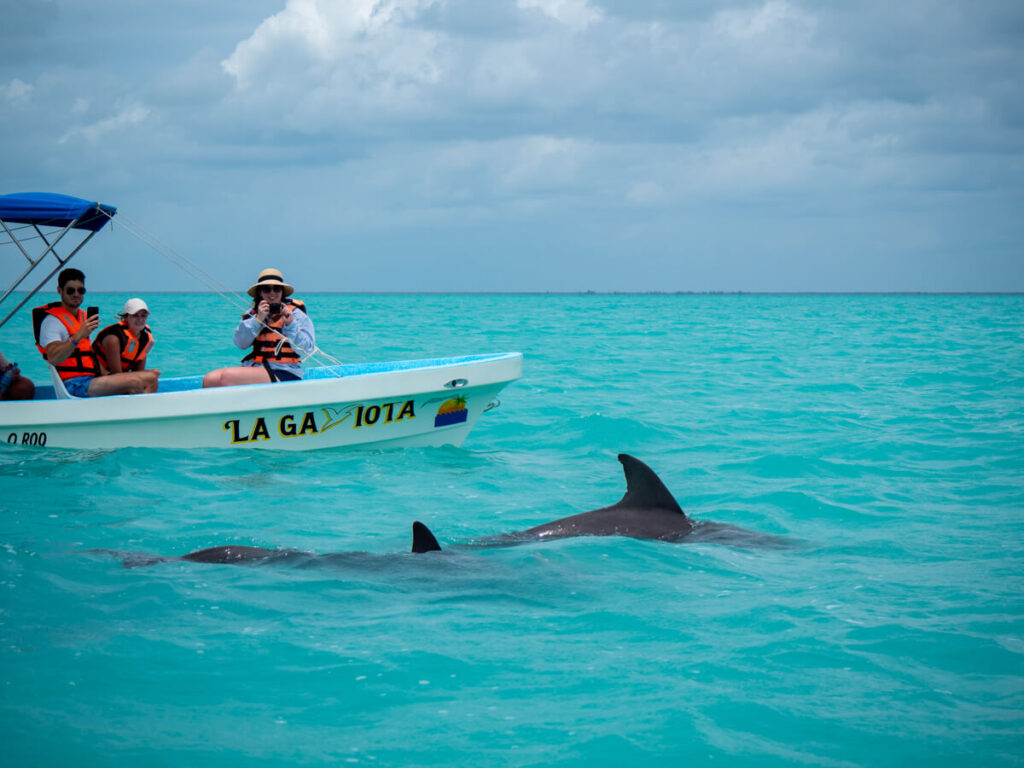
Taking a boat trip of Sian Kaʼan Biosphere Reserve is the most common way to visit, particularly on the Punta Allen side. Tours typically navigate through mangrove channels, open lagoons, and coastal waters, with strict speed limits to protect manatees and dolphins. You’re not guaranteed sightings, but dolphins, turtles, rays, and crocodiles are regularly spotted (and we saw loads on our trip). These trips are tightly regulated, with licensed guides and fixed routes, which is exactly why the ecosystem still feels intact.
2. Wildlife watching
Sian Kaʼan is home to over 300 bird species, along with animals that live on Mexico’s Yucatán Peninsula like howler monkeys, spider monkeys, jaguars (rare but present), tapirs, crocodiles, manatees, dolphins, and countless reptiles. Wildlife encounters here are observational – no feeding, no chasing, and no photo ops – which is refreshing from some of the less ethical experiences offered in more touristy parts of Quintana Roo. Most sightings happen naturally from boats or along lagoon edges.

3. Muyil River Canal Float
The Sian Kaʼan Biosphere Reserve Canal Float is one of the area’s most unique experiences. After a short boat ride, you enter a series of lagoons connected by ancient Mayan canals and float downstream wearing a life vest. Similar to Bacalar’s Los Rápidos, the current acts like a natural lazy river and carries you gently through crystal-clear water surrounded by mangroves, with no swimming or splashing necessary.
The Muyil River Canal Float is located on the lagoon, a short walk from the Muyil Mayan Ruins, which are much quieter than Tulum Ruins. You can visit independently by walking to the boat dock from the ruins, where local guides often wait with boats to take you out. The price is fixed at 1000 pesos (~$60 USD) per person.

4. Snorkelling
Snorkelling in Sian Kaʼan takes place along the coastal reef, which is part of the Mesoamerican Barrier Reef System that stretches all the way from Isla Contoy near Cancún to Honduras. It’s only included in tours on the Punta Allen side.
While it’s not as impressive as snorkelling in Cancún or SCUBA diving in Cozumel, it’s still nice to get in the warm, turquoise water. You’ll likely see fan coral, seagrass, and conch shells, and while marine animal sightings are rare when snorkelling, the occasional stingray or turtle might pass by.

5. Beaches
Sian Kaʼan’s beaches are undeveloped, wild, and often completely empty. There are no beach clubs, loungers, or bars, just white sand, dunes, and the sea. Conditions can be rougher than in Tulum, and sargassum can still be present seasonally, but the lack of infrastructure is precisely the point. These beaches feel like what the Riviera Maya looked like before mass tourism arrived.

Animals you can see in Sian Kaʼan Biosphere Reserve
Sian Kaʼan Biosphere Reserve’s biggest appeal to us was the sheer amount of wildlife you can see. It’s so unusual to find such a variety of species in one place. In just one tour, we saw:

Here are the main species you’ll likely see:
1. Manatees
Sian Kaʼan is one of the few remaining strongholds of the endangered West Indian manatee in Mexico. These gentle, slow-moving herbivores live in the reserve’s freshwater and brackish lagoons, feeding on seagrass and aquatic plants.
Unlike swimming with manatees in Belize, which takes place in the crystal-clear open ocean, the lagoon is murky, and you can’t go in, so you’ll only see the manatee from above. They blend in surprisingly well with the water, but guides are experts at spotting them, even before they surface. You’ll be able to see their little snouts break the surface of the water as they come up to breathe.

2. Crocodiles
The reserve is home to the American crocodile, one of the largest reptile species in the Americas. They’re commonly seen along mangrove-lined canals and lagoon edges, often basking on banks or floating with just their eyes visible. They’re incredibly hard to spot, as they camouflage into the branches – even with our guide pointing it out, it took ages for us to find the one in the photo below. Despite their size, they’re generally shy and avoid boats when not disturbed. Their presence is actually a sign of a healthy ecosystem, as crocodiles sit at the top of the food chain.

3. Dolphins
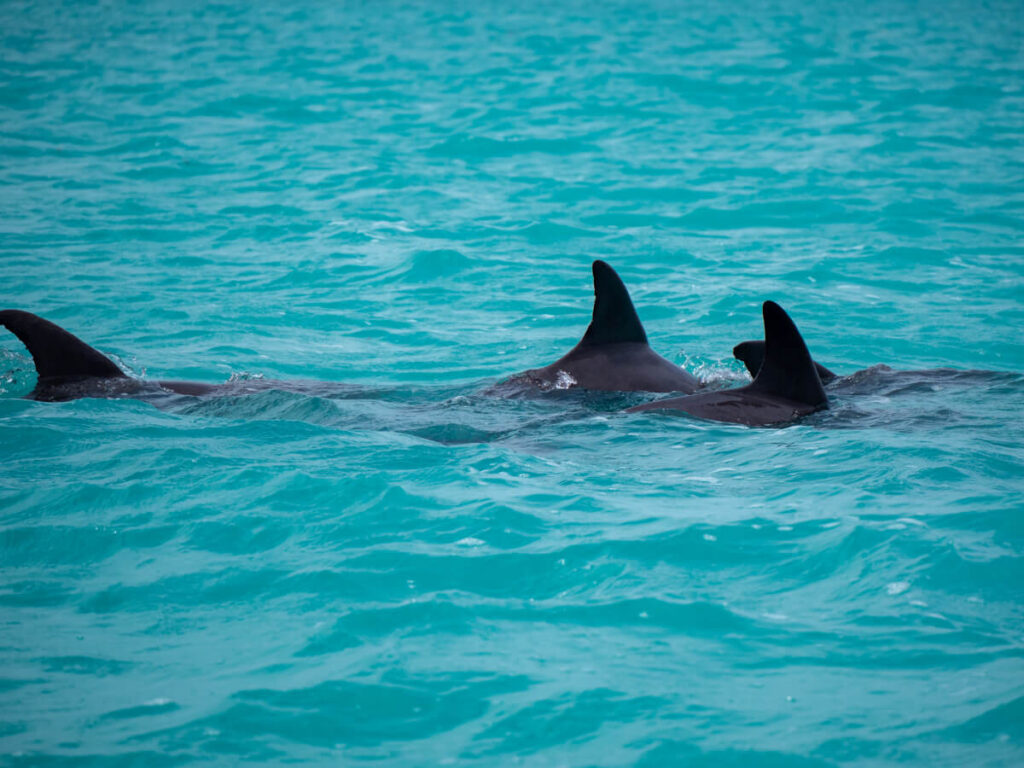
Bottlenose dolphins regularly patrol the coastal waters near Punta Allen. They’re intelligent, social animals that live in small pods and sometimes ride the pressure waves created by passing boats. Unlike dolphin encounters elsewhere in Mexico, interactions here are ethical, as they take place in the dolphins’ natural habitat. Boats aren’t allowed to chase or encircle them.

4. Sea turtles
Four species of sea turtle are found in and around Sian Kaʼan, including green, loggerhead, hawksbill, and occasionally leatherback turtles. The reef and seagrass beds provide feeding grounds for them, while sections of the coastline are important nesting beaches during the warmer months. You’re most likely to spot turtles surfacing for air, but it’s possible to see them grazing underwater while snorkelling, too. Local conservation programmes operate quietly in the background to monitor nesting and protect their eggs from predators.

5. Rays
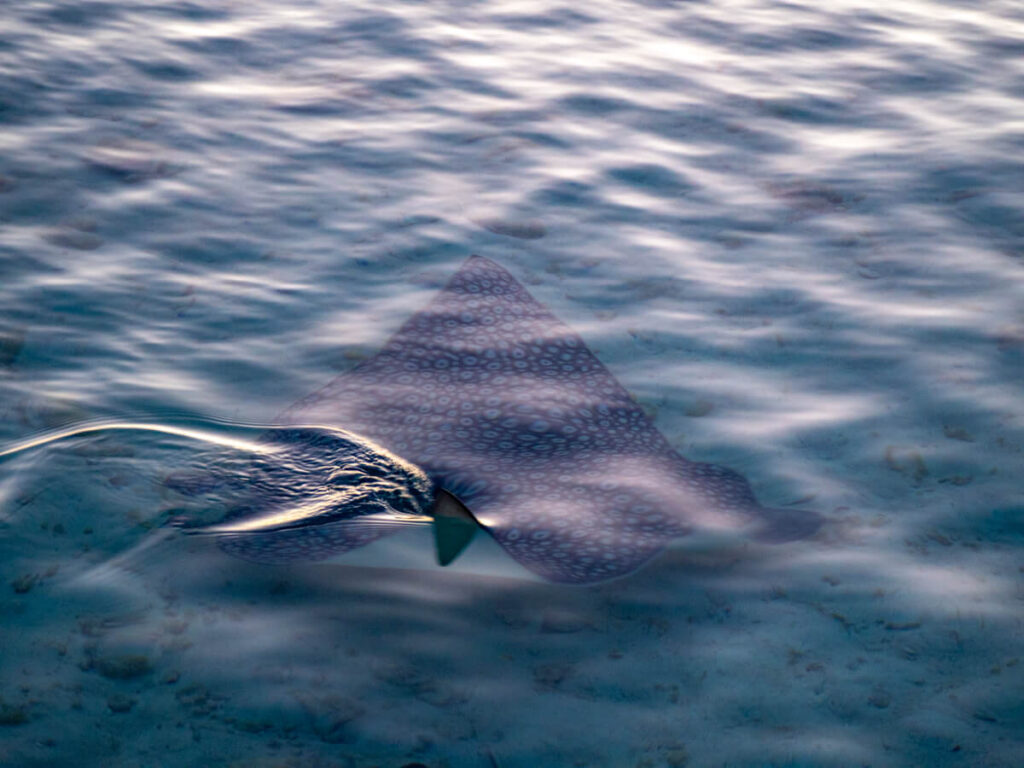
Spotted eagle rays, southern stingrays, and occasionally manta rays move through the shallow lagoons and reef edges. Eagle rays are especially distinctive, with white spots and long whip-like tails, often seen gliding in pairs or small groups. They’re hard to spot from the surface, and lookmore like a black blob than the ethereal sight we’ve seen while SCUBA diving. Stingrays are also sighted, tending to rest partially buried in sandy bottoms, blending in almost invisibly.
6. Birds
Sian Kaʼan is a birdwatching paradise, with hundreds of recorded species thanks to its mix of wetlands, jungle, mangroves, and coastline. Common sightings include great blue herons, snowy egrets, roseate spoonbills, ospreys, and pelicans. Frigatebirds are hard to miss, soaring overhead with wingspans of over two metres, while migratory species pass through seasonally. Even without trying, you’ll notice how alive the reserve feels from the constant bird activity alone.

How to visit Sian Kaʼan Biosphere Reserve
Getting to Sian Kaʼan Biosphere Reserve usually means first getting to Tulum first. Sian Kaʼan is a vast reserve, access points are limited to two key locations, and infrastructure is intentionally minimal to protect the environment.
Broadly, there are two main ways to experience the reserve: via Punta Allen on the coastal side or Muyil on the lagoon side. The main ways to visit it include:
Most travellers visit Sian Kaʼan Biosphere Reserve as part of an organised Sian Kaʼan tour, which takes care of permits, transport, boats, and local guides who actually understand the landscape. You can technically visit parts of Sian Kaʼan independently, but what you’ll see and how smoothly it goes depends heavily on the route you choose.
Sian Kaʼan tours come in all sorts of shapes and sizes, from the classic boat tours to kayaking and birdwatching, but here are the main combinations you’ll find:

Punta Allen vs Muyil Tours
There’s quite a difference between Sian Kaʼan tours on the coastal and lagoon sides, and which is right for you will depend on your interests, budget, and time frame.
Punta Allen tours focus on the marine and coastal ecosystems of Sian Kaʼan and are the best option for wildlife lovers. Reaching Punta Allen involves a short, 25-minute drive along a dirt road south of Tulum, followed by a boat trip through mangroves and out into open water. These tours typically include dolphin spotting, birdwatching, reef snorkelling, and sometimes a visit to the quiet fishing village itself for lunch. They’re longer, more expensive, and more physically demanding, but also feel wilder and more immersive.
Muyil tours access Sian Kaʼan from the lagoon side via the Muyil Ruins, just south of Tulum. These trips are easier and quicker to reach and centre around the famous Mayan canal float, where you drift slowly through crystal-clear water and mangroves. Boats explore what is essentially two isolated lagoons attached to each other by a narrow channel, with the floating experience taking place at the end of the largest lagoon. You’ll still likely see birds and crocodiles, but marine wildlife like dolphins and turtles isn’t part of this route.

Which company to book a Sian Kaʼan Biosphere Reserve tour with?
Choosing the right operator matters hugely in a protected area like Sian Kaʼan. Responsible companies limit group sizes, use licensed local guides, follow speed restrictions, and avoid wildlife harassment. Here are our top picks:
Mexico Kan Tours
Mexico Kan Tours is one of the most respected tour operators in Tulum, known for small-group experiences led by certified local guides, with a strong emphasis on environmental education, wildlife protection, and community-based tourism. They offer a variety of Sian Kaʼan tours, including a full-day tour to Punta Allen (the tour that we took), a half-day tour to the Boca Paila Bridge, a full-day tour to Muyil Ruins with the canal float, and a half-day evening tour to the Boca Paila Bridge for sunset. We recommend the full-day Sian Kaʼan boat trip to Punta Allen with a snorkel stop tour.
Community Tours Sian Ka’an
Community Tours Sian Ka’an is a cooperative run by local families within the Sian Ka’an Biosphere Reserve, offering boat tours and nature experiences that directly fund conservation and provide income for the surrounding communities. They offer full-day and half-day tours to the Muyil Ruins and the floating canal, as well as birdwatching and sunset tour options. We recommend the full-day Muyil Ruins, Sian Kaʼan boat trip & canal float tour.
Viajes Conciencia
Viajes Conciencia (Conscious Travel) was founded by a local guide who specialises in Mayan anthropology, tropical biodiversity, and indigenous spirituality, offering immersive experiences that prioritise cultural respect. They offer full-day tours to both the coastal side and the Muyil side of Sian Kaʼan.
Cooperativa Punta Allen
The Punta Allen Cooperative is a locally run fishing and tourism cooperative based in the small village of Punta Allen, inside the Sian Kaʼan Biosphere Reserve. Made up largely of local fishers and their families, the cooperative plays a key role in managing boat tours, wildlife excursions, and sustainable fishing practices in this highly protected area. Booking through the cooperative ensures that tourism revenue stays within the community rather than flowing to outside operators, and can be done in person when you arrive, or in advance via WhatsApp or Facebook. Prices are fixed, and you pay per boat, so this is a better option for groups or those who don’t mind paying ~$300 USD for a private tour.

Can you visit Sian Kaʼan without a tour?
You can visit parts of Sian Kaʼan independently, but it comes with limitations.
The Muyil Ruins and the initial lagoon area can be accessed without a tour, though you’ll still need to pay entrance fees and organise boats separately if you want to go further.
Driving to Punta Allen on your own is technically possible, but the road conditions are rough, the signage is poor, and you won’t be allowed on regulated boat routes without a licensed guide. The road to is a natural deterrent for tourists to protect the area, as it’s full of potholes, bumpy, and contains speed bumps. It’s not concrete, but they do repave it after each wet season. Even still, it’s not recommended to drive in the rainy season, when it becomes pretty rough.

Taking a Sian Kaʼan tour vs do it yourself
It is possible to get to Punta Allen on your own, too, but it’s not for everyone. The journey takes 2-3 hours to cover the 35 miles (45 km) from Tulum’s Hotel Zone, with large potholes, makeshift rope speed bumps, and rough terrain, so a high-clearance vehicle (like a jeep) is absolutely necessary. Then, you’ll need to organise a tour with the local community cooperative.
It’s not possible to do Punta Allen on your own as a day trip, so you’ll have to arrange accommodation for an overnight stay, too. While it might seem like the cheaper option to go alone, after paying for the entrance permit, fuel, a tour, and accommodation, it’s often more expensive than just taking an organised day tour with transport included. Honestly, we’d recommend booking a standard van and boat tour to save you the ordeal of driving and cut out 1.5 hours of road travel.
Muyil is the best option if you’re keen to visit Sian Kaʼan independently. It’s more easily accessible, at only 20-minutes drive, and has the added benefit of being by the Mayan ruins, so it is a good option for history lovers. You can simply head south on Highway 307 to the archaeological site, which is around 20 minutes’ drive. You can also take the ADO bus from the terminal in Downtown if you’re not renting a car in Tulum.
But visiting Sian Kaʼan on a guided tour is by far the easiest and safest way to experience the reserve. Tours, whether from Punta Allen or Muyil, handle logistics like permits, transport, and boat rentals, and guides know the best spots for wildlife sightings, snorkelling, and floating the canals. They also share local knowledge about the history, ecology, and Mayan heritage of the area, which is hard to replicate on your own.

What to expect on a Sian Kaʼan Biosphere Reserve boat tour
Your experience at Sian Kaʼan Biosphere Reserve will depend on the tour company you book with and which side you choose to visit. Generally, tours include pick up and drop off from either your accommodation or a central meeting point like the operator’s office in Downtown Tulum. Then, you’ll embark on the van journey to your destination.
On the coastal side, you’ll follow the bumpy road to Punta Allen before transferring to a boat. You’ll spot wildlife on your way through the lagoon, before exiting into the open ocean. If you’re on the full-day tour, you’ll also stop for a snorkel on the reef and lunch in Punta Allen or at a nearby beach.
On the lagoon side, you’ll start at the Mayan ruins, where you’ll learn a bit about the site’s history. Then, you’ll follow the boardwalk through the jungle to the boat dock, where you’ll spot wildlife in the lagoon. If the canal float is included, you’ll head to the channel, where you’ll jump in and be carried along by the current for around 45 minutes. You’ll be met by your guide and head off, either home or to lunch, depending on your tour inclusions.
Our Mexico Kan Tour Sian Kaʼan Biosphere Reserve Review
We took the full-day tour of Sian Kaʼan Biosphere Reserve to Punta Allen with Mexico Kan Tours, one of Tulum’s leading operators, who we chose for their eco-conscious outlook. We met at their office bright and early, where we were met by the shuttle van.
Guides can really make or break your experience, and Carlos and Roberto were fabulous. Carlos has a background in history and anthropology and we learned absolutely loads about wildlife and the history of the local area. They gave us a good briefing about what the day would entail, as well as making a point of mentioning ethical practices like not touching or getting too close to marine life and not putting your GoPro in water, so as not to disturb animals and not to lose your hand to a crocodile!
The road had recently been redone when we visited, so it wasn’t too bumpy, and the journey to Boca Paila, the gateway to the peninsula, only took us 20 minutes, rather than the usual 45 minutes. We arrived at some facilities that included bathrooms, where we were encouraged to put on our eco-friendly sunscreen, as it’s not allowed to be used inside the reserve.

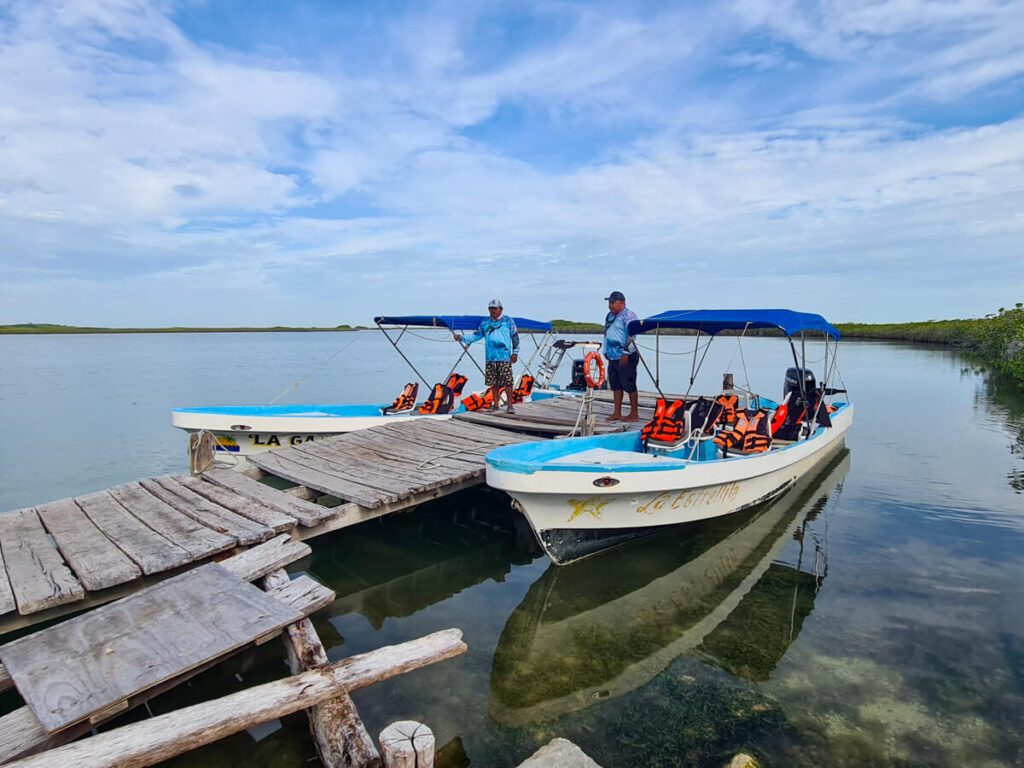
Then, we did the short walk to the boat dock. There were 11 people in our group, so it wasn’t too big, and we were split into two boats, so the group size felt even smaller.
What’s really nice about the boat portion is that your captain is a local Maya fisherman who doubles as a guide, so it’s a really authentic experience.

We started with a boat journey through the mangroves, which were so thick and dense. The water here has a distinctive greenish hue, which is a combination of sunlight filtering through the canopy and the tannins leaching from the mangrove roots.
Mangroves aren’t just beautiful, they’re critical for the ecosystem, acting as nurseries for fish and rays, protecting the coast from erosion, and absorbing carbon dioxide. Floating quietly through this labyrinth of roots, it was easy to see why conserving them is so important, especially in a region under pressure from overtourism and development.

The boat itself was comfortable and stable, perfect for spotting wildlife without disturbing it. They’re the traditional Mayan pangas you find all over Mexico, and ours had an awning, which kept us out of the strong sunshine. Whizzing through the network of canals was super fun.
Some species use the bay for breeding, including bottlenose dolphins, sea turtles, and several fish species. The sheltered mangrove channels and shallow waters create the perfect nursery environment, where young animals can grow with some protection from predators.

Before long, it was time to look for our first wildlife of the day: manatees. We had not seen one before this trip, so we were super excited when our guides managed to find us two! They would slowly rise to the surface of the water, poking their noses out to breathe.

Birds like herons, roseate spoonbills, and ospreys rely on the mangrove areas to nest, feeding on the abundance of fish and crustaceans. We’re not big birders, but we were blown away by the sheer diversity of species, from pretty birds with colourful plumage to huge cranes and birds of prey.
We saw a green heron and a baby (which was so small and fluffy) perched quietly along mangrove edges. Baby green herons stay in the nest for a couple of weeks, during which the parents are constantly feeding them tiny fish and insects. Seeing a parent and chick together is a rare treat, as the juveniles are camouflaged and well-hidden in the mangroves.
We also spotted a roseate spoonbill, an iconic, bright pink wader. Spoonbills are social birds and are often found in small flocks nesting in mangroves or foraging in bays. Their presence is a good sign of healthy wetland ecosystems, as they rely on clean, productive waters for feeding.

Our guides also managed to find us a crocodile hiding among the vegetation. It was sitting in the mangroves in an area not too far from Puente Boca Paila, the bridge that crosses the channel where the lagoon meets the sea. We went out to it in the boat, and you can see the area where the water changes colour from murky brown to bright blue, as fresh and salt water mix.

We stopped at Isla Parajos (Bird Island), which, true to its name, was absolutely teeming with birds. There were countless magnificent frigates. The males are easily recognisable by their puffed-up, bright red throat pouch, which they inflate to attract females during mating season. They’re also incredible aerial acrobats, able to glide effortlessly for hours without flapping their wings, and are often seen snatching fish from the water or stealing prey from other birds, a behaviour called kleptoparasitism.

We also saw pelicans, a tiger heron, and brown boobies, cousins of the more famous blue-footed boobies (which are known to inhabit the Galapagos, but we saw some in Loreto Bay National Marine Park). They’re expert fishers, plunging headfirst into the water at high speeds to catch small fish.
In the treetops, we also saw three ospreys, raptors that are perfectly adapted to hunting fish. They hover high above the water, then plunge feet-first to snatch prey with sharp talons. Their unmistakable M-shaped wings in flight make them relatively easy to identify.

As we reached the end of the lagoon, the water changed from green to a gorgeous milky blue colour. It wasn’t too long before we found a pod of bottlenose dolphins, which we observed quietly for a while. We think the males were trying to impress females, as one leapt from the water.
There were some other boats around too, and most were pretty good at following the rules and going slowly, although not all, which highlights the importance of picking a responsible operator.

Our dolphins were quickly followed by a shadow in the water – an eagle ray! And then by two sea turtles, one of which was enormous, which came up to breathe at the ocean’s surface. They feed on seagrass, algae, and sponges, playing a key role in maintaining healthy marine ecosystems. Conservation measures, like restricted access to nesting beaches and regulated tour practices, help ensure that these turtles continue to thrive despite increasing tourism pressures in the region.
Next up was our snorkelling stop, which took place on a little reef. It had some colourful corals and was nice to swim around, but not the most exciting spot in the Riviera Maya. We also stopped off near a beach for a swim, which was lovely and clear.

Then it was time for lunch in Punta Allen, which conveniently had bathrooms and showers for us to freshen up. The food was great, and the sea views made it even better.
We had a little guided walk through the village on our way to the boat dock, which is a rustic yet cute town. It’s a great place to relax if you want a more off-grid experience.

We boarded our boats and set off north, passing another eagle ray on the way! The journey through the mangroves was a different route from the way we’d come down, and so beautiful.
Then, we transferred back into the van for Tulum.

Overall, we’d highly recommend Mexico Kan Tours’ Sian Kaʼan Biosphere Reserve tour. From the start, the guides impressed us with their deep knowledge of the local ecology, wildlife, and history. They clearly care about conservation, pointing out species, explaining the animal populations, and sharing fascinating stories about the Maya canals and ancient trading routes.
We also really appreciated the balance between adventure, education, safety, and responsible eco-tourism. On the van journey there, we were offered metal water bottles, which could be refilled from the cooler, which is such a nice touch (we’d brought our own reusable bottles). If you want to see Sian Kaʼan authentically, this is a great option.

Sian Kaʼan Biosphere Reserve Tickets
Entrance to Sian Kaʼan itself isn’t free, and how much you’ll pay depends on which part of the reserve you’re visiting. The permit to enter the reserve itself is 215 pesos (~$12 USD), payable to CONANP (Comisión Nacional de Áreas Naturales Protegidas), Mexico’s government agency of natural protected areas.
If you take an organised tour, the fee is usually included, so you don’t need to worry about it. The fee helps fund conservation efforts, local guides, and maintenance of the reserve, so it’s a small contribution for a huge environmental impact.
Like many attractions in Mexico, you’re provided with a paper bracelet to show proof of payment, and you need to wear this for the duration of your visit.
How much is the entrance fee for Sian Kaʼan Biosphere Reserve?
If you’re heading to the Punta Allen side, fees are generally included in organised tours rather than paid separately. Independent access is limited, and the cooperative manages entry, so you’ll need to pay the 215 peso permit if you drive yourself.
To enter Muyil Ruins, you need to pay the entrance fee of 70 pesos (~$4 USD). There’s a further 50 peso ($3 USD) fee for the boardwalk to the dock, and then a tour of the lagoon with the canal float is 1000 pesos (~$60 USD).

How much are Sian Kaʼan Biosphere Reserve tours?
Punta Allen tours usually cost $150-250 USD per person for a group tour, depending on the group size and inclusions.
Shorter half-day trips to Muyil start around $50-100 USD per person, while full-day tours are about $100-150 USD, including kayaking or a guided float down the canal. These tours are more accessible and less expensive but still offer plenty of wildlife and scenic views.
Private tours can be $250-400 USD per boat, depending on the size of the group and whether food or snorkelling equipment is included. Prices are higher than other tours in Tulum because the area is harder to reach, the drive is bumpy, and the cooperative carefully limits visitor numbers to protect the ecosystem.

Sian Kaʼan Biosphere Reserve Opening Hours
Sian Kaʼan Biosphere Reserve is open daily, but exact times of entry and exit will vary by area and tour operator. Its opening hours are listed as 7:00 AM-6:00 PM, but there are accommodations along the peninsula, including in Punta Allen, so you can technically visit it 24/7.
Tours to Punta Allen often start early in the morning (6:00-7:00 AM), entering the reserve around 8:00 AM and returning in the afternoon.
The Muyil Ruins are typically open 8:00 AM-5:00 PM.
Sian Kaʼan Biosphere Reserve Rules
Sian Kaʼan is one of Mexico’s most beautiful yet strictly protected areas, and part of its magic comes from keeping the reserve as untouched as possible. That means there are some important rules all visitors need to follow:
These rules help preserve the ecosystem and its inhabitants in a way that’s working much better than in other places in the region, like the turtles in Akumal, which are overcrowded.

Where to stay to visit Sian Kaʼan Biosphere Reserve
Most visitors use Tulum as a base to explore Sian Kaʼan, as it’s the closest major town. Choosing where to stay in Tulum can mean a longer or shorter journey. Staying in Downtown Tulum gives you more comfort, restaurants, and easy access to tour operators, but the Hotel Zone is the gateway to the reserve, and many tours pick up there, too.
Some travellers book tours from as far away as Playa del Carmen, but you’ll have a long journey time on top of what is already a pretty travel-heavy tour. It’s best to use Tulum as a base, at least for a night.
Top Tulum Hotels

Staying in Punta Allen is another good option if you want to be closer, but it often requires a 4×4 rental car and more expensive accommodation along the peninsula. It’s perfect if you want to immerse yourself in nature and spend early mornings watching wildlife, but amenities are much more basic than in Tulum.
Top Sian Kaʼan & Punta Allen Hotels

Camping in Sian Kaʼan Biosphere Reserve
Camping is only possible in Sian Kaʼan Biosphere Reserve at designated sites near Punta Allen. Most areas of the reserve prohibit independent overnight stays to protect wildlife and fragile ecosystems, and campfires are forbidden. Some eco-lodges allow tented accommodations or small cabins that blend into the environment, often with solar electricity and composting toilets. Hotel Cielo y Selva is a popular option – a remote, low-impact jungle lodge, offering a mix of rustic cabins and tented accommodation. While Serenidad Shardon is a small, off-grid glamping retreat in Punta Allen, known for its thoughtfully designed safari-style tents, peaceful atmosphere, and emphasis on privacy, sustainability, and slowing down rather than social scenes or party vibes.

Is Sian Kaʼan Biosphere Reserve safe to visit?
Sian Kaʼan is generally safe, but it’s not your average tourist attraction. There are no resorts or heavy infrastructure in most areas, so safety depends on preparation. Travel with a certified guide or organised tour, especially in Punta Allen or when boating in the mangroves, as currents, crocodiles, and slippery banks can be hazardous. The roads to Punta Allen are rough and remote, so a sturdy vehicle and daylight travel are recommended. Wildlife is protected, but should still be treated with caution – never approach manatees, crocodiles, or sea turtles. Cell service is spotty in most parts, so let someone know your plans before heading deep into the reserve. You should be fine, but it’s always important to have travel insurance, just in case.

Is Sian Kaʼan Biosphere Reserve worth visiting?
Since tours are quite expensive in comparison to other excursions in Tulum and access is limited, many people wonder whether Sian Kaʼan Biosphere Reserve is worth visiting. We’d argue a strong yes. Sian Kaʼan is one of the most pristine natural areas in the Caribbean, offering a mix of mangroves, lagoons, coral reefs, and untouched beaches that you simply won’t find in Tulum itself. It’s not only worth visiting, but we’d highly encourage it – our tour was one of our favourite things we did in Mexico.
Wildlife sightings, from dolphins and manatees to sea turtles and exotic birds, are genuinely abundant – we saw so much wildlife in one day, many animals we’d never seen before. The Mayan canal systems and historical remnants are fascinating, while the small town of Punta Allen is very charming. Plus, the trip is an opportunity to witness conservation in action and support local eco-conscious tourism. Skipping it would mean missing out on one of the region’s most unique natural and cultural areas.

What to pack to visit Sian Kaʼan Biosphere Reserve
To ensure a smooth and comfortable experience in Sian Kaʼan Biosphere Reserve, don’t forget to pack your:

Sian Kaʼan Biosphere Reserve FAQs
To help you plan a smooth trip to Sian Kaʼan Biosphere Reserve, we’ve answered these frequently asked questions.
How to get to Sian Kaʼan?
You can access Sian Kaʼan from two main points: Punta Allen on the coast or Muyil near Tulum. Most visitors go with a guided tour, either from Tulum or Punta Allen, because navigating the reserve on your own is tricky, the roads are rough, and the waterways can be confusing. Self-driving is possible, especially at Muyil, but otherwise you need a 4×4.
What is the Sian Kaʼan floating tour?
The floating canal tour is a gentle, lazy river experience near Muyil after a canoe, kayak, or small boat trip through the lagoons and mangrove channels. It’s designed to let you glide quietly through the reserve without disturbing wildlife.
Can you swim in Sian Kaʼan?
You swim in Sian Kaʼan in designated areas like some lagoons, the reef, the Mayan channel, or isolated beaches near Punta Allen with a guide. Swimming is not allowed in mangrove channels or fragile areas, as it can disturb wildlife or damage delicate ecosystems. Sea conditions can be rough along the Caribbean coast, so always check tides and currents, and never swim alone in remote areas or on your own.
Can you snorkel in Sian Kaʼan?
The reef sections of Sian Kaʼan are fantastic for snorkelling. Guided tours often include snorkel stops over shallow coral formations teeming with fish, rays, and sometimes sea turtles. You can’t snorkel from shore, as the reef sits a short boat ride from the land. Snorkelling in the lagoons is less common, as the water is murkier and protected for wildlife, but some tours offer kayak or paddleboard options that let you get close to the water safely.
Should I choose Sian Kaʼan or Muyil Canal?
Muyil Canal is a shorter, easier experience from Tulum, has the Mayan ruins, and is ideal for a half-day trip with kayaking or floating through mangroves. Sian Kaʼan is a bigger commitment, full day or multi-day if you’re going to Punta Allen, but the wildlife, pristine beaches, and eco-conscious tours are far more impressive.

Read next:
A Responsible Traveller’s Guide to Tulum: Worth Visiting or a Tourist Trap?
25 Unique & Non-Touristy Things to Do in Tulum + 4 Activities to Avoid
How to Get to Tulum: The Easiest & Cheapest Ways
How to Get Around Tulum: 12 Transportation Methods
Where to Stay in Tulum: Neighbourhoods & Top Hotels For Every Budget
15 Best Vegan & Veggie Restaurants in Downtown Tulum
How to Visit Tulum Mayan Ruins: Worth it?
A Traveller’s Guide to Akumal Beach Town & Bay: 10 Things to Do + 5 to Avoid
