How to Visit Tulum Mayan Ruins: Worth it?

Discover everything you need to know about visiting Tulum Archaeological Site in this guide to the Mayan Ruins, beach, and Jaguar Park.

This post may contain affiliate links, which means we might earn a small commission on anything purchased through these links at no extra cost to you. Learn more on our disclaimer page.
The Tulum Ruins are small compared with other major Mayan sites, but what they lack in scale they make up for with their cliffside setting overlooking the sparkling Caribbean Sea. They’re one of the most visited archaeological sites in Mexico, but visiting isn’t as straightforward (or as magical) as the photos suggest. Between crowds, entrance fees, multiple checkpoints, and confusing transport options, it’s easy to arrive unprepared and end up frustrated.
We read so much online that is incredibly out of date. In this guide, we cover everything you need to know before visiting the Tulum Ruins, including ticket costs, opening hours, how to get there from Tulum‘s town or the beach area, and what to expect once you’re inside. Whether you’re deciding if they’re worth visiting at all or just want to avoid the usual mistakes, this will help you plan a smoother visit.
Tulum Mayan Ruins at a glance

More from Tulum
What are the Tulum Mayan Ruins?
The Tulum Mayan Ruins, also called Tulum Archaeological Site, are the remains of a walled coastal city built by the ancient Maya, dramatically set on limestone cliffs above the Caribbean Sea. Unlike many inland Mayan sites, Tulum was a major trading port, controlling maritime routes along the eastern Yucatán coast.
The ruins are relatively compact compared with sites like Chichén Itzá or Cobá, but their seaside location makes them not only one of the top things to do in Tulum, but also one of the most visually striking archaeological sites in Mexico. We’ve visited 14 Mayan sites throughout Latin America, and none have had the unique seaside setting of Tulum’s.
Tulum’s clifftop position wasn’t just aesthetic – it offered protection and allowed Maya traders to spot canoes approaching from miles away. You’ll see temples, ceremonial buildings, defensive walls, and residential structures scattered around the site, all overlooking turquoise water.
There are literally thousands of Mayan sites scattered throughout Mexico (estimates range from 35,000 to over 50,000), but only around 190 can be visited. Tulum Ruins is one of the most visited sites in the country, partly because it’s so easy to get to from Tulum and because it’s also easy to combine with beaches and cenotes nearby.
Tulum Ruins History
Tulum was originally founded around 1200-1500 CE, making it a late-period Mayan city, and it remained inhabited until shortly after the Spanish arrived in the early 16th century. Its original name was ‘Zamá‘, meaning ‘City of Dawn‘, a reference to its east-facing position and sunrise views.
The city flourished as a trading hub, exporting goods like obsidian, jade, textiles, honey, salt, and cacao between inland Mayan settlements and coastal regions. The thick stone walls surrounding the city were unusual for Mayan sites at the time and were designed to protect Tulum from raids, particularly from rival coastal groups.
After Spanish contact, European diseases and shifting trade routes led to the city’s gradual abandonment. Unlike some Mayan cities like Tikal and Caracol, Tulum wasn’t lost to the jungle – local Mayan communities always knew it was there.

Top Tulum Ruins Tours
Visiting the Tulum Ruins is straightforward to do independently, but tours can add useful context, smoother logistics, and access to nearby highlights without the faff of organising transport yourself.
Most tours bundle the ruins with cenotes, reef snorkelling, Sian Ka’an Biosphere Reserve, or other Mayan sites, making them especially appealing if you’re short on time or don’t have a car.
Mexico Kan Tours is our go-to operator in Tulum, as they have a great eco-conscious ethos. There are some other great companies too, including Eco Mayan Adventures, who have a combined Tulum Ruins and Cobá tour, and Tulum Bike Tours, with a combined Tulum Ruins and cenote swim bike tour. Here are our top tours:

Can you visit Tulum ruins on your own?
One of the appeals of visiting Tulum Ruins is that the site is easy to visit independently. This is how we experienced it on our first visit, and we had a great time.
The site is well signposted, easy to navigate, and has clear walking paths with information boards throughout. You don’t need a guide to enter, but hiring one can add useful context, especially if you’re interested in Mayan history and symbolism. As we’ve done so many tours of other Mayan sites, we didn’t feel we needed it here.
Visiting on your own also lets you arrive early, move at your own pace, and avoid being rushed through the site on a group tour. That said, guided tours can be worthwhile if you want deeper explanations of the architecture, trade networks, and astronomy behind the structures.

Where are the Tulum Ruins?
The Tulum Ruins are located just north of Tulum’s Hotel Zone, between Downtown (Tulum Pueblo) and the beach area.
They sit in Tulum National Park, a new protected area that encompasses the coastline where the archaeological site and Ruinas Beach (Playa Ruinas) lie.
This area also coincides with a new area called Jaguar Park (Parque del Jaguar). It’s marketed as the national park, but is actually just a tourism initiative to privatise access to the ruins and beach from the highway.
The ruins themselves are perched directly above the sea, with a small beach below that’s sometimes open for swimming, conditions permitting. Their location makes them one of the few Mayan sites where history and coastline collide so dramatically.

Tulum Ruins Map
You can see the layout of the site, its main attractions, and its entrances and exits on the map below.

How to get Tulum Ruins Tickets
Tulum Ruins is managed by INAH (Instituto Nacional de Antropología e Historia). You cannot buy tickets on their website. There are many other official-looking websites selling tickets, but they’re all third parties of some kind.
Tickets can also be bought as part of the entrance fee to Jaguar Park.
You can buy official tickets in person at the Tulum Mayan Ruins ticket Booth.
As with many attractions in Mexico, you will receive a paper bracelet, which you need to wear for the duration of your visit.

How much does it cost to visit Tulum Ruins?
How much the entry costs is so confusing, and it seems that different prices are quoted on different days to different people. When we first visited the ruins in 2022, it cost us 85 pesos (~$4.50) each to enter the ruins, and there was no fee to enter the Jaguar Park, as it didn’t exist. But prices for Tulum Ruins have inflated crazily over recent years.
The entrance fee to the Tulum National Park is managed by CONANP (Comisión Nacional de Áreas Naturales Protegidas), Mexico’s governmental agency of natural protected areas. This fee is 120 pesos (~$7 USD) per person, per day. This grants you access to the protected area in which the ruins and Playa Ruinas sit.
The entrance fee to the Mayan ruins is managed by INAH (Instituto Nacional de Antropología e Historia), Mexico’s federal agency responsible for the nation’s historic sites. It costs 100 pesos (~$6 USD) per person.
There’s another organisation, Grupo Mundo Maya (formerly GAFSACOMM), that manages the Parque del Jaguar tourism initiative, that’s privatised much of the area from the highway to the beach. It charges an entrance fee for access to the coastline from the highway, at:
Children under 12 years old, older adults (INAPAM), Mexican retirees and pensioners, Tulum residents (with proof), and people with disabilities are free. On Sundays, access to Jaguar Park is free for Mexicans, although you still need to pay the CONANP 120 peso (~$7 USD) conservation fee if you go through the main entrance.
The Jaguar Park entrance fee grants you access to the ruins and beaches. The company also has a beach club at Playa Pescadores (an additional 1250 peso (~$72 USD) fee) and upsells snorkelling and boat tours.
It’s our understanding that you can visit the ruins and beach without paying the additional entrance fee to Jaguar Park if you tell the guards you are just visiting the ruins or the beaches.
All beaches in Mexico are public. Due to backlash about the soaring entry prices and privatisation, free access to Playa Ruinas has been granted at the south of Jaguar Park if you’re on foot or bicycle.

Tulum Ruins Opening Hours
The Tulum Ruins opening hours are 8:00 AM-5:00 PM, with last entry at 3:30 PM.
The Jaguar Park opening hours are 8:00 AM-7:00 PM, with last entry at 5:00 PM.

When is the best time to visit Tulum Ruins?
Early morning is by far the best time to visit Tulum Ruins, with fewer crowds, cooler temperatures, and better light for photos. We arrived as soon as it opened, and the site was pretty quiet. By late morning, the site gets busy fast, especially with tour groups arriving from Cancún and Playa del Carmen. By midday, it was one of the most crowded places we’d been in Mexico. Late afternoon can be calmer again, but the heat is intense, and you need to be aware of last entry.
Peak season (December-April) is busiest, so if you’re in Tulum in off-season, it’ll likely be slightly quieter. Holidays like Christmas, New Year, Easter (Semana Santa), and the Day of the Dead (Día de los Muertos) are worth avoiding.
Weekends are also popular, so try to visit on a weekday morning, and Sundays are particularly crowded because of free entry for nationals.

How long do you need at Tulum Ruins?
Most people need 1.5 to 2 hours at the Tulum Ruins, including walking from the entrance, exploring the main structures, and stopping at viewpoints along the cliffs. The site is relatively compact compared to places like Uxmal or Chichén Itzá, so you don’t need a full day.
If you plan to hire a guide, take photos, or visit the beach below the ruins, allow closer to 2.5 hours.
The ruins are easy to combine with nearby beaches, so you could add a few hours to your visit for walking along the beach road, stopping by the lighthouse (Faro de Tulum), lounging on the sand, and swimming in the sea. There are also boat tours from the coast, which you could add on for a few hours.

How to get to Tulum Ruins
Getting to the Tulum Ruins is relatively easy compared with many attractions in the Riviera Maya, largely because they sit right on the main coastal road between Downtown and the Hotel Zone. Getting to Tulum itself is super easy, with a variety of transportation methods. The challenge of visiting the archaeological site isn’t distance so much as traffic, pricing, and timing, especially during peak hours.
The entrance to Jaguar Park sits on Highway 307. The ticket office for Jaguar Park and the official parking lot are located here. From there, the entrance to the ruins is about a 15-minute walk, or you can take the safari-style shuttle train (50 pesos or $3 USD per person) – the journey is only 5 minutes, but you might be queuing for up to 10 minutes for it to arrive.

By tour
Visiting the Tulum Ruins as part of a tour is a popular option, especially if you want to skip all the logistical faff and have someone else handle everything for you. Transport is usually included, often with hotel pickup and drop-off, which removes the need to deal with taxis, parking, or navigating the Jaguar Park entrance.
Tours to Tulum Ruins typically combine the ruins with cenotes, beaches, or nearby sites, making it an efficient day trip if you’re short on time. You’ll also learn loads about the site and its history, which you’d likely miss on your own.
The downside is that, unless you opt for a private tour, you’ll be moving on someone else’s schedule, often arriving mid-morning when the site is busiest. Group sizes vary, and some tours rush through the ruins fairly quickly.
By rental car
Driving to the Tulum Ruins gives you flexibility, especially if you’re combining the visit with cenotes or other stops. The ruins are clearly signposted from both Downtown and the Hotel Zone, and the drive itself is straightforward. If you’re driving to Tulum Ruins, whether by car, scooter, or motorbike, you can simply follow Highway 307 to the entrance.
Traffic can be heavy late morning onwards, particularly along the beach road and in peak season (December-April) and during holidays.
As with the scams at Manuel Antonio National Park that we encountered, there are lots of “official parking lots” at the entrance that aren’t official at all. There is only one Tulum Ruins official parking lot, which costs 100 pesos (~$6 USD) for the day (cash only). You’ll still need to walk or shuttle from the parking area to the ruins entrance.
By ADO bus
There’s a lot of misinformation out there about taking the ADO bus to Tulum Ruins. While it’s true that you can technically take the bus, the reality is different. ADO buses run along the main highway all day and do pass the entrance road to the Tulum Ruins, but this option is more awkward than it sounds. Services are infrequent, stops aren’t always clearly marked, and buses don’t drop you directly at the ruins gate. We visited the ADO Terminal in Downtown to enquire about tickets to the ruins, and were advised by staff to take a colectivo instead.
If you do manage to get an ADO bus, on the way to the park, you’ll be dropped off on the highway, which you need to cross to get to the entrance. On the way back, you can wait in the ADO Bus Terminal at Tulum Ruins, which is more of a small convenience store that sells tours than a typical bus station – it’s small and gets crowded. We’ve also heard of buses passing by and not stopping, so it’s not the most reliable option.
By colectivo
Colectivos are one of the best-value and most commonly used ways to get around Tulum, and services run frequently to Tulum Ruins. These shared minivans run frequently along the highway between Downtown, the ruins, and nearby towns. You can flag one down on Avenida Tulum, the main street in Downtown, or near colectivo stops and simply ask for “Ruinas”.
They drop you near the ruins access road, from where you’ll enter Jaguar Park. They’re fast, cheap (30 pesos (less than $2 USD) per person each way), and used by locals and travellers alike. The main downsides are tight seating and limited luggage space, but for this short trip, they’re ideal.
By taxi
Taxis are the easiest but most expensive way to get to the Tulum Ruins. There are no meters, and prices are set by zones, often inflated for tourists thanks to a union that’s known locally as the “taxi mafia“. Taxi rides in Tulum are super expensive, even for short journeys. Always agree on the fare before getting in, especially if you’re coming from the Hotel Zone.
By bicycle
Cycling to the Tulum Ruins is popular and doable, especially from the Hotel Zone if you’re entering via the free southern entrance. The terrain is flat, and there are bike lanes along parts of the route, though they’re not continuous. Bike parking is available near the entrance, but security varies, so bring a solid lock.
On foot
Walking to the Tulum Ruins is also possible via the southern entrance, but it’s likely to be long, hot, and not particularly scenic. We really struggled with the heat on a short walk from the ruins to Playa Pescadores – don’t underestimate the sun! Sidewalks are inconsistent, and depending on your starting point, parts of the route can run alongside busy roads. It’s not an option we’d recommend.

Tulum Ruins Directions
From Downtown, it’s around a 10-15 minute drive to Tulum Ruins, or a longer bike ride depending on traffic and heat. From the Hotel Zone, they’re even closer, though congestion along the beach road can slow things down.
How to get to Tulum Ruins from Downtown
From Downtown Tulum, the ruins are around 2-2.5 miles (3-4 km) north, depending on where you’re staying. Simply follow Highway 307 north until you reach the entrance to Jaguar Park, which is well signposted. Turn right onto Avienda Ruinas, where you’ll find parking.
How to get to Tulum Ruins from the Hotel Zone
From the Hotel Zone, the ruins can be accessed by heading north along Avenida Coba to Highway 307, where you can follow the road to the entrance. Alternatively, you can travel north along La Costera to access Jaguar Park via the free entrance. You can park near the entrance and walk in or use the free golf cart shuttles to get to the beaches. If you want to drive inside the park, you need to have a beach club reservation and pay a 100 peso (~$6 USD) fee. You can also keep going to the ruins from this entrance, but you’ll need to pay the archaeological site entrance fee when you arrive.

Tulum Ruins Rules and Restrictions
The ruins are a protected archaeological site, and rules are enforced more strictly than they used to be, including:

What to see at Tulum Ruins
Now you know all the (very complicated) logistics, let’s look at what there actually is to see in Tulum Ruins and why you’d visit in the first place.
Tulum Ruins Structures
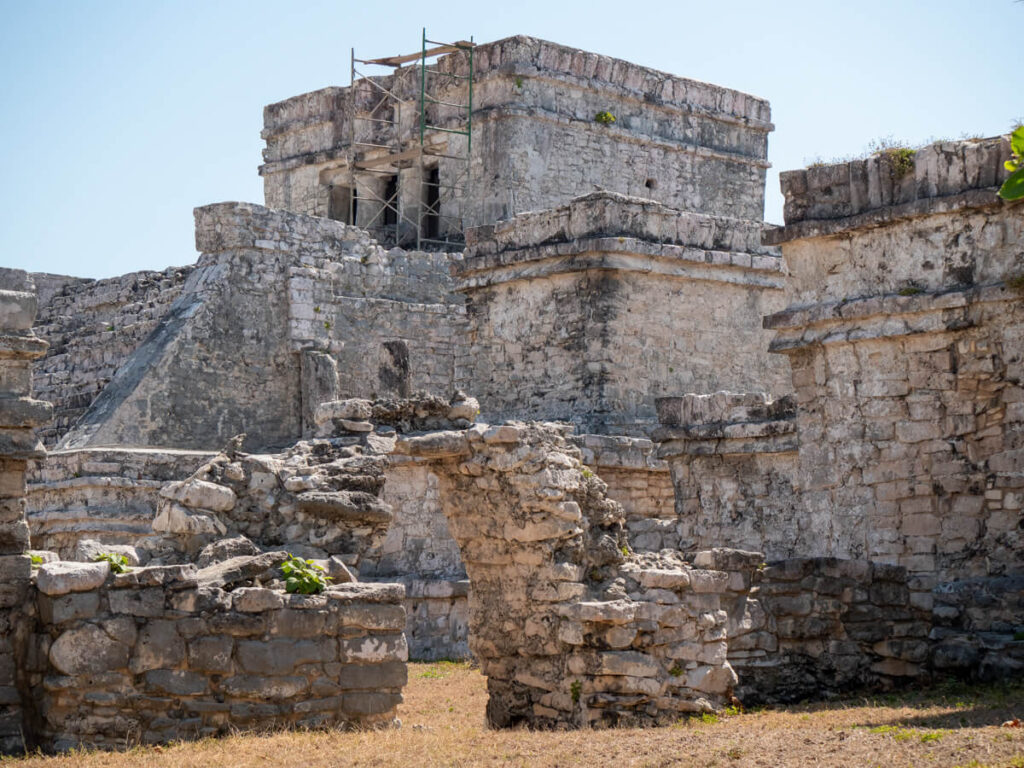
What makes the structures at the Tulum Ruins special is that they are really well preserved, with ongoing conservation work helping to stabilise and restore the site. When we visited, archaeologists were actively working on sections of the ruins, which gives you a sense of real-time archaeology. Most of the structures you’ll see date from around 1200-1500 CE, when Tulum was a thriving coastal trading hub rather than a ceremonial city. Buildings were constructed from local limestone and finished with plaster, many once brightly painted. While most of the colour has faded, traces of murals and carvings still survive in a few temples. Here are the main buildings to look out for.
El Castillo
El Castillo (The Castle) is one of the most iconic structures at Tulum, and the tallest at 7.5 metres (25 ft) high. It sits right in the heart of the complex, on the edge of the cliff and likely functioned as both a ceremonial temple and a navigational lighthouse for Mayan traders arriving by sea. Carvings and alignment features suggest it was connected to solar movements, particularly during equinoxes. Its elevated position made it visible from far offshore, guiding canoes through gaps in the reef.

El Palacio
El Palacio (The Palace) is one of the larger residential-style structures inside the walls. It’s believed to have housed elite members of society, possibly administrators or merchants tied to Tulum’s trade network. The building includes multiple rooms and doorways, indicating a more domestic function rather than a purely ceremonial one. While less visually dramatic than El Castillo, it gives a better sense of how people actually lived within the city. Look closely and you can still see remnants of plasterwork on the walls.

Templo del Dios de Viento
Templo del Dios de Viento (The Temple of the Wind God) is the iconic postcard picture of Tulum Ruins. It’s a small, rounded structure perched on the edge of the cliffs overlooking the sea. Its unusual circular shape helped reduce wind resistance during hurricanes, which were already a known threat to coastal settlements. The temple is thought to have been dedicated to Ehecatl, the wind deity, whose role was tied to rain, storms, and navigation.

La Casa de las Columnas
La Casa de las Columnas (The House of the Halach Uinic) is believed to have been the residence of Tulum’s ruler or highest authority figure. “’Halach Uinic’ translates to ‘true man’, a title used for local governors in Mayan society. The structure is relatively simple but strategically positioned near the ceremonial areas. Its placement reflects the close relationship between political leadership and religious life. Look out for iguanas basking in the sun along the top of its walls.

Templo de los Frescoes
Templo de los Frescoes (The Temple of the Frescoes) is one of the most historically significant buildings at Tulum. It contains some of the best-preserved murals at the site, depicting Maya deities, celestial symbols, and ritual scenes. These frescoes offer insight into religious beliefs during Tulum’s late occupation period. The temple went through several construction phases, showing how the city evolved over time. This is one of the few places where you can clearly see remnants of original artwork, so it’s worth looking at.

Playita Tortuga
Playita Tortuga is a small beach area near the ruins that’s often overlooked by visitors rushing through the site. It’s not ideal for swimming, and is actually roped off a lot of the time, because (true to its name) it’s an important turtle nesting site. It’s a good place to pause away from the crowds and look for signs of turtles – we saw this imprint of a nest in the sand, pictured below.

Playa Ruinas
Playa Ruinas is the famous beach directly below El Castillo. The water is usually clear and shallow, making it one of the most scenic swimming spots in Tulum, but access can be restricted when currents are rough. It was closed during our visit, and the tide was completely in anyway, so there was no beach to see. You can usually access it via a wooden staircase from the ruins, but be sure to time your visit with low tide if you want to go down on the sand or swim.

Tulum Ruins Iguanas
Iguanas are everywhere at the Tulum Ruins and are practically part of the attraction. They bask on stone walls, wander across pathways, and pose patiently for photos. The warm limestone and lack of predators make the ruins an ideal habitat for them. Despite their relaxed attitude, they’re still wild animals, so give them space and don’t try to touch or feed them.

Tulum Ruins birdwatching
The ruins are also a surprisingly good spot for birdwatching, especially early in the morning. You’ll often see brown pelicans, magnificent frigatebirds, ospreys, and various coastal species soaring overhead. The mix of jungle, cliffs, and sea creates a rich ecosystem within such a small area. We saw several brightly-coloured orange orioles. Bring binoculars if you’re into birding, as many species nest in the surrounding trees.

What to expect at Tulum Ruins – Our experience
Our journey to Tulum Ruins started in Downtown, where we caught the colectivo. At each stop on the main road, a staff member would radio colectivos to stop and help you onto the right one. They pass every 5 minutes or so, which is really convenient. We paid 25 pesos per person when we got off.
The arrival experience is similar to that at Manuel Antonio National Park, where vendors greet you dressed up as officials trying to sell you tour packages, but aren’t actually affiliated with the park in any way. The area at the main entrance has been totally overdeveloped, with shops, tour operators, and even a Starbucks. You’ll find lots of souvenirs on offer and individual merchants selling the general tourist tat you can find all over the Riviera Maya. A simple “no gracias” and a smile go a long way. We were also disappointed to see a tout offering paid photos with a captive monkey, which raises serious animal welfare concerns. These animals are often chained, stressed, and used purely as props for quick cash, with no regulation or oversight. It’s best to avoid these interactions altogether and not support attractions or individuals that exploit wildlife.
From the access road, we walked into the park and, instead of taking the shuttle, we carried on all the way down to the entrance for the Mayan ruins. Here, we queued to get tickets – it was cash only, and we had to have it exactly, as they didn’t have any change.
Inside the ruins was quite peaceful, as we’d arrived early in the morning, and the sea views were spectacular. You can walk along the well-marked paths between the limestone structures, with a lovely coastal breeze that makes the heat more manageable. The site gets busy quickly, but it never feels overwhelming because the layout is open and spread out. We particularly enjoyed spotting iguanas everywhere – sunning themselves on ruins, paths, and walls.
After we’d seen the ruins, we headed to a nearby beach, as Playa Ruinas was closed. We underestimated the difficulty of walking in the heat and were grateful for a fresh coconut from a local vendor – they’ll cut it up for you to eat on your way back. We reached Playa Pescadores, and were so disappointed it was covered in sargassum (even though it was only the very beginning of the season) and it absolutely stank! We didn’t stay long, heading back to the park entrance.
Instead of heading back to town, we took a colectivo north to check out the turtle tours in Akumal, which was a disappointing faux-eco-tourism experience, but that’s a story for another time.

Is it worth going to Tulum Ruins?
This is a tricky one to answer. Tulum Ruins were honestly probably our least favourite Mayan site that we visited in all of Latin America. But that doesn’t mean you’ll think the same.
Generally, we’d say Tulum Ruins is worth visiting, especially if it’s your first time in Tulum and you’re not visiting Mayan ruins elsewhere. While the ruins aren’t the largest or most elaborate in Mexico, their cliff-top setting is genuinely unique and hard to beat. The site is super accessible, you don’t need much time to see it all, and it’s a great way to infuse a bit of history into your trip to Tulum.
But in our opinion, visiting Tulum Ruins via Jaguar Park is not only not worth it, but a total rip-off. We can’t believe how much has changed, developed, and become more expensive since our first visit.
We’d also recommend skipping the ruins completely if you’re thinking of going on a weekend, on an afternoon, or during a busy holiday period. They’re so touristy and one of the most crowded sites in Mexico, with maybe the exception of Chichén Itzá. Try to go first thing on a weekday morning.

Is it safe to visit Tulum Ruins?
Tulum Ruins are generally very safe to visit. We never felt uncomfortable or unsafe here, but the pressure from touts can be unpleasant, and it’s easy to feel like you’re being scammed left, right, and centre with such unclear ticketing information.
Security staff are present throughout the site, paths are clearly marked, and it’s easy to explore independently without a guide. The main risks are environmental rather than criminal – strong sun, heat, uneven stone steps, and slippery areas near cliff edges can be hazardous. Wear sturdy shoes, bring lots of water in a reusable bottle, and follow the barriers, as climbing on structures is not allowed. Like any busy place, keep an eye on your belongings, too.

What to wear to Tulum Ruins
The Tulum Ruins are completely outdoors, exposed to the sun, and surprisingly hot, so comfort matters more than style. Lightweight, breathable clothing is essential, like loose cotton or linen rather than tight or synthetic fabrics. Comfortable walking shoes or trainers are a must, as the paths are uneven limestone and can be slippery, especially after rain. A wide-brimmed hat or cap and sunglasses will make a big difference, as there’s very little shade once you’re inside the site. If you plan to visit the beach below the ruins, wear swimwear underneath and bring a light cover-up for walking around the archaeological zone.

What to pack to visit Tulum Ruins
To ensure a smooth and comfortable experience in Tulum Ruins, don’t forget to pack your:

Where to stay to visit Tulum Ruins
Tulum Ruins sit right between Tulum Town and the Hotel Zone, so you don’t need to base yourself directly next door, but you do want to think about traffic, heat, and how early you’re realistically going to start your day. Staying in Downtown Tulum makes sense if you’re prioritising value, food options, and flexibility. The Hotel Zone, on the other hand, puts you closer to the coast and nearer to the ruins’ south entrance, but comes with higher prices and heavier crowds. There are lots of great hotels in Tulum, but here are our top hotel picks.
Top Tulum Hotels

Tulum Ruins FAQs
To help you plan a smooth trip to Tulum Ruins, we’ve answered these frequently asked questions.
What ancient ruins are in Tulum?
The Tulum Ruins are the remains of a fortified Mayan port city, known historically as Zamá (City of Dawn). The site includes coastal temples, administrative buildings, residential structures, and defensive walls, all set dramatically on limestone cliffs above the Caribbean Sea. Unlike inland sites, Tulum was built around trade rather than ceremony, with strong links to other Mayan cities via sea and inland routes.
Are Tulum Ruins Mayan?
The Tulum Ruins are Mayan, not Aztec. They were built and occupied by the Maya during the Late Postclassic period, roughly between 1200 and 1500 CE, and were still inhabited when the Spanish arrived. This makes Tulum one of the last cities the Maya lived in before European contact.
Why did the Mayans abandon Tulum?
Tulum was gradually abandoned in the decades following Spanish contact in the early 16th century. European diseases, disruption of trade routes, and colonial pressures played a major role, rather than any sudden collapse. The site remained known to local Maya communities long after it stopped functioning as a trading city.
Are Tulum Ruins free?
No, the Tulum Ruins are not free to visit. There’s a federal archaeological site fee, plus an additional conservation or park fee, depending on how you enter the area. Prices can change, but you should expect to pay in Mexican pesos.
How big are Tulum Ruins?
The Tulum Ruins themselves are relatively compact compared to sites like Chichén Itzá or Cobá. You can comfortably walk the entire archaeological zone in 1.5-2 hours, even at a relaxed pace. What makes Tulum special isn’t its size, but its coastal setting and preservation.
How to access Tulum Ruins?
The main entrance to Tulum Ruins is just north of Tulum Town along Highway 307. From there, you can either walk through Jaguar Park to the ruins or take a short shuttle that runs between the park entrance and the archaeological zone. There’s another entrance to the north of the Hotel Zone that is free to enter on foot or with a bicycle, and we cover both of these in more detail in this post.
Can you drive to Tulum Ruins?
You can drive to the Tulum Ruins via the main entrance, and there are several paid parking lots near the entrance. Parking is straightforward in the official car park, but it fills up quickly during peak hours, especially mid-morning. Arriving early makes a big difference.
Can you see Tulum Ruins from the beach?
It would be a bit of a hack if you could simply access the public beach for free and see Tulum Ruins from a distance, but alas, that’s unfortunately not the case. You can technically glimpse the cliffs and a few structures from the water or nearby beaches, but it’s not a substitute for visiting the site. The best views are from inside the archaeological zone.
Can you climb Tulum Ruins?
No, climbing is not allowed at the Tulum Ruins. Like most archaeological sites in Mexico, access to the tops of structures has been closed to protect the ruins and ensure visitor safety. You can still walk right up to the buildings and get excellent views without climbing.
Which ruins are better, Tulum or Chichén Itzá?
Despite costing nearly the same amount to enter, Chichén Itzá is larger, more monumental, and architecturally impressive, while Tulum is smaller but unmatched in setting, perched above the Caribbean Sea. If you want scale and history, Chichén Itzá wins; if you want atmosphere, views, and a shorter visit, Tulum may feel more rewarding.

Read next:
A Responsible Traveller’s Guide to Tulum: Worth Visiting or a Tourist Trap?
25 Unique & Non-Touristy Things to Do in Tulum + 4 Activities to Avoid
How to Get to Tulum: The Easiest & Cheapest Ways
How to Get Around Tulum: 12 Transportation Methods
Where to Stay in Tulum: Neighbourhoods & Top Hotels For Every Budget
15 Best Vegan & Veggie Restaurants in Downtown Tulum
A Complete Guide to Visiting Sian Ka’an Biosphere Reserve
A Traveller’s Guide to Akumal Beach Town & Bay: 10 Things to Do + 5 to Avoid
