What You Need to Know Before Taking Tren Maya: Routes, Stops, Tickets & Times

Our honest review and experience of riding Tren Maya, Mexico’s newest rail system.

This post may contain affiliate links, which means we might earn a small commission on anything purchased through these links at no extra cost to you. Learn more on our disclaimer page.
Tren Maya is one of Mexico’s most talked-about travel projects, connecting the Yucatán Peninsula’s biggest cities, archaeological sites, and natural attractions by rail. Designed to make travel between places like Cancún, Mérida, Bacalar, and Palenque faster and more accessible, it’s marketed as a game-changer for both locals and travellers.
But beyond the glossy headlines, the reality of using the Tren Maya as a tourist isn’t always straightforward – routes, stations, schedules, and environmental concerns all come into play. Throughout its construction, guides have cropped up online, written before its completion and by people who haven’t even set foot on the train. We were literally some of the first people ever to ride the train on our most recent trip to Mexico, and have collated everything you need to know, including what the Tren Maya actually is, where it runs, how to use it as a traveller, what it costs, and the pros and cons you should know before planning your trip around it, in this guide.
Tren Maya at a glance

More from Yucatán
What is Tren Maya?
El Tren Maya (the Mayan Train or Tsíimin-K’áak, meaning Fire Horse in Yucatec Maya) is a huge project that connects a whole host of destinations in eastern Mexico. It consists of a modern passenger rail network designed to redistribute tourist flow from the overcrowded coastal areas and to provide easy access to some of the previously neglected yet beautiful inland areas.
Different parts of the route were completed at different times, but the train has been fully operational since 2025, offering long-distance, intercity, and regional services. We recently took the journey from Cancún to Bacalar, as soon as this stretch of track opened, and it was a very interesting experience.
Trains are air-conditioned, comfortable, and designed for both locals and travellers, with different service classes depending on the route. Tren Maya also plays a strategic role in cargo transport, helping move goods more efficiently across the region.
While controversial during its construction, Tren Maya has quickly become a major part of how people move around southeastern Mexico.

Where does Tren Maya go?
The Tren Maya route (ruta) loops through the Yucatán Peninsula in eastern Mexico. It is divided into 7 sections and connects 5 states – Chiapas, Tabasco, Campeche, Yucatán, and Quintana Roo – linking the Caribbean coast with inland cities, jungle regions, and the Gulf of Mexico.
The route passes beach destinations, colonial towns, Mayan archaeological zones, and lesser-visited rural areas. Rather than focusing only on tourism hubs, it’s also been designed to serve everyday transport needs for local communities.

How long is the Tren Maya route?
The full Tren Maya network stretches roughly 966 miles (1,554 km), making it one of the largest rail projects in modern Mexican history. Travel times vary depending on the section, train type, and number of stops, but long-distance journeys are significantly faster and more comfortable than buses.

Tren Maya Map
You can see the Tren Maya route on the map below.

Tren Maya Route
Tren Maya’s stations connect some of the Yucatán Peninsula’s most popular destinations with places you’ve probably never heard of before.
There are 34 stops in total, including 20 major stations and 14 smaller stops. The route passes through 23 Pueblos Mágicos (magical towns) and 6 hotels designated as Tren Maya accommodations near archaeological sites and natural areas.
The route starts in Palenque (Chiapas) and travels northeast towards Cancún (Quintana Roo), through two routes that encircle the Yucatan Peninsula, one to the west through Campeche and the other east towards Chetumal, Bacalar, Tulum, and Playa del Carmen.

Tren Maya Highlights and Attractions
Here are some of the main stops and attractions on the Tren Maya route.
1. Cancún
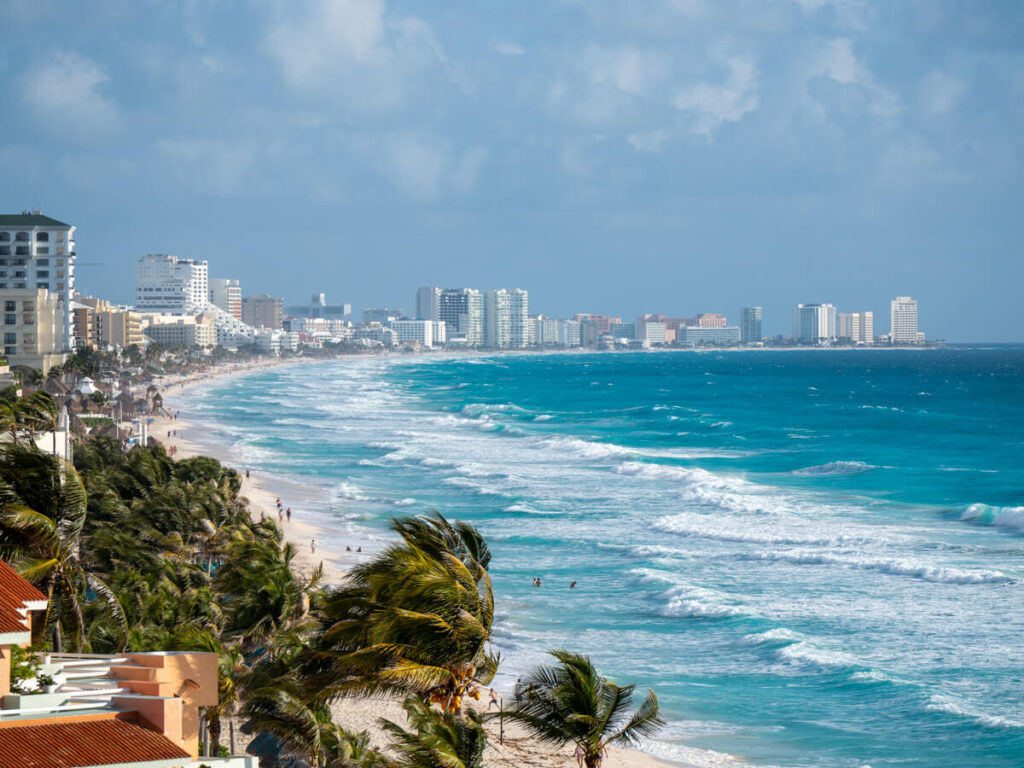
Cancún is probably the most popular place to visit in Mexico. A huge resort city built specifically for tourism, it’s known for its beachside resorts in the glitzy Hotel Zone, turquoise waters, nearby Isla Mujeres, and a plethora of tours and activities. It’s a huge travel hub, with an international airport and an ADO bus terminal, and it is now also the main gateway to the Tren Maya.
If you’re staying in the city, there are plenty of fun things to do in Cancún, from sailing to paradise islands like Isla Contoy and SCUBA diving at the MUSA underwater museum to snorkelling in cenotes and taking a day trip from Cancún to Mayan ruins.
While it’s very touristy, it’s also very convenient. Cancún’s transport connections make it simple to arrive by air and continue inland by train, either south along the coast or west towards Campeche.
2. Playa del Carmen
Playa del Carmen sits between Cancún and Tulum, just south of the popular town of Puerto Morelos, and offers a more walkable, compact feel than either. It’s known for its beachy lifestyle with a busy strip of restaurants and good nightlife options, making it popular with younger travellers and digital nomads.
The town is also well-positioned for visiting cenotes, nearby ruins, and eco-parks. Plus, it has ferry connections to Isla Cozumel, which offers some of the best SCUBA diving in Mexico.

3. Tulum
Known for the striking, clifftop Tulum Mayan ruins overlooking the Caribbean Sea and its upscale eco-resorts, Tulum is one of the most popular bases in Quintana Roo. The town itself is split into a Downtown and beachside Hotel Zone, while the wider area is packed with cenotes, lagoons, and nature reserves like the Sian Ka’an Biosphere Reserve.
The town itself has a relaxed, bohemian feel, although like Cancún, it’s suffered from overtourism and gentrification and can be busy in peak season, which affects natural areas and wildlife like Akumal Bay’s sea turtle population. Akumal Bay itself sits just north of Tulum.

4. Bacalar
Bacalar is centred around the Lagoon of Seven Colours, famous for its shifting shades of blue created by varying depths. It’s far calmer than the Riviera Maya, with a slower pace of life that suits activities like kayaking, paddleboarding, and swimming in the lagoon at spots like Los Rápidos.
It’s home to a variety of sustainable hotels, like Eco-hotel Casa Lamat, where you can enjoy lakefront views and activities like sunrise yoga, one of the best things to do in Bacalar.
You’ll also find boat trips on offer that can take you to Bacalar’s cenotes, deep sinkholes. The city also has historical interest, with its Fort of San Felipe being linked to pirate attacks.

5. Chetumal
Chetumal is a city in the south of Quintana Roo, right on the Mexico-Belize border. With far fewer tourists, it feels more local than some of the more popular destinations on the route. Travellers don’t really make it this far unless they’re crossing to or from Belize via the water taxi that connects the city with San Pedro on Ambergris Caye and Caye Caulker.
It may be more of a practical base, but there are still some interesting things to do in Chetumal, from local museums to day trips to beaches and Mayan ruins, which can fill a day or two if you’re stopping off here.

6. Calakmul
Hidden deep within one of Mexico’s largest protected rainforests, Calakmul was once one of the most powerful Mayan cities in the region, rivalling Tikal at its peak. The site contains over 6,000 recorded structures, though only a fraction are excavated, giving the area a truly wild, exploratory feel.
Climbing the tallest pyramid rewards you with uninterrupted jungle views stretching all the way to the Guatemalan border on clear days. You’re also highly likely to see wildlife like howler monkeys, spider monkeys, and toucans in the treetops. Its remoteness has helped preserve both the ruins and the surrounding ecosystem, so it’s a totally different (and much quieter) experience than other, more popular Mayan sites in Mexico.

7. Palenque
Palenque is one of the most atmospheric Mayan sites in Mexico, set against lush jungle foothills rather than flat scrubland. Although smaller than Calakmul or Chichén Itzá, its structures are remarkably detailed, with finely carved hieroglyphs and temples.
The Temple of the Inscriptions is especially significant, housing the tomb of one of the most powerful known Mayan rulers. Mist often hangs over the ruins in the early morning, adding to the sense of mystery – plus, arriving early is the best way to see the site with barely any other people around. Nearby waterfalls and forest trails make it easy to combine archaeology with nature in a single day, too.

8. Valladolid
Valladolid is a charming colonial town that’s a bit more relaxed than some of the other cities in the Yucatán Peninsula. The city’s pastel-coloured streets are compact enough to explore entirely on foot, with highlights like the main square, 16th-century San Servacio Cathedral, and the historic Convent of Saint Bernardino of Siena.
Valladolid is surrounded by dozens of cenotes, including the Instagram-worthy Cenote Suytun and Cenote X’kekén, as well as archaeological sites like the famous Chichén Itzá and lesser-known Ek’ Balam. The city is also known for its strong Yucatecan food culture, particularly slow-cooked dishes using traditional spices and techniques, making it a great place to try street food.

9. Chichén Itzá
Chichén Itzá is one of the most important archaeological sites in Latin America. A UNESCO World Heritage site and one of the Seven Wonders of the World, it’s probably the most popular tourist site in Mexico.
At its height, this Mayan city was a major political and ceremonial centre, and the layout reflects advanced astronomical and mathematical knowledge. The main pyramid, El Castillo, is precisely aligned so that light and shadow create the illusion of a serpent descending the steps during the equinoxes.
Beyond the pyramid, the site includes ballcourts, temples, and sacred cenotes that reveal the complexity of Mayan society. It’s undeniably touristy, often with huge crowds unless you arrive in the first hour of the day, but its scale and significance still make it an impressive stop worth visiting.

10. Mérida
Mérida is often described as the cultural capital of the Yucatán, and it lives up to that reputation. The city is home to a mix of grand colonial architecture and strong indigenous heritage that’s still visible in language, food, and daily customs. Free cultural events, including the Mayan ballgame Pok-ta-Pok and music and dance performances, regularly take place in the public square.
Mérida is also one of Mexico’s safest cities, making it a comfortable base for longer stays, although it’s by far the hottest place we visited in the country, with a humid climate thanks to its surrounding jungles. Its location makes it ideal for day trips to lesser-known archaeological sites like Uxmal Ruins and cenotes across the northern peninsula in an area shaped by the ancient Chicxulub impact – the massive asteroid strike that’s widely believed to have caused the extinction of the dinosaurs and left behind the porous limestone landscape that formed the region’s vast cenote system.

11. Campeche
Campeche stands apart from many other stops, being located on the west coast of the peninsula. It’s far less touristy than other destinations, but it’s still super interesting thanks to its fully intact city walls, originally built to defend against pirate attacks. The historic centre is a UNESCO World Heritage site, with colourful façades and quiet streets.
Unlike the Caribbean coast, Campeche faces the Gulf of Mexico, giving it a different atmosphere, with several beautiful islands and cuisine influenced by maritime traditions. As part of the Tren Maya journey, Campeche is sure to become more and more popular.

Tren Maya Ticket Prices
The cost of riding the Tren Maya varies depending on the class of service and the distance you’re travelling, but while it’s pricer than the bus, it’s generally affordable compared with flying or private transport.
There are four pricing brackets for Tren Maya tickets:
Tren Maya uses a dynamic fare system, which means that tickets are cheaper the earlier you purchase them. The discounts are as follows:
Ticket prices also vary by service. There are three different kinds of ticket types:
There’s also a digital, multi-day MayaPass, which allows you to take unlimited trips for 7 consecutive days along the Mérida–Tulum route. You can hop on and off as many times as you like, which is perfect for backpackers.

How much does it cost to ride the Mayan train?
Standard Tourist fares for local or regional segments often range from roughly 300–570 pesos (~ $17-40 USD) for shorter hops between nearby stops. Longer stretches of the full route cost more, with end-to-end trips costing around 800-1,500+ pesos (~$45-85+ USD) depending on category and demand.
If you opt for a Premier-class ticket, which includes more comfortable seating, air-conditioning, and sometimes onboard services, prices can be higher than Standard, typically 400-900 pesos (~ $22-50 USD) for the same local or regional segment distances.
The 7-day MayaPass costs:
Children, seniors, and local residents often have discounted fares, and advance tickets are cheaper than buying on the day.
The journey from Cancún to Bacalar cost us 2227 pesos, so around $60 USD per person and only took 4.5 hours. The ADO bus would have taken 6-7 hours and cost about $40 USD per person. It doesn’t sound much different, but we were on quite a tight itinerary, so getting in on the train at lunchtime meant we still had half a day to explore. A rental car was going to add a huge $350 USD one-way, which wasn’t feasible.

Buying Tren Maya Tickets
You can buy Tren Maya tickets (boletos) online or in person at a station.
The only official Tren Maya website to buy tickets is: https://reservas.ventaboletostrenmaya.com.mx/
You can toggle the website between Spanish and English. It’s easy to use – you simply choose your departure and arrival destinations, the number of passengers, and travel dates, then choose your ticket type and seats, before filling out your personal, contact, and payment details, and you’re done! You’ll be emailed your confirmation and boarding pass as a PDF.
You need to be sure to book the right type, as tourist tickets are more expensive than local ones (which keeps services affordable for locals while tourists still contribute to the local economy). If you book the wrong ticket type, you won’t be allowed to board the train.
Tren Maya also has a mobile app for iOS and Android, where you can check schedules and purchase tickets.
You need a valid form of ID (passport) to buy tickets and board the train.
Tickets are personal and non-transferable, and changes to your journey must be requested at least 48 hours in advance.
Tickets give you a luggage allowance of one suitcase up to 40 x 25 x 55 cm, weighing no more than 10 kg, plus a carry-on bag. Larger bags will incur an extra fee. Each passenger may bring one bicycle, with a maximum of 6 bicycles per train (2 per car).

Tren Maya Schedule
Tren Maya services run daily, with schedules varying by route, distance, and train type. Most routes operate from early morning until evening, making it easy to plan day trips or longer point-to-point journeys. Frequency is higher on popular coastal and city routes, as much as every 30-60 minutes, while more remote jungle sections have fewer daily departures.
For up-to-date schedules, the Tren Maya timetable can be found on the official website, which displays the stations, departure times and journey durations for each stretch.

Tren Maya Trains
The Tren Maya network consists of 42 modern trains. There are 3 train models:
Each train is limited to a maximum speed of 99.42 miles per hour (160 km/h).
Tren Maya Facilities
Tren Maya trains are modern and designed for comfort. Carriages have spacious seating, overhead luggage storage, and designated areas for larger bags.
As standard, they include:
We travelled on Tren Maya when it was brand new, so it was squeaky clean and very comfortable. We were surprised how spacious the seats are – even in the standard coaches, they’re much nicer than the trains we’re used to in the UK.

Is there food on Tren Maya?
Food availability on Tren Maya depends on the service and route, but many trains offer snacks, drinks, or light meals for purchase onboard. On longer journeys, you may find a small café-style service selling packaged food, hot drinks, and cold beverages. Wine and beer are available, but it’s not usual to drink alcohol on trains like the culture we have in the UK, so don’t expect a party atmosphere and don’t be disrespectful to other passengers.
Shorter regional routes don’t always include catering, so it’s a good idea to bring your own snacks just in case (although you’re not allowed to eat them on the train, unfortunately).
On our journey, there was a café with snacks, hot food, and hot drinks, as well as a vending machine of snacks and cold drinks.
The stations themselves also have food stalls or small cafés where you can grab something before boarding.


Tren Maya Stations
The Tren Maya stations are spread across both urban centres and more remote areas, often sitting slightly outside historic town centres. Most stations are modern and clearly signposted, with ticket counters, waiting areas, toilets, and basic amenities. Larger hubs have more facilities, while smaller stations are fairly minimal but efficient. Cancún even has a gift shop with Tren Maya paraphernalia for sale.

Tren Maya Station Platforms
The platforms themselves are spacious and typically covered or partially shaded, which makes waiting more comfortable in the Yucatán heat. Clear markings indicate boarding areas, carriage positions, and accessibility zones for passengers with reduced mobility.
At larger stations like Cancún, platforms are wider and paired with multiple tracks. The whole station is inside, with a large domed roof and multiple escalators and lifts leading down to the platforms from a raised concourse. Smaller stops tend to be simpler but are still well organised. Bacalar has outdoor but covered platforms, with escalators and lifts leading down to the main station area.
Electronic screens and announcements provide departure information, and we thought English signage was pretty decent.

Tren Maya Connections
One of the key criticisms we saw about Tren Maya was that the stations are located outside the city centres, meaning you need to take a connection. The stations are designed to connect easily with public transport like buses, taxis, and regional transport rather than operating in isolation. They also have pick-up and drop-off areas, as well as parking lots.
Honestly, it wasn’t really very difficult to navigate the connections; the buses and taxis are very affordable, and having to connect to a transfer from the train station is very standard in a lot of Europe, so we’re used to it.
Shuttle buses
Shuttle buses operate at many Tren Maya stations, linking platforms with nearby towns, city centres, and tourist zones. These are especially important where stations are located outside urban cores.
Shuttles usually run to coincide with train arrivals and departures, though frequency can vary. In Cancún, the train station is located at the international airport. There’s a 35 peso (~$2 USD) shuttle bus between the station and the airport. Equally, there’s a 35 peso (~$2 USD) shuttle bus from the downtown bus station in Valladolid to the train station and a 45 peso (~$2.50 USD) shuttle bus in Mérida.
You can also pick up a taxi or Uber directly from the station to reach Downtown or the Hotel Zone of each location.

Taxis
Taxis are widely available at or near Tren Maya stations, particularly in larger cities and tourist areas. Ride-hailing apps like Uber also work in some cities like Cancún and Tulum, and can be cheaper than a regular taxi.
When we arrived into Bacalar Station, we were directed to a short taxi queue outside (there’s no Uber). It was 50 pesos (~$2.50 USD) to reach Downtown in 10 minutes. Fares are usually fixed, but if not, it’s best to agree on a price before getting in.

Tren Maya Hotels
There are 6 Mayan Train Hotels:
These are official accommodations along the route that have been designed to make train travel more convenient and comfortable when you need to stop somewhere overnight.
Their locations are pretty self-explanatory from their names.

Tren Maya Rules
Tren Maya has clear rules designed to keep journeys smooth and safe for everyone.
These rules are enforced more strictly on some routes than others, but they’re in place to protect both passengers and the region.

Is it safe to take Tren Maya?
Tren Maya is considered a safe way to travel around the Yucatán Peninsula. The trains are modern, well-maintained, and staffed, with security present at stations and onboard. We saw armed military guards at several of the stations, which is pretty standard to see in touristy areas like Cancún and Tulum.
The route passes through some of the safest states in Mexico, and incidents affecting passengers are rare. As with any transport, it’s still wise to keep an eye on your belongings, especially at busy stations.
Your ticket covers medical and funeral expenses in the event of a railway accident. There were some criticisms of safety standards during construction, but the director, General Óscar Lozano Águila, has insisted Tren Maya is perfectly safe.

What is it like to take Tren Maya? Our Review
To give you an idea of what to expect when taking Tren Maya, we documented our experience. We took Tren Maya from Cancún to Bacalar on our second trip to Mexico. It was only a fleeting visit to the Yucatán Peninsula, as we headed down south to Belize to backpack Central America for the second time.
As we had such limited time, being able to take the new train was a huge advantage, allowing us some time to explore Bacalar on the same day that we arrived. If we’d taken the bus, we would have only had the evening to explore Downtown.
We bought our tourist tickets online. We found the website easy to use, but you need to look out for the seat allocation: although we were given seats 3 and 4, they weren’t actually together, but separated by the bar. We were able to choose our own seats together for free.
We arrived to Cancún Station by Uber, which was super smooth. From the drop-off area, we headed into the station. As we were early and some of the first people to ever ride this route, it was completely quiet. No shops or cafés were open except the gift shop.
Finding the ticket office was a bit tricky, as the signage was a difficult to follow. It didn’t help that some of the station was still not open, so there were escalators leading to empty floors. We imagine it’ll be much easier to navigate as it’s completely open and up and running now.
The staff at the ticket office were very helpful, confirming our reserved tickets and telling us to wait in the area until the platforms opened. When the time came, a queue formed to access the platforms. We had to show our ID (passports) to enter (like at an airport boarding gate) and were organised by carriage type and seat before being allowed to head down the escalators to the correct carriages.
The whole process was super smooth, everything was very new and clean, and the staff were very helpful. The journey itself whizzed by as we swept through the countryside. Most of the views were of jungles and mangroves, so it wasn’t the most varied view, but it was lovely to travel past the greenery. The free WiFi and charging ports didn’t work (probably because it was so new), but we didn’t mind as we had our Airalo eSIMs – we expect they will be working by now. We also tried the food, although there weren’t many vegetarian or vegan options. It was ok, but nothing particularly amazing. Overall, it was a quick and convenient travel experience that went super smoothly.

Benefits of travelling on the Tren Maya
The Tren Maya offers a unique way to explore Mexico’s Yucatán Peninsula. The project was a $30 billion investment, a huge undertaking, and had ambitious objectives, promising faster travel, economic growth, and increased tourism across the region. Here are some of the project’s benefits:

Tren Maya Controversies
Tren Maya’s construction was hugely controversial. Environmentalists, archaeologists, indigenous groups, and local communities have all raised concerns about the network’s impacts.
At first, it was hard to understand why. There was very limited information about the project online in its initial phases. Even speaking to locals in person in Mexico before taking the train, we weren’t met with many strong opinions to deter our travel plans, just some wariness about safety and some political opinions about the government. But as we dug deeper, we were made aware of concerns about deforestation, displacement, cost, cash flows, and safety standards.
It helps to understand some history. The Tren Maya project was conceived and championed by Mexico’s government, led by President Andrés Manuel López Obrador (AMLO) and his party, Morena. It was a central part of AMLO’s infrastructure and tourism plan, aiming to boost economic development across the Yucatán Peninsula, especially in underdeveloped inland areas.
Construction began in stages in 2019-2020, with the first sections opening in 2023-2024, and the full route fully operational by 2025.
Below is a closer look at the key controversies surrounding the project:
Essentially, the Tren Maya project has been deeply polarising. A lack of transparency, mismanaged environmental impacts, and limited community engagement have overshadowed what could have been a transformative transport initiative. Even with mitigation plans, critics argue that the long-term ecological and cultural costs may outweigh the benefits. Calls to boycott the train reflect frustration over the perceived destruction, though some point out that avoiding the service would do little to reverse the damage and could deprive local communities of the economic gains they already rely on.
Acknowledging these concerns, the Mexican government has formally recognised the environmental harm caused by the Tren Maya project and introduced a comprehensive restoration plan, including reforestation, enhanced wildlife crossings, protection for cenotes and caves, and removal of unnecessary infrastructure.

Tren Maya Pros and Cons
There’s a lot to think about, so we’ve put together some quick-fire pros and cons of taking Tren Maya.
Pros
Cons

Tips for taking Tren Maya
Here are some top tips for travelling on the Tren Maya, based on how it actually works in practice:

Is Tren Maya Worth it?
The Tren Maya can absolutely be worth it, but it depends on how you plan to travel and what you expect from the experience. If you want a comfortable, air-conditioned way to cover long distances between places like Cancún, Mérida, Palenque, and inland Mayan sites without driving, it’s a genuinely useful option. It’s faster than most buses on longer routes, removes the stress of traffic and parking, and makes multi-stop itineraries much easier, especially if you’re short on time.
Having said that, it’s not perfect. Tickets are often more expensive than buses, schedules can be limited on certain sections, and some stations are still isolated, meaning you’ll need shuttles or taxis to reach towns and hotels. We honestly wouldn’t bother with it for short journeys like Cancún to Puerto Morelos or Playa del Carmen, as the ADO bus network is perfectly adequate.
The biggest caveat is the controversy surrounding its construction. Environmental damage, rushed approvals, and inadequate consultation with Indigenous communities have left a lasting shadow over the project. Although the train is now operational and restoration plans are in place, many travellers understandably feel conflicted about supporting it, which is a personal choice.
But overall, the Tren Maya is worth it for convenience, comfort, and access to more remote locations, particularly if you want to explore inland Yucatán. If you’re travelling on a tight budget, want maximum flexibility, or feel strongly about the project’s environmental impact, buses or regional flights may suit you better.

Tren Maya Video
Check out our video of taking Tren Maya, and be sure to follow us on Instagram for travel tips from similar destinations!
Tren Maya FAQs
We’ve answered these frequently asked questions to help you plan your journey on Tren Maya.
Is Tren Maya finished?
As of 2025, the Tren Maya route is fully operational, with regular services connecting the Yucatán Peninsula’s major tourist hubs, archaeological sites, and inland towns.
Can you sleep on Tren Maya?
You can sleep on the Mayan Long Distance Train model, one of the three kinds of Tren Maya Trains. It features cabins with seats that turn into beds.
How can I buy Tren Maya tickets?
Tren Maya tickets can be purchased online through the official Tren Maya website, via the mobile app, or at station ticket counters in person. Booking in advance is recommended for peak-season travel and lower prices.
How much did Tren Maya cost?
The Tren Maya project’s total investment was roughly $30 billion USD, covering construction, rolling stock, and related infrastructure.
Is Tren Maya a success?
Tren Maya’s success is mixed: it offers comfortable, fast, and eco-friendlier travel while opening access to new destinations, but controversies over environmental and indigenous impacts remain significant.
Does Tren Maya go to Cancún Airport?
Tren Maya connects directly to Cancún International Airport, making it convenient for travellers flying in or out of the region. We took the train from here, and it was a smooth journey.
Does the Tren Maya go to Chichen Itza?
The Tren Maya line stops near Chichén Itzá and at Valladolid, providing easier access for tourists without needing a car or a long bus journey.
Does Tren Maya go to Playa del Carmen?
Playa del Carmen is one of the key stops on the Tren Maya route, connecting the coast with inland sites.
Is there a free shuttle from Tren Maya?
Some Tren Maya stations, like Cancún, offer free or low-cost shuttle services to nearby towns, hotels, and attractions, but availability varies by station, so check locally before planning your connection.

Read next:
A Traveller’s Guide to Cancún: What to Know as a First Timer
How to Get to Cancún: Transfers, Connections, Buses + More
Is Isla Mujeres Worth Visiting? Our Honest Answer + Travel Guide
