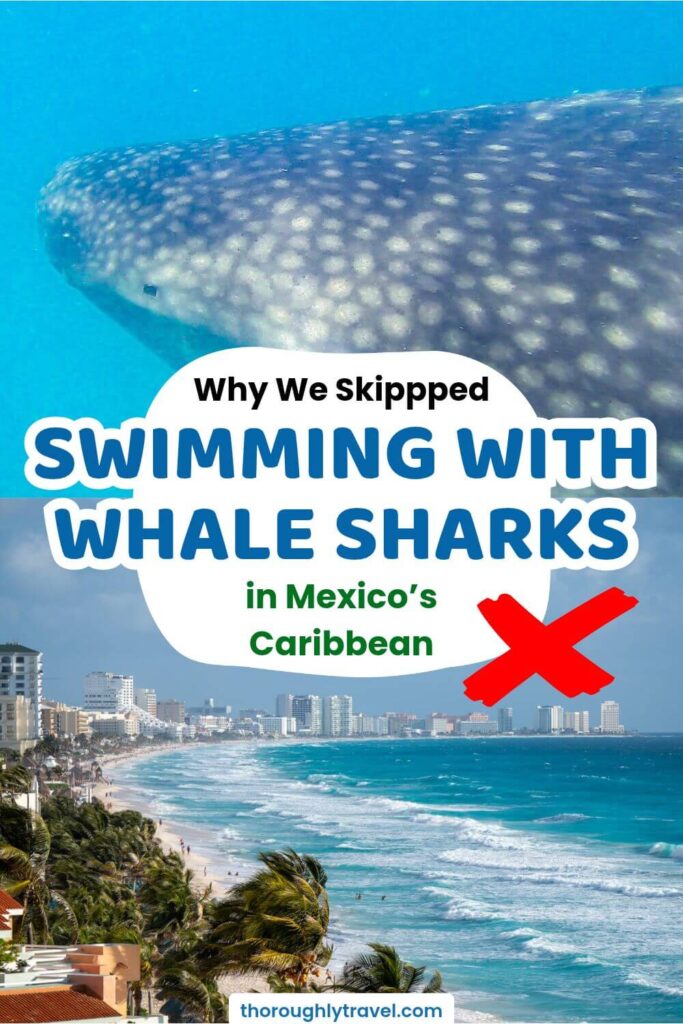
Why We Skipped Swimming with Whale Sharks in the Mexican Caribbean & Where to Go Instead

The truth about swimming with whale sharks in Mexico, why we skipped it in Cancún, Isla Mujeres, and Isla Holbox, and where we ethically swam with whale sharks in Mexico.

This post may contain affiliate links, which means we might earn a small commission on anything purchased through these links at no extra cost to you. Learn more on our disclaimer page.
Swimming with whale sharks is high on many travellers’ bucket lists, and the Mexican Caribbean is one of the best-known places in the world to see them. Every year, these enormous fish gather in the waters off the Yucatán Peninsula, with tours departing from popular destinations like Cancún, Isla Mujeres, and Isla Holbox. But just because an experience is widely advertised doesn’t mean it’s the right choice for responsible wildlife tourism.
We considered swimming with whale sharks in the Riviera Maya during both of our previous trips to Mexico but ultimately decided against it. After looking into how the tours operate, the number of boats involved, and the potential impact on the animals, we weren’t convinced that the experience was worth supporting. In this guide, we’ll explain why we chose not to swim with whale sharks in the Mexican Caribbean, what concerns we have about the tours, and where we’d recommend going in Mexico to swim with whale sharks ethically instead. We’ll also compare alternative destinations, explain what makes a whale shark encounter more responsible, and share practical advice for choosing an experience that puts wildlife first.
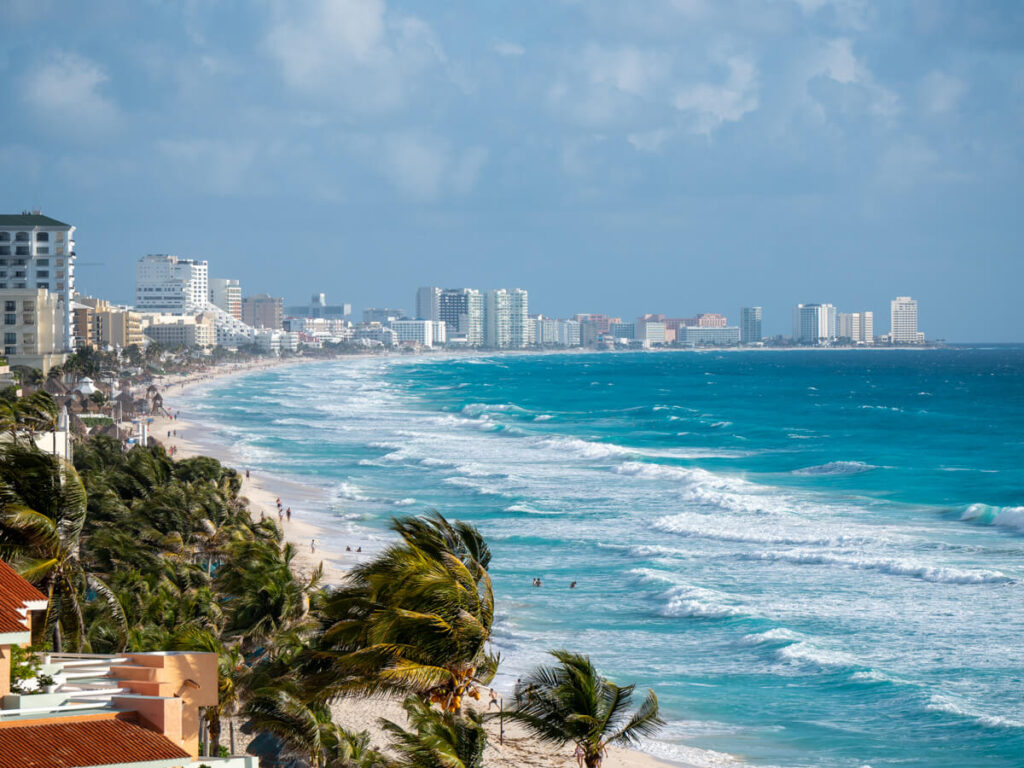
More from Mexico
About Mexico’s whale sharks
Mexico is one of the world’s best-known destinations for encountering whale sharks, and for good reason. The country experiences two whale shark seasons: one in summer at the northeastern tip of the Yucatán Peninsula and one in winter off the Pacific Coast.
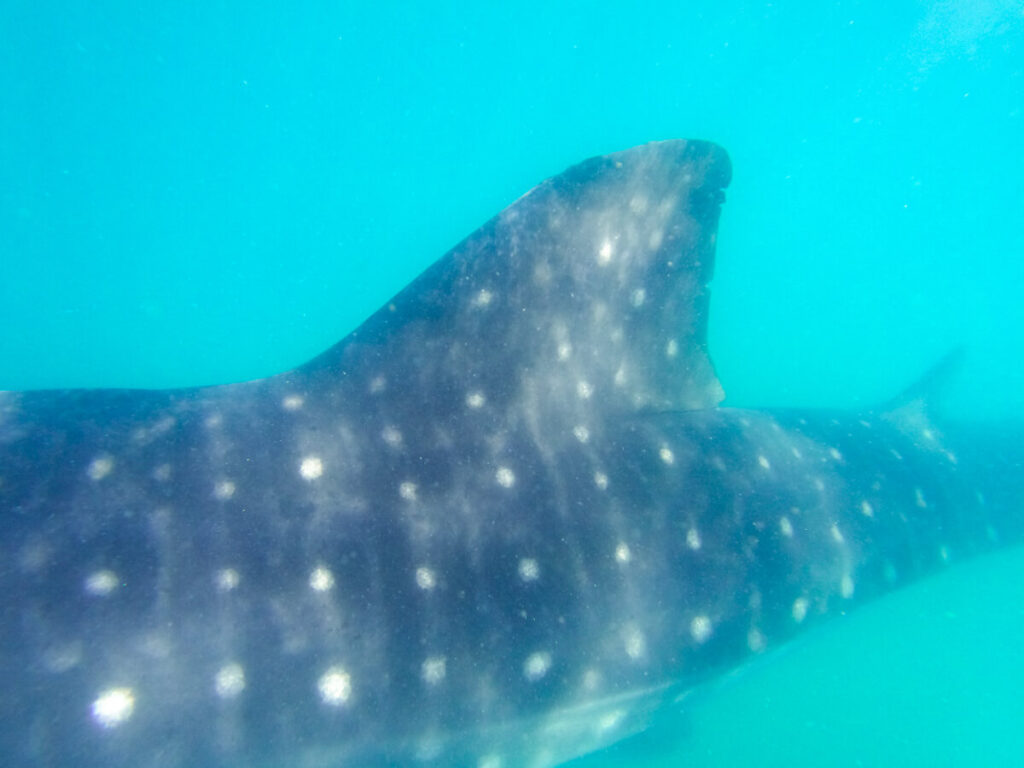
Despite their name, whale sharks aren’t whales at all. They’re slow-moving, filter-feeding sharks that travel through tropical and warm temperate waters in search of food. Rather than hunting large prey, they filter tiny organisms and fish eggs from the water, sometimes gathering in particularly productive areas where food is abundant.
The scale of the aggregations can be absolutely huge, sometimes numbering up to 400 whale sharks in the same area at once. The discovery helped put the region on the map as a major ecotourism destination, and tourism soon expanded from fishing communities such as Holbox to Isla Mujeres and Cancún.
And that’s where our reservations begin. A mass congregation of whale sharks off the coast of an area of Mexico notorious for the pressures mass tourism creates a difficult balance between wildlife conservation and commercial demand. Can it truly be done sustainably?
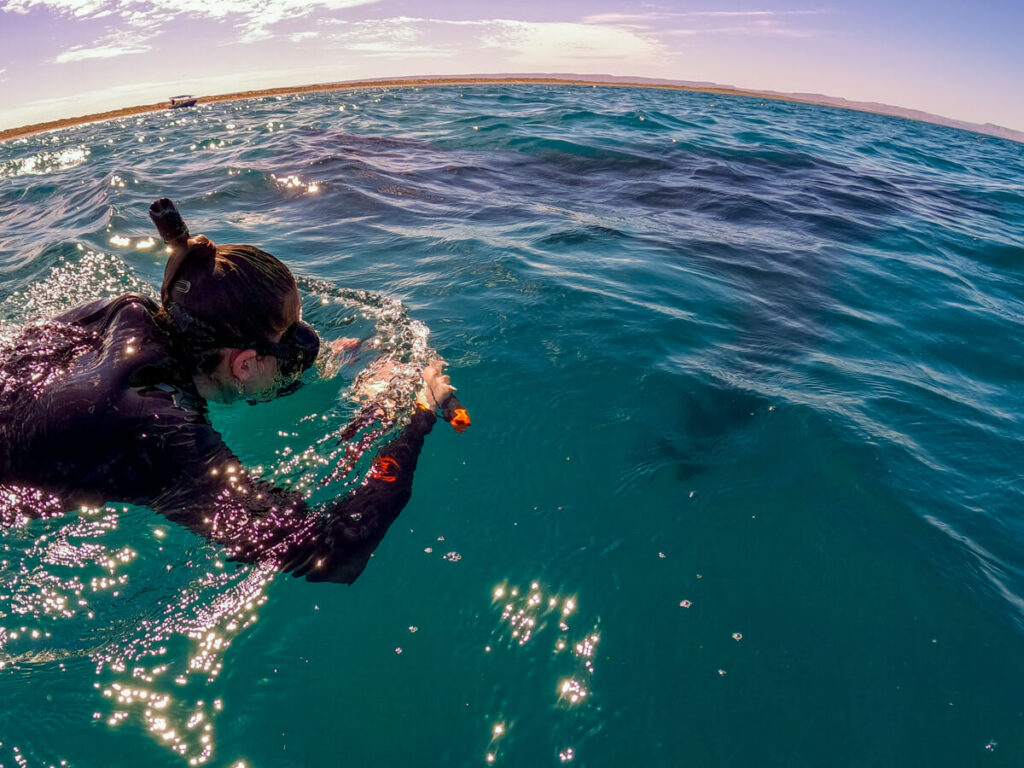
Planning a trip to Yucatán?
Mexico is a very popular destination, so be sure to book in advance as early as possible!
Top Experiences in Yucatán
Eco-Hotels in Yucatán
Transport in Yucatán
Best eSIM for Yucatán
Where is the best place in Mexico to see whale sharks?
Swimming with whale sharks in Mexico is permitted in several parts of the country, but the experience varies considerably depending on where you go.
The two main regions are the Mexican Caribbean, which is famous for its huge summer aggregations, and the Sea of Cortez on the west coast, which would be our personal choice and was a highlight of our last trip to La Paz.
Mexican Caribbean
No matter where you depart from in Quintana Roo, boats generally head to the same body of water: the Afuera (also known as El Azul or the Blue Realm). A deep-water zone located far offshore, east of the northeastern tip of the Yucatán Peninsula, this area is known for seasonal concentrations of whale sharks feeding on fish eggs and other planktonic food. Researchers have also documented whale sharks off Cabo Catoche near Isla Holbox, which is closer to shore.
Tours operate from several destinations, including:
Sea of Cortez
The Sea of Cortez (also called the Gulf of California) offers a very different setting for whale shark encounters. Rather than travelling out from the busy resorts of the Caribbean coast, you can explore feeding areas much closer to shore in Baja California Sur.
In both regions, whale shark tourism is regulated, and operators should hold the relevant authorisations. However, having rules in place doesn’t mean every operator will follow the rules, or that the trip will feel quiet, intimate, or well managed.

When can you see whale sharks in Mexico?
Whale sharks visit different parts of Mexico at different times of year. The Mexican Caribbean season falls during the summer, while the main viewing periods on the Baja California Peninsula vary between locations, but typically span the winter months.

How to swim with whale sharks in Mexico?
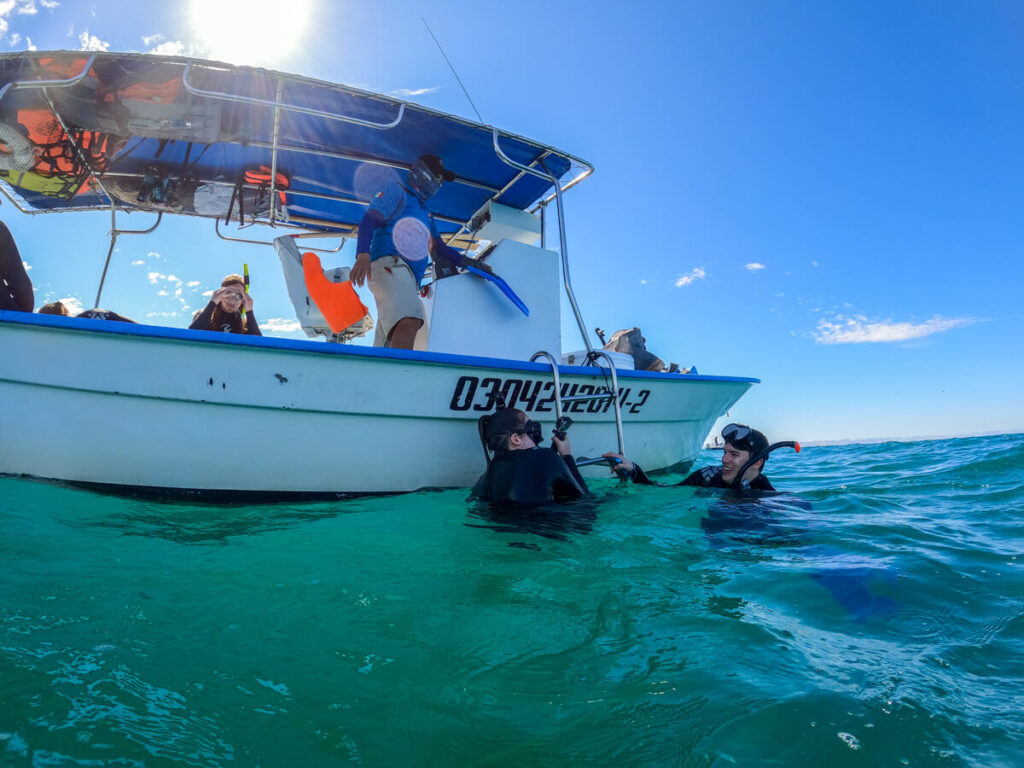
Whale shark tours in Mexico typically involve a boat trip to a seasonal feeding area, where the captain and guide search for whale sharks near the surface. If one is spotted, you’ll receive a safety briefing before taking turns entering the water to snorkel alongside it, always following the guide’s instructions and keeping a respectful distance.
The experience differs between the east and west coasts. In the Mexican Caribbean, boats travel offshore to reach the huge summer aggregations, and the journey can take an hour or more depending on your departure point. On the Pacific side around La Paz, whale shark tours operate within a designated area of the bay, much closer to shore.
The main difference is that tours in La Paz are allocated a specific slot via daily ballot. There are four slots, with a maximum of 14 boats at a time, meaning the daily cap is 56 boats. In the Mexican Caribbean, the limit is 120 boats per day, which is considerably higher.
Tours in the Caribbean typically only go out to see the whale sharks, while combination trips on the Pacific side can include other stops like swimming with sea lions, sailing to Isla Espíritu Santo, or lunch on Balandra Beach.
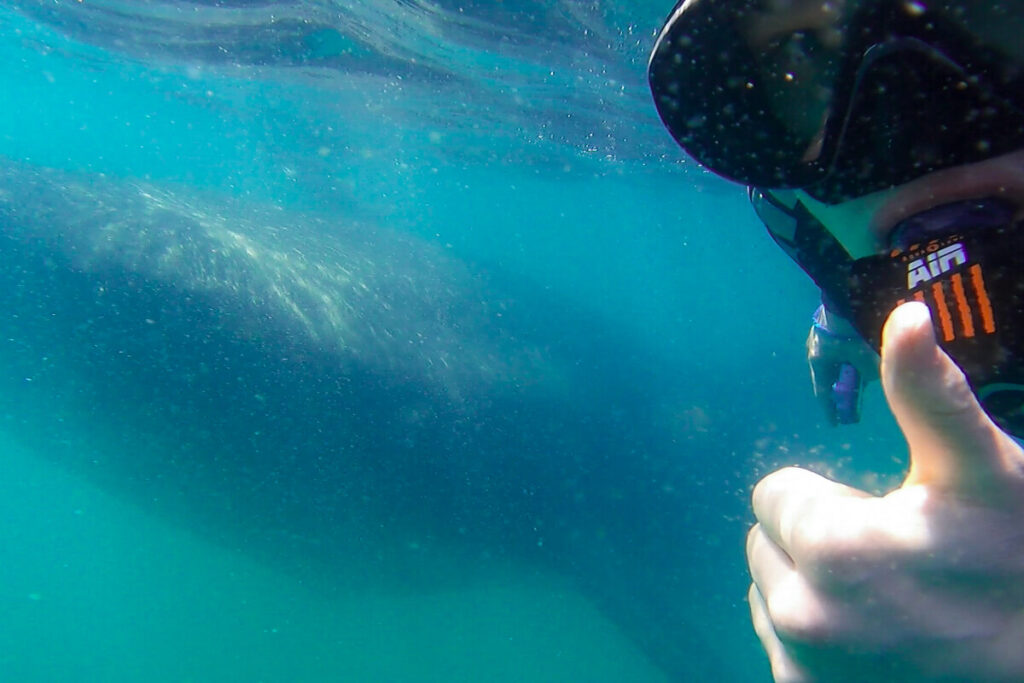
Is swimming with whale sharks in Mexico ethical?
Whale sharks are classified as Endangered on the IUCN Red List, meaning they’re at a high risk of extinction in the wild. Their populations have declined significantly over several generations, largely due to human activities like fishing, accidental capture, and collisions with boats.
They’re also slow-growing animals that take years to reach maturity, making it difficult for populations to recover when numbers fall. Protecting the individuals that gather in Mexico’s seasonal feeding grounds is therefore incredibly important.
That doesn’t mean swimming with whale sharks in Mexico is unethical, though. It’s not a simple yes-or-no answer, and the impact depends heavily on where you go, how many boats are operating, how well the rules are enforced, and the behaviour of individual tour operators.
For generations, fishing was an important source of income for coastal communities, including on Isla Holbox, where commercial shark fishing took off in the 1940s before declining in the 1980s. As whale shark tourism developed in the early 2000s, local fishermen began moving into the tourism industry, retraining as boat captains, crew members, and wildlife guides. This gave some people an alternative way to earn a living from the sea without relying solely on catching fish. Research in La Paz found that many tourism charter operators had previously worked as small-scale fishers and had improved their incomes and quality of life after moving into tourism.
We think this is an important part of the conservation story – when local communities can earn a worthwhile living from keeping wildlife alive and attracting visitors to see it, there’s a stronger economic reason to protect these animals.
Of course, tourism needs to be properly managed, and the benefits need to reach local people for this to work in the long term as a form of sustainable tourism.
Mexico does have a lot of regulations designed to protect whale sharks and minimise disturbance. Compared with some other whale shark tourism hotspots around the world, Mexico is much better than places like Oslob in the Philippines, which has attracted criticism for feeding whale sharks to keep them close to shore, a practice linked to changes in their natural behaviour, a sign of unethical wildlife tourism.
However, having regulations on paper doesn’t guarantee that they’re always followed. Research published in 2025 found frequent breaches of whale shark tourism rules in the Mexican Caribbean, while studies in Bahía de La Paz have documented concerning levels of injuries among whale sharks, including injuries associated with boats.
Ultimately, we don’t think swimming with whale sharks in Mexico is inherently harmful. If you choose a properly authorised operator that follows the regulations, keeps group sizes manageable, gives the animals space, and puts their welfare ahead of getting guests a photograph, it can be a low-impact wildlife experience.

How does Mexico protect whale sharks?
Mexico has several layers of protection in place for whale sharks, covering everything from where tours can operate to how boats and swimmers must behave around the animals. The aim is to allow people to observe and swim with whale sharks without putting unnecessary pressure on the species or its feeding grounds.
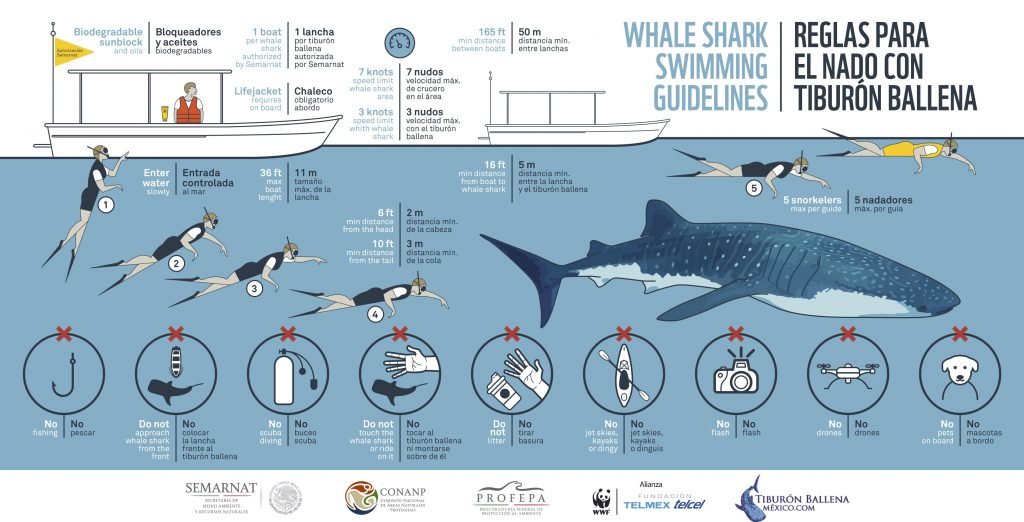
A key piece of legislation is NOM-171-SEMARNAT-2018, a national standard that sets out the rules for whale shark observation and swimming activities throughout Mexico. It covers requirements for tour operators, authorised swimming areas, boat behaviour, guide-to-swimmer ratios, and minimum distances from the sharks. It also prohibits touching, chasing, harassing, or riding whale sharks.
There are two main government organisations involved in managing these activities:
Enforcement is also important. PROFEPA, Mexico’s Federal Attorney for Environmental Protection, carries out inspections and checks that tour operators have the correct permits and are following the rules. This can include checking boats, passenger numbers, and how many vessels are gathering around individual whale sharks.
The regulations themselves include practical measures designed to reduce disturbance. For example, boats must control their approach and speed, only a limited number can interact with an individual shark at once, and swimmers must maintain the prescribed distances. Visitors are also prohibited from touching or pursuing the animals, and certain equipment and behaviours are restricted.
We’ve done a deep dive into the regulations for swimming with whale sharks in La Paz in our dedicated guide, which goes into way more detail and also covers the whale shark management plan for the 2026-2029 seasons.
The regulations for swimming with whale sharks in Mexico’s Caribbean are similar, including:
There are additional rules for boat operators laying out how to approach the whale sharks, what to do in the zone, how the boat should be driven, and how to manage the activity.
Why we skipped swimming with whale sharks in Mexico’s Caribbean
We personally chose to skip swimming with whale sharks in Cancún, Isla Mujeres, and Isla Holbox. Here’s why.
Scientific evidence
Scientific research found non-compliance was frequent even when boat numbers were well below the permitted limit of 120, while this study found relatively high rates of reported physical contact between tourists and whale sharks, even though it’s forbidden. They also found that the presence of a patrol boat had limited success in reducing non-compliant behaviour.
While some contact is likely accidental, it’s still concerning, as it can cause stress or injury to the animals. It’s possible that sheer commercial demand for encounters with whale sharks makes responsible management more challenging. With so many operators competing for customers, there can be pressure to deliver close encounters and memorable photographs, potentially at the expense of following the rules. Tourists may also arrive with little understanding of whale shark behaviour or the regulations, and some may be inexperienced snorkellers or less confident in open water.
Social media only exacerbates the problem. The desire to capture that perfect close-up photo or video can encourage operators to prioritise memorable encounters over keeping their distance, while tourists may arrive with unrealistic expectations about how close they can get.
Conditions can make things more difficult, too. Unlike a sheltered bay, the Caribbean aggregation areas are often reached in deeper, exposed water, where currents, waves, and boat traffic can make getting in and out of the water more challenging. When there are numerous swimmers and boats around the same animal, the chances of accidental contact, confusion, and disturbance are likely to increase.
Anecdotal evidence
We also came across plenty of anecdotal accounts describing overcrowded encounters, like this Reddit thread, which describes 20 boats chasing a single whale shark. Reviews and first-hand accounts like these are an important part of our research process, and suggest that all may not be as well managed as the tour operators’ websites would have you believe. It was a theme that came up in reviews during our research.
We’ve seen videos like this Instagram post, which show boats crowding whale sharks, choppy conditions, and numerous people in the water. This specific post mentioned 3-40 boats, 300+ people, and just 3 whale sharks, which is totally unsustainable.
When conditions are rough, tourists are not strong swimmers or prepared for the experience, and tours are overcrowded, the risk of accidental contact and disturbance increases. It can also make the experience uncomfortable or even unsafe for visitors who aren’t confident swimmers or aren’t prepared for open-water conditions.
Who to book with
If you’re considering a whale shark tour in Mexico’s Caribbean, we’d check the operator holds current SEMARNAT authorisation – every licensed boat must display an official flag (banderola).
We also want to be clear that none of this means swimming with whale sharks in Mexico – or operators offering the activity – are inherently unethical. A lot depends on the day, the company, and how well the rules are followed. Some encounters may be well managed and respectful, while others may not be.
We did find companies making an effort to keep groups manageable and educate guests about the animals and the rules. We did a lot of research into the available options, and these are four we’d look into first if you decide to go ahead with the tour:
Who not to book with
Who you don’t support is arguably more important than who you book with. We’d personally avoid any operators whose wider business includes captive wildlife attractions or other animal experiences you don’t agree with.
That includes captive dolphin encounters, like those offered at Dolphin Discovery and Xcaret parks. Additionally, Cancun Adventures promotes its commitment to conservation and education, but it sits within The Adventures Group, whose wider portfolio includes captive dolphin facilities in Cabo and Puerto Vallarta. Its sister brand, Cabo Adventures, also sells camel-riding experiences.
We appreciate that these are separate activities and that the companies promote their own animal welfare policies, but they’re not experiences we’d choose to support, so we’d rather not spend our money within the wider group.
Our takeaway
For us, the scale of the industry, the research documenting repeated rule-breaking, and the accounts of overcrowded encounters and rough conditions were enough to put us off, and we weren’t comfortable contributing to the demand.
With La Paz offering a better-regulated alternative that we felt more confident about, it was an easy, albeit sad, decision for us to skip the Mexican Caribbean whale shark tours. It felt like the more responsible decision.
Swimming with whale sharks in Mexico’s Caribbean vs Baja California
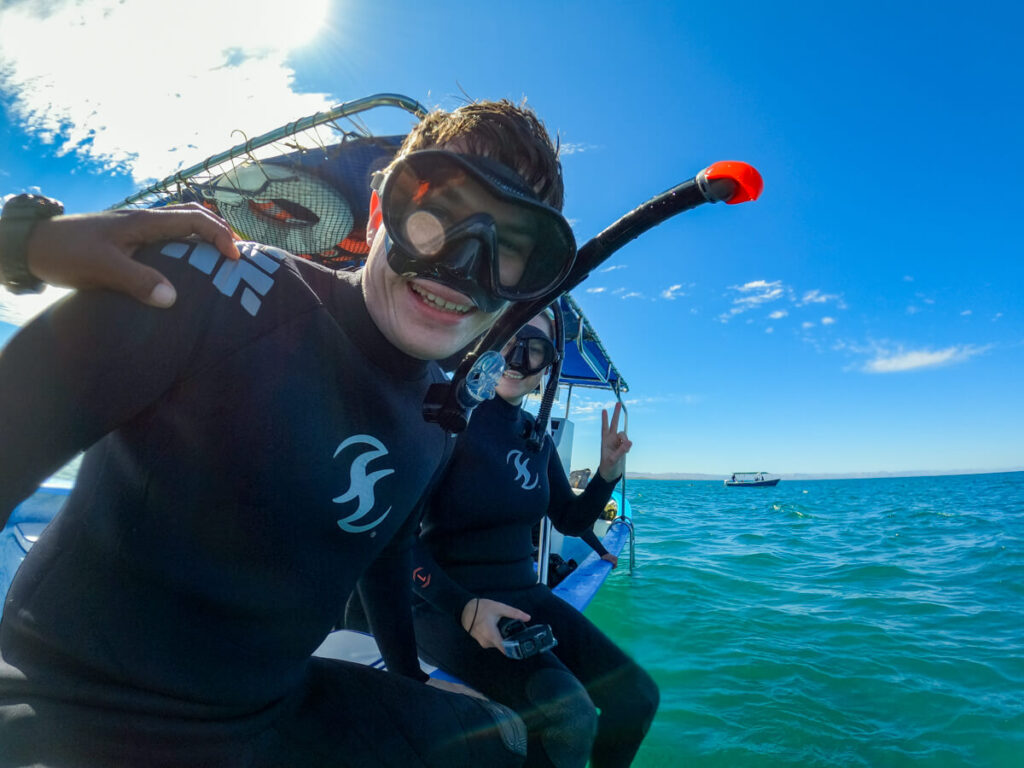
When planning our trips and looking at whale shark tours, we didn’t rule out the east coast altogether, but La Paz seemed to offer a more controlled experience, and ultimately gave us greater confidence in choosing a responsible tour.
Here’s what stood out to us when comparing the two destinations.
The regulations
There are nationwide rules governing whale shark tourism in Mexico, but the local management arrangements are different, and we felt La Paz offered a more regulated way to experience the encounter.
One of the biggest differences is the number of boats authorised to operate in the Mexican Caribbean. Around 300 boats were licensed in the 2026 season, and up to 120 boats were allowed to operate in the whale shark tourism area each day.
That’s considerably more than in La Paz, where 112 operators are licensed and only 56 boats are allowed in the swim zone each day.
La Paz has a designated Whale Shark Refuge in the bay, with a specific management plan for the activity.
The journey
The location of the whale shark swim zone also makes a difference to your personal tour experience. In Mexico’s Caribbean, tours generally travel offshore to reach the seasonal feeding aggregations, which can mean a fairly long boat journey (around an hour) before you even get in the water. We’ve also read and heard that it’s quite a rough journey, frequently with choppy waters.
In comparison, the whale shark zone in La Paz is protected in the bay and only around 15 minutes from the marina, so it’s much closer and smoother.
The operators
Choosing the right operator matters wherever you go. One thing we liked about researching La Paz was the clearer focus on operating the tour responsibly. We found more operators being openly transparent about how the tours work, what the regulations are, and stating they were committed to eco-friendly practices, which were green flags for us.
The crowds
This was another big deciding factor for us. The Caribbean’s enormous seasonal gatherings attract a lot of interest, and the popularity of the experience means that multiple tour operators may be searching the same broad area.
We came across accounts of crowded encounters, including reports of numerous boats gathering around individual sharks.
As we said, La Paz allows fewer boats into the area a day, with four designated time slots, so it’s better managed to disperse the boats and be less crowded.
Other factors
We will say, though, we can see the appeal of swimming with whale sharks in Isla Mujeres and off the east coast – the waters are warmer than the Pacific, it’s highly convenient if you’re travelling the Yucatán Peninsula, and the season is perfectly timed with the summer holidays (although that’s actually not the best time to visit Mexico’s Yucatán).
Is it safe to swim with whale sharks in Mexico?
Swimming with whale sharks in Mexico can be a safe and memorable experience, provided you go with a responsible, licensed operator and follow the safety instructions.
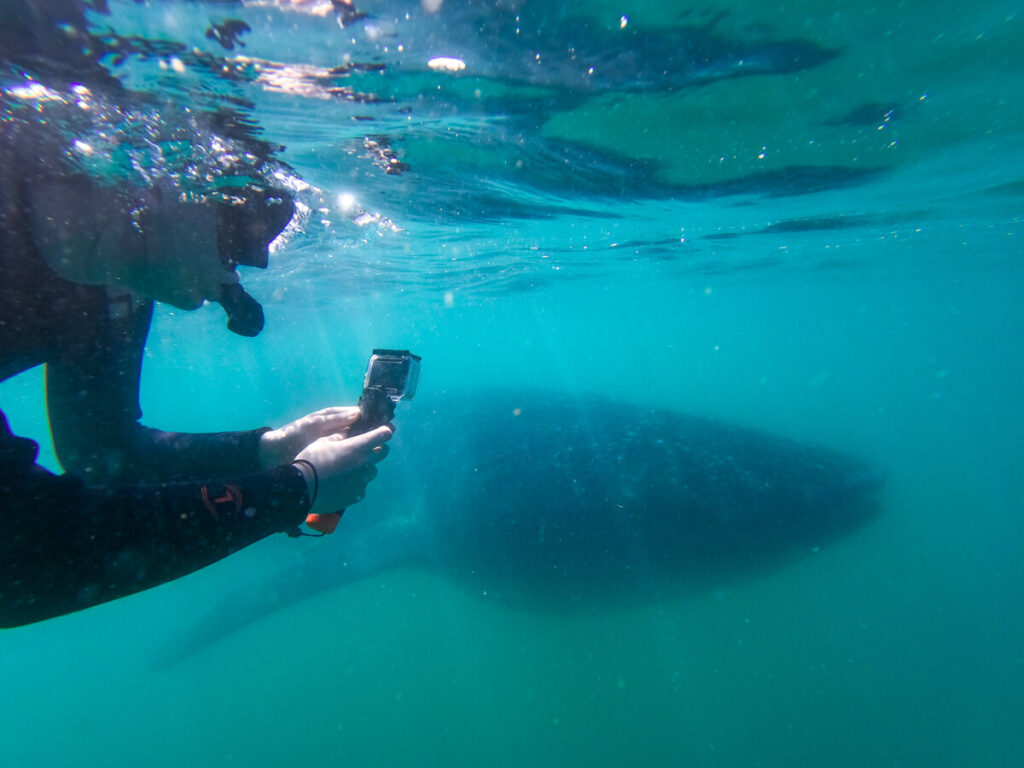
Despite their enormous size, whale sharks are gentle, filter-feeding fish and pose very little direct threat to people. That said, they’re huge and being hit by one would hurt, which is why maintaining the designated distance from them and not diving down or getting in front of them is so important.
The bigger safety considerations are often the conditions around the encounter rather than the whale sharks themselves. Boat traffic, waves, currents, visibility, and the number of people in the water can all affect how safe and comfortable a swim feels.
You don’t need to be an expert swimmer to join every whale shark tour, but you should be comfortable in the water, an able swimmer, and able to use a snorkel.
Travel insurance can save you $$$ if things go wrong
Don’t forget to buy travel insurance! From lost luggage to emergency medical care abroad, travel insurance gives you peace of mind so you can solely focus on the adventure. It might not be exciting, but you’ll be very glad you have it if something goes wrong. A few of our favourite companies are:
Get 8 weeks of electronic theft coverage free with SafetyWing Travel Insurance with our code: THOROUGHLY8 (new members only). Simply click the pink camera and laptop icon on the Nomad Essential page to redeem the reward before creating a new account.
Find out more: 6 Best Travel Insurance Companies for Every Kind of Trip

Is swimming with whale sharks in Mexico worth it?
Swimming with whale sharks in Mexico can be an incredible wildlife experience. There’s something special about seeing the world’s largest fish up close and watching it glide effortlessly through the water. Whether you choose the Caribbean or Baja California, the opportunity to snorkel alongside these gentle giants is undoubtedly memorable.
But whether it’s worth it depends on more than simply seeing a whale shark. The quality of the encounter, the number of boats and swimmers around the animals, and how responsibly the tour is managed all make a difference. A crowded experience, where boats compete for access and swimmers struggle to keep their distance, isn’t necessarily the magical encounter you might have imagined.
We’d also consider the cost, the time spent travelling to the feeding areas, and the fact that sightings and time in the water are never guaranteed. You should also read up about what to expect on the whale shark tour, as it’s much more structured than just hopping in the water.
For us, it was the reason we visited La Paz, and it was one of the highlights of our trip. Somewhat controversially though, we actually preferred swimming with sea lions, which is a more relaxed experience and doesn’t require lots of swimming or getting in and out of the water. It also felt more intimate, as we were able to really interact (hands-off) with the sea lions, who are very curious, rather than just observing the whale sharks that basically didn’t know we existed. Something to think about – it’s worth going to La Paz for the sheer number of animals you can see in Baja.
Ultimately, we’d recommend swimming with whale sharks in Mexico if you choose your destination and operator carefully, understand the potential impact of wildlife tourism, and are happy to put the animals’ welfare ahead of getting the perfect photograph.
Swimming with Whale Sharks in Mexico Resources
If you want to read the scientific research behind whale shark movements, tourism impacts, and conservation in Mexico, check out these resources we used in our writing process:

Mexico whale sharks FAQs
To ensure an enjoyable experience swimming with whale sharks in Mexico, we’ve answered some frequently asked questions.
Where is the best place to swim with whale sharks in Mexico?
During summer, the Mexican Caribbean is the main destination for swimming with whale sharks, with tours departing from Cancún, Isla Mujeres, and Isla Holbox. In winter, La Paz in Baja California Sur is a popular alternative and where we did it.
What months can you swim with whale sharks in Mexico?
The Mexican Caribbean season generally runs from 15 May to 17 September, with July and August offering some of the best chances of sightings. In La Paz, the season typically runs from October to April, although actual swimming dates depend on the number of present whale sharks.
Can you swim with whale sharks in Cancún?
Yes, you can swim with whale sharks in Cancún between May and September. Tours travel offshore to seasonal feeding areas, as the whale sharks aren’t usually found close to the city’s beaches.
Can you swim with whale sharks in Isla Mujeres?
Yes, Isla Mujeres is one of the main departure points for whale shark tours in Mexico. Trips run during the summer season, when whale sharks gather in feeding areas offshore. You don’t need to be staying on the island to join a tour, as some operators also offer pick-ups from Cancún and the Riviera Maya.
Can you swim with whale sharks in Isla Holbox?
Yes, Isla Holbox is another popular base for whale shark excursions between May and September. Boats head out from the island to find seasonal feeding areas, and some tours combine the experience with snorkelling at nearby reefs or other stops. Holbox is a good option if you’d prefer to stay on a quieter island rather than in Cancún.
Is it better to swim with whale sharks in Cancún or Isla Mujeres?
Both destinations offer access to the same broad seasonal whale shark region, so the sharks you encounter may be the same. Cancún is convenient if you’re staying in the Hotel Zone or mainland resorts, while Isla Mujeres offers a more island-based departure point. We’d compare the operators and what’s included rather than choosing based on the departure location alone.
Is it safe to swim with whale sharks in Cancún?
It can be, provided you choose a licensed operator and follow the safety instructions. Tours take place in open water, where waves, currents, and boat traffic can make conditions challenging. Check that you’re comfortable snorkelling offshore and don’t feel pressured to enter the water if conditions aren’t suitable.
How much does it cost to swim with a whale shark in Mexico?
Shared whale shark tours in Mexico’s Caribbean generally cost around $100-280 USD per person, depending on the departure point and what’s included. Private trips cost more, and some operators charge additional fees for transport or marine reserve access. Always check the total price before booking.
Are whale sharks bothered by humans?
Whale sharks are wild animals, and repeated interactions with boats and swimmers can affect their natural behaviour. Crowded encounters may interrupt feeding or cause whale sharks to change direction or move away. This is why responsible operators should keep groups small, maintain their distance, and allow the sharks to swim freely.
Can you touch a whale shark?
No, touching whale sharks is prohibited and should always be avoided. Contact can damage their protective skin and disturb the animals. Keep your distance and never try to grab, chase, or block a whale shark, even if it swims close by.
Can you SCUBA dive with whale sharks in Mexico?
No, SCUBA diving and freediving with whale sharks aren’t permitted as part of Mexico’s regulated whale shark tourism activities. Encounters are conducted by snorkelling at the surface, where you can observe these enormous fish without diving equipment or specialist certification.
Can you see whale sharks without swimming with them in Mexico?
Yes, you can sometimes see whale sharks from the boat without entering the water. This is a good alternative if you’re not a confident swimmer or simply prefer to observe wildlife without getting in. However, sightings are never guaranteed, and you should check with your operator that staying on board is an option.
Found this post useful? Pin it to Pinterest to save it for later!

Read next:
Is Swimming with Whale Sharks Ethical? 8 Best Places & Where to Avoid
How to Ethically Swim with Whale Sharks in La Paz
7 Best Ethical La Paz Whale Shark Tours + Who to Avoid
30+ Animals in Mexico’s Yucatán Peninsula and Where to Find Them
The Best Time to Visit Mexico’s Yucatán Peninsula for Weather & Wildlife
A Comprehensive Guide to Travelling the Riviera Maya
10 Magnificent Things to Do in the Riviera Maya + 3 NOT to Do
A Comprehensive Guide to Travelling the Costa Maya
Ultimate Guide to Ethical Whale Watching in Mexico: Our Experience
