How to Visit the Great Blue Hole by Air and Sea

A complete guide to seeing the Belize Blue Hole from above and below, including a comparison of flying over and diving in the Great Blue Hole.
This post may contain affiliate links, which means we might earn a small commission on anything purchased through these links at no extra cost to you. Learn more on our disclaimer page.
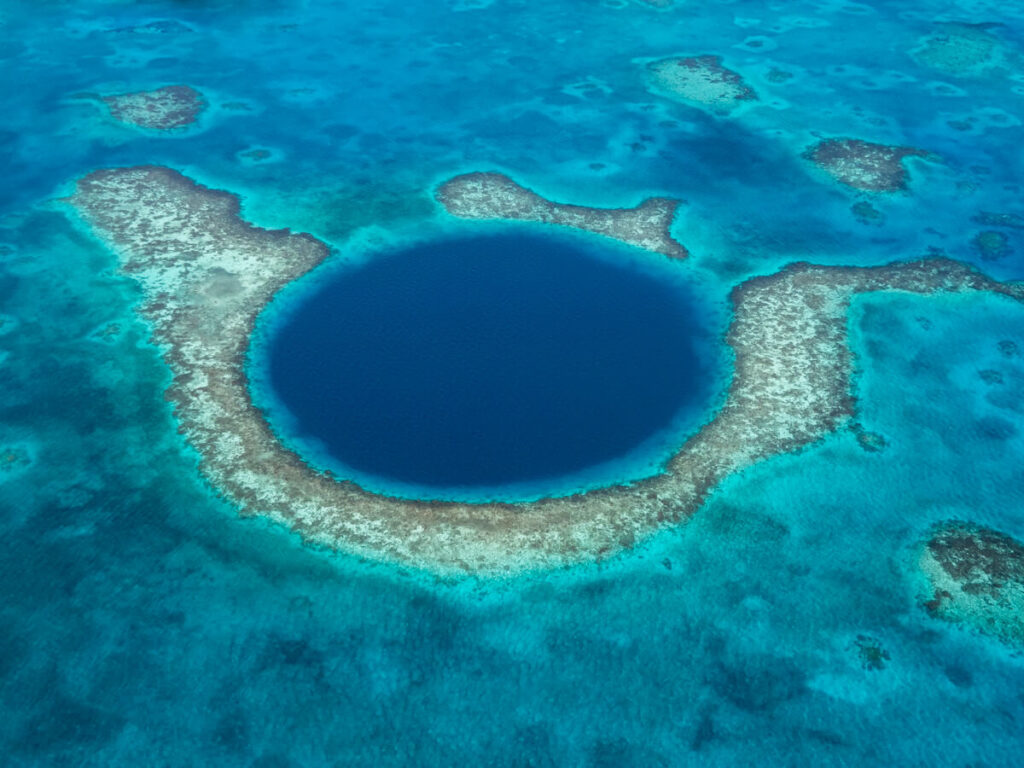
The Great Blue Hole is one of the most stunning natural phenomena in the world. A deep blue marine sinkhole in the middle of the turquoise-coloured Belize Barrier Reef, the Blue Hole isn’t just one of the best things to do in Belize, but is the main reason many travellers visit this small Central American country in the first place.
Visitors are attracted by the possibility of SCUBA diving in the hole, which is filled with stalactites and stalagmites, and has been deemed ‘one of the best dive sites in the world’. Another option, flying over the Blue Hole, provides panoramic views of the hole, the surrounding reef, remote cayes, and marine life. In this article, we’ve condensed everything you need to know about visiting Belize’s Blue Hole, including a comparison of diving and flying over it, to help you plan the best experience for you.
The Great Blue Hole, Belize, at a glance

More from the Blue Hole
What is the Great Blue Hole?
Once a limestone cave formed 150,000 years ago, Belize’s Great Blue Hole is a world-famous marine sinkhole situated in the middle of the ocean on the Belize Barrier Reef.
It’s a bit like the cenotes in Mexico’s Yucatan region. The cave would have originally been dry, being formed when water levels were much lower. As the tides rose, it filled with saltwater. Now, it’s a huge, dark blue, circular-shaped hole that sits seemingly in the middle of the ocean, where it contrasts with the bright azure sea.
The Great Blue Hole is synonymous with Belize, and no visit is complete without seeing this stunning sight. Visiting the Great Blue Hole is easy from both Ambergris Caye and Caye Caulker and needs to be added to your Belize bucket list.

About Belize’s Blue Hole
The Great Blue Hole is 124 metres deep and almost perfectly round at 300 metres wide.
It’s popularly seen from the air for that classic picture-postcard shot, and it’s one of the best SCUBA diving spots in Belize (if not the world).
Due to its sheer depth, little life survives inside. Instead, divers are rewarded with limestone cave formations and huge stalactites and stalagmites.
Belize’s Great Blue Hole is UNESCO World Heritage Listed, and many people (including us) believe it should be listed as one of the Natural Wonders of the World.

Where is the Great Blue Hole of Belize?
The Great Blue Hole lies deep in the ocean, 43 miles (70 km) from the Belizean mainland. It is just south of Belize City and a part of Lighthouse Reef, a small atoll in the Belize Barrier Reef. The Barrier Reef spans 180 miles (290 km) and is one of Belize’s best protected reserves and a UNESCO World Heritage site.
The Blue Hole is surrounded by reefs and some of Belize’s most beautiful islands that form a small part of the Mesoamerican Reef, the second-largest barrier reef in the world (after Australia’s). The Mesoamerican Reef extends 625 miles (1000 km), all the way from Isla Contoy in Mexico to Honduras.
Due to its remote nature, it’s not that easy to just visit the Blue Hole. It’s fairly expensive, and there are limited access options. But it’s so worth factoring in the trip into your Belize itinerary.

Great Blue Hole Belize Map
We’ve pinned the Great Blue Hole on our interactive map.
How to get to the Great Blue Hole Belize
As the Blue Hole lies so far away from the mainland, there are only three main options for visitors:
Each method has advantages, and the best way to visit Belize’s Blue Hole will depend on your interests and budget. We’ve broken down the pros and cons of each option in this post.

Taking a scenic flight over the Great Blue Hole
Taking a flight over the Blue Hole is, in our opinion, the best way to experience it. You’ve probably seen aerial shots of this icon when researching your Belize trip, and you can only see it like that yourself from the air. By soaring over the site, you can appreciate its sheer size and beauty. Plus, you get to see so many more stunning parts of the Barrier Reef, too.
Scenic flights over the Great Blue Hole typically last around an hour and take place in small passenger planes. There are two main companies, Tropic Air and Maya Island Air, with different schedules, meaning that a flight goes out each day, typically in the morning, to ensure the best light conditions.
It’s also possible to take a Blue Hole Helicopter Tour with Astrum Helicopters if you’d prefer a more private, doors-off experience.
Passenger plane Blue Hole flights leave from Caye Caulker, Ambergris Caye, and San Pedro, while the helicopter flights take off from Belize City, San Pedro (Ambergris Caye), and Placencia.
Taking a scenic flight is the cheapest way to visit the Great Blue Hole. A flight costs around $230-300 USD per person with a small surcharge to sit co-pilot, while helicopter experiences start at around $500 USD.

Snorkelling the Great Blue Hole
While it’s possible to snorkel in Belize’s Blue Hole, it’s not really a recommended experience for a number of reasons:
Honestly, there’s some amazing snorkelling in Belize, from Hol Chan Marine Reserve to remote islands on the Barrier Reef like Half Moon Caye, and all these sites are much easier to get to than the Blue Hole, with a lot more to see once you’re there.

SCUBA diving the Great Blue Hole
SCUBA diving is considered one of the best ways to visit the Great Blue Hole in Belize, as you get to actually go inside it. Once included as “one of the top 10 dive sites in the world” by the famous explorer Jacques Cousteau, the Blue Hole is a world-famous dive site.
Blue Hole SCUBA diving tours leave from San Pedro on Ambergris Caye and from Caye Caulker. It’s possible to make the trip from the mainland, too, but it’s a much longer journey with far fewer options. We’ve delved into the pros and cons of diving the Blue Hole in the next section.

What is it like to dive the Great Blue Hole?
The trip is a long day with tours departing around 5:00-6:00 AM and returning between 4:00-6:00 PM.
The journey from San Pedro takes around 2.5-3 hours by boat, while it’s 2-2.5 hours one-way from Caye Caulker. The journey can be rough, so it’s best to prepare if you’re prone to seasickness.
We’ve heard mixed things about the dive in the Blue Hole. Some people love it while others find it rather boring. The hole itself is over 124 metres (400 ft) deep, so even diving to 40 metres (the max depth for Advanced divers) means you won’t get anywhere near the bottom.
Here are some pros and cons of diving the Blue Hole:
Pros
Cons

Most operators offer a 2 or 3-tank dive day with one dive in the Great Blue Hole and another at the nearby Half Moon Caye.
A 3-tank dive trip may offer another site like the Aquarium at Long Caye Wall, Eagle Ray Wall, Tarpon Caves, or Quebrada. These sites are known for their stunning coral formations, diverse marine life, and excellent visibility, making them great complements to a Great Blue Hole dive. The depths of other nearby sites are:
Whether diving the Great Blue Hole is worth it is really down to the individual. It’s also important to consider your experience, as it’s not an easy dive. The currents and depths are not to be underestimated, and although some companies will take Open Water Certified divers out, it shouldn’t be attempted by anyone below Advanced level. If it seems like it’s too much or you’re not confident you’d have a great time, you can always choose to fly over the Blue Hole instead.
On the other hand, many divers love diving the Blue Hole, being thrilled to tick such a natural wonder off their bucket list. Half Moon Caye is also considered one of the best dive sites in Belize, and many people find the Blue Hole trip worth it for this dive site alone. Not to mention that the island itself is a remote paradise. Some tours include lunch on the island, which is simply stunning, and a is a real bonus to the dive day.

Belize Blue Hole Dive Shop Recommendations
There are loads of dive shops that visit the Blue Hole to choose from on both islands. After a truly horrific experience with a dive shop in Caye Caulker taking us out in dangerous conditions, we know the importance of choosing a provider that prioritises safety. Here are the shops we’d recommend based on good things we’ve heard from others.
San Pedro:
Caye Caulker:
There is a wider variety of dive operators in San Pedro, Ambergris Caye, than on Caye Caulker that offer trips to the Blue Hole.

How much does it cost to dive the Blue Hole in Belize?
Diving Belize’s Blue Hole is an expensive experience. Expect to pay over $300-400 USD for a day trip.
While expensive, it is a bucket list item for many, and you do get a lot for what you pay for. The long return journey, park fees, food, and equipment are all normally included, and most operators run a three-tank trip so you can get the most out of diving while you’re there. Some operators price the tour lower but then charge for equipment rental, so be sure to factor this in if you’re shopping around.
If you’re really keen to snorkel the Blue Hole, expect to pay around $180-200 USD for a day trip.

Our experience visiting the Great Blue Hole
At the time of our trip to Caye Caulker, we weren’t Advanced certified divers, so that sort of ruled out SCUBA diving the Blue Hole. We considered getting our certifications to do the experience, but several things held us back, including the cost and time a dive trip to the Blue Hole takes. In the end, choosing to fly over the hole was a much better choice for us, our budget, and our itinerary.
We had the best time flying over the Blue Hole with Tropic Air. The flight was so scenic with the most stunning views of the Belize Barrier Reef, remote islands, and, of course, the iconic hole. We got to see Lighthouse Reef Atoll and Turneffe Atoll, with their vibrant coral formations visible beneath the crystal-clear waters, as well as sharks and rays, and the Split that separates Caye Caulker’s islands.
Visiting the Blue Hole in Belize is a once-in-a-lifetime experience we’d highly recommend to anyone, whether you choose to fly over it or SCUBA dive in it. It was a real highlight of our entire Belize trip.

Is the Blue Hole in Belize worth visiting?
Absolutely, the Blue Hole is one of the best places to visit in Belize and is a bucket list experience that is really worth doing. Whether you’re diving or flying, you’re bound to have a great time seeing this natural geological wonder. Divers often fall in love with the nearby reef dives as much as they do the challenge of the deep dive inside the dark blue of the hole. While flyovers offer a unique opportunity to see the Blue Hole as it appears on the cover of guidebooks.
The only real exception is that, for most people, it’s probably not worth visiting the Blue Hole just to snorkel, as you won’t see much, and it’s a shame to go all the way out there to not really experience the hole’s depths. The same could be said if you’re only Open Water certified, as you won’t see much at the max depth of 18 metres (60 ft), you really need to go down to the Advanced max depth of 40 metres (100 ft) to see the impressive cave formations.
If you’re considering both options, remember not to dive and fly within 24 hours of each other!

The Great Blue Hole Belize: Dive vs Flight
Whether to fly over or dive the Blue Hole is a personal choice that depends on your interests, experience, budget, and time constraints. Here’s a summary of the key points we’ve covered in this post:
No matter which method you choose, you’re bound to have an incredible time seeing the Great Blue Hole in Belize!

Where to stay to see the Great Blue Hole in Belize
Belize City, Ambergris Caye, Caye Caulker, Turneffe Island, and Cassia Hill Resort
We stayed in the beautiful Belizean Shores Resort on Ambergris Caye and would highly recommend it for those seeking a base to visit the Blue Hole from. There are also plenty of lovely hotels on Caye Caulker, from budget to boujee options.

When to visit the Belize Blue Hole
There’s really no bad time to visit the Great Blue Hole in Belize, and visitors can enjoy it year-round.
However, April to June typically have the most ideal water conditions and clearest visibility, so you might wish to visit then if you’re planning on diving the hole.
If you’re planning to fly over the hole, the dry season between November and April is best, as there is less chance of cloud cover.

Belize Great Blue Hole FAQs
We hope this article has equipped you with everything you need to know to see Belize’s Great Blue Hole from above and below, but we’ve answered these frequently asked questions in case we missed anything.
Where is the deepest blue hole in the world?
The deepest known blue hole in the world is the Challenger Deep in the Mariana Trench, located in the western Pacific Ocean. It reaches a depth of about 10,900 metres (36,000 ft), far deeper than the Great Blue Hole in Belize.
What city is closest to the Great Blue Hole?
The closest major city to the Great Blue Hole is Belize City, located on the mainland of Belize. It serves as the main gateway for tourists visiting the Blue Hole. However, the Blue Hole is also popularly accessed from the islands of Caye Caulker and Ambergris Caye.
Can you swim in the Great Blue Hole in Belize?
Swimming on a snorkel tour of the Blue Hole is possible, but not generally regarded as one of the best ways to visit. The depth and the surrounding marine environment make it more suitable for SCUBA diving.
Is it worth it to snorkel the Blue Hole, Belize?
Snorkelling in the Great Blue Hole is a less recommended option compared to diving or flying. While the clear water allows for a great view from the surface, the Blue Hole is primarily a dive site, and the marine life is not as abundant near the surface.
Can beginners dive the Blue Hole, Belize?
The Great Blue Hole is not recommended for beginners. It is a deep dive with strong currents and unique conditions, making it more suitable for advanced or experienced divers.
How deep do you dive in the blue hole?
The maximum depth of the Blue Hole is about 40 metres (130 ft). Divers typically descend to a depth of 30 to 40 metres (100-130 ft) to explore the stalactites and underwater formations.
How far is the Blue Hole from Belize City?
The Blue Hole is located around 43 miles (70 km) off the coast of Belize City.
How far is the Blue Hole from Caye Caulker?
The Blue Hole is approximately 103 miles (65 km) from Caye Caulker.
How far is the Blue Hole from San Pedro, Ambergris Caye?
The Blue Hole is located about 78 miles (81.5 km) from San Pedro on Ambergris Caye.
How long is the boat ride from Belize City to Blue Hole?
The boat ride from Belize City to the Blue Hole takes approximately 2 to 3 hours each way, depending on the sea conditions and the operator.
How long is the boat ride from San Pedro, Ambergris Caye to Blue Hole?
The boat ride from Ambergris Caye to the Blue Hole takes about 2.5 to 3 hours, depending on the weather and the boat’s speed.
How long is the boat ride from Caye Caulker to Blue Hole?
From Caye Caulker, the boat ride to the Blue Hole typically takes around 1.5-2 hours.
How much does it cost to go to the Blue Hole in Belize?
The cost to visit the Blue Hole varies depending on the type of trip:
What animals are in the Great Blue Hole?
You can see lots of different kinds of animals in Belize. Marine life in the Blue Hole includes reef sharks, hammerhead sharks, nurse sharks, spotted eagle rays, tropical fish, and various species of sea turtles. You may also spot the odd Belizean manatee floating at the surface. The hole itself has fewer fish, but the surrounding reefs are teeming with life.
Are there sharks in the Blue Hole?
Yes, sharks are commonly seen in the Blue Hole, particularly reef sharks and sometimes hammerhead sharks. These are usually found at deeper depths.
How was the Great Blue Hole formed?
The Blue Hole was formed during the last Ice Age, when sea levels were much lower. It was originally a dry cave system, but as the sea level rose, the cave collapsed, creating the underwater hole we see today.
Is the Great Blue Hole of Belize considered a sinkhole?
Yes, the Great Blue Hole is considered a marine sinkhole or ‘blue hole’. It’s a submerged limestone cave system that collapsed and filled with water over thousands of years.
What is inside the Blue Hole in Belize?
Inside the Blue Hole, you’ll find stalactites and stalagmites, remnants of the cave’s dry past. The surrounding waters are relatively clear, but the depth limits the amount of marine life directly within the hole.
What’s at the bottom of the Blue Hole?
At the bottom of the Blue Hole, there are massive stalactites hanging from the ceiling of the submerged cave. Other than that, there’s not much to see as the bottom is devoid of life.
What did they find at the bottom of Belize’s Blue Hole?
Explorers and divers have found ancient stalactites and some evidence of past marine life in the Blue Hole. The discovery of stalactites at such a depth indicates that the Blue Hole was once a dry cave system, as these structures cannot form underwater.
Does anything live in the Blue Hole?
While there are fewer fish and marine creatures directly inside the Blue Hole, surrounding reefs and the area around the hole support abundant marine life, including sharks, rays, turtles, and fish.
Is the Blue Hole safe?
The Blue Hole is generally safe for experienced divers, though it’s important to be aware of the depth, strong currents, and the need for proper dive equipment. For beginners, it’s not recommended due to the challenging conditions.
What is the mystery of the blue hole?
The mystery of the Blue Hole lies in its geological formation, its depth, and the fact that it was once a dry cave system that collapsed.
Why is the Blue Hole blue?
The Blue Hole is blue because of its depth and the way light refracts through the water. The clear waters at the hole’s edges contrast sharply with the deeper blue centre, giving it its iconic colour.
Is the Blue Hole a wonder of the world?
The Blue Hole is not officially listed as one of the Seven Natural Wonders of the World, but it is often considered one of the most remarkable natural formations and has been designated a UNESCO World Heritage site as part of the Belize Barrier Reef.

Read next:
Flying Over the Great Blue Hole with Tropic Air
27 Best Things to Do in Caye Caulker
30 Best Things to Do in San Pedro & Ambergris Caye
San Pedro, Ambergris Caye vs Caye Caulker: Which Island is Right For You?
Our Belize Destination Guides:
Our Belize Travel Guides:
