When & where to See Scarlet Macaws in Honduras

Discover when, where, and how to see the national bird of Honduras, the scarlet macaw, in the wild.
This post may contain affiliate links, which means we might earn a small commission on anything purchased through these links at no extra cost to you. Learn more on our disclaimer page.
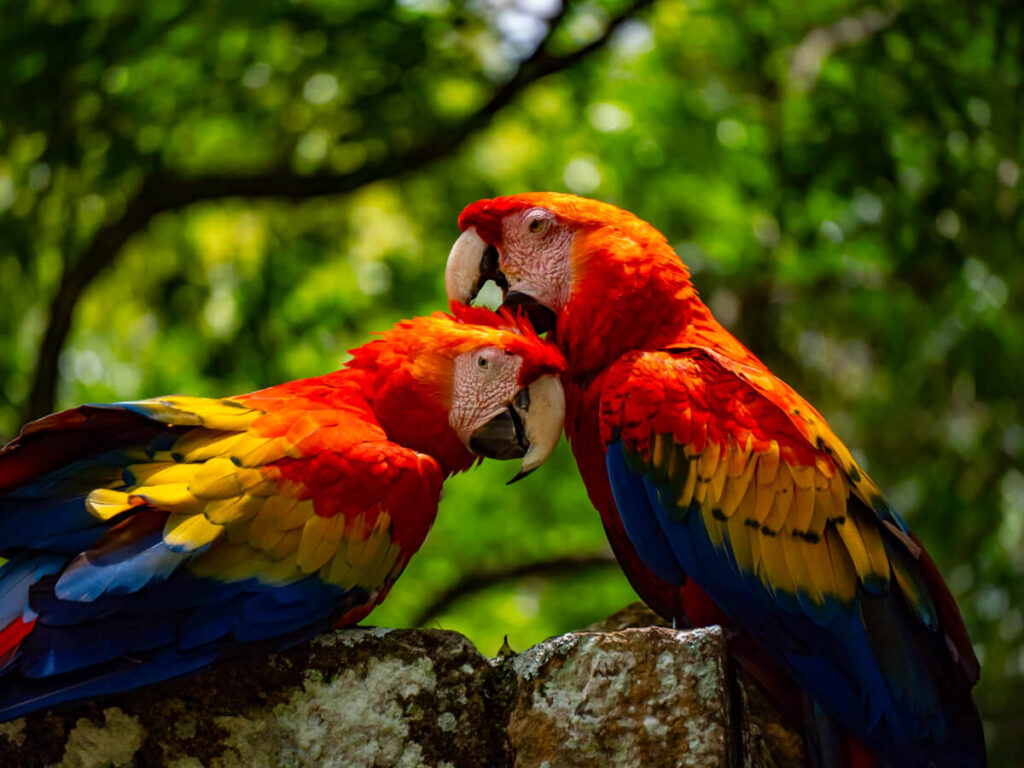
Once nearly extinct, the bright red, yellow, and blue scarlet macaw is a treasured symbol of Honduras and a protected bird. These striking parrots have made a remarkable comeback thanks to dedicated conservation efforts throughout the country. Today, you can see them soaring freely over ancient temples or nesting in forest reserves, their squawky calls echoing through the canopy.
Seeing scarlet macaws in the wild was well and truly on our Central America bucket list, so we were thrilled to find there are several places in Honduras where you can see them in the wild, ethically. Discover the best places to see scarlet macaws in Honduras, as well as when and how, in this guide.
Scarlet macaws in Honduras at a glance
More from Copán Ruinas
Are there scarlet macaws in Honduras?
Scarlet macaws can be found throughout Central America, from Mexico and Belize to Panama and beyond. Not only are there scarlet Macaws in Honduras, but they’re the country’s national bird. These brightly coloured birds, known locally as guacamayas, were once considered sacred by the ancient Maya and are even depicted in carvings and stelae found across the region.
Sadly, their numbers declined drastically due to habitat loss and the illegal wildlife trade, with thousands captured over the decades to be sold as exotic pets.
But thanks to the tireless efforts of conservation programs and protected reserves, the population has recovered in recent years, particularly in western and northern Honduras.
Today, the scarlet macaw (Ara macao) is a proud symbol of the country’s natural and cultural heritage. Seeing them soar overhead, often in mated pairs or small flocks, is one of the most memorable wildlife encounters you can have in Honduras, and we’re going to tell you exactly how to experience it yourself, ethically.

Where are scarlet macaws located?
Scarlet macaws are native to the tropical rainforests of Central and South America, with Honduras marking the northern edge of their natural range.
In Honduras, they live primarily in lowland and mid-elevation forests, where they feed on fruits, nuts, seeds, and clay from riverbanks that aid in digestion.

Where to see scarlet macaws in Honduras
Scarlet macaws are most often spotted near forest clearings or around ancient ruins, where tall trees provide ideal nesting sites.
Their loud squawks make them easier to hear before you see them. One of our favourite pieces of wisdom we’ve picked up from a local guide is that the louder and harsher the bird call, the prettier the bird. Birds with pretty calls are usually ones with plainer plumage.
Thanks to ongoing reintroduction efforts, they can now be found across several national parks and reserves in Honduras, not just in isolated areas.
The western region of Honduras, near the border with Guatemala, is the most accessible and well-known location, but if you venture further afield, you can also find them soaring over remote biosphere reserves in the east and south of the country.
The best places to see scarlet macaws in Honduras include:

1. Copán Ruinas
In western Honduras, the hills and forests surrounding Copán Ruinas are one of the best places to spot scarlet macaws. This region has been instrumental in restoring macaw populations, and it’s one of the few places where you can reliably see them flying freely overhead.
Copán Ruinas itself is a small yet charming town, known for its Mayan archaeological site (Copán). This is where we saw our first-ever scarlet macaws, and it is the most popular place for visitors to Honduras to spot them, too.
Copán is also historically significant for these birds – the Maya once considered them messengers of the sun god, and their likeness appears on ancient carvings throughout the area.
Early morning and late afternoon are the best times to hear their calls echoing through the valley or to watch flocks gliding across the sky.

Copán Archaeological Site
Copán Mayan Archaeological Site is a UNESCO World Heritage site that dates back over 1,500 years, and one of the best things to do in Copán Ruinas. It was once known as Mo’ Witz (Macaw Mountain) by the Maya, which indicates that the birds were present in abundance then.
Today, around 40 to 50 macaws live in the area, many reintroduced as part of a successful conservation program between Copán Ruinas and Macaw Mountain Bird Park.
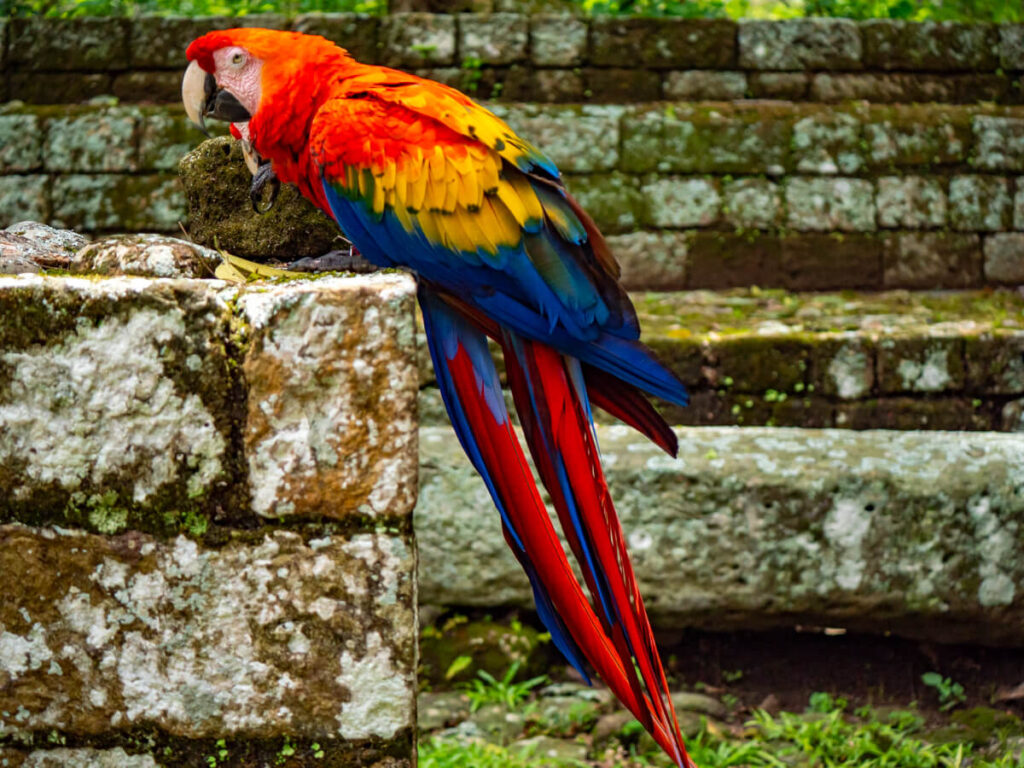
The birds are completely wild yet comfortable around visitors, often perching on the ancient ruins or in the ceiba trees, giving you a close-up view. If you arrive early in the morning, you’ll likely see them feeding or sunning their wings.

Macaw Mountain Bird Park
Macaw Mountain is one of the best places in Honduras to see macaws and other tropical birds. As many of the birds they care for are kept in captivity, it offers visitors guaranteed sightings.
A bird rescue and rehabilitation centre, the park is integral to looking after numerous birds that have been donated or confiscated from the illegal wildlife trade. It works to rewild the Copán Valley through its scarlet macaw programme, helping repopulate the region after years of decline.
While it’s never nice to see animals in enclosures, it’s unfortunately necessary to care for these birds, which are in rehabilitation, part of the release programme, or given a permanent home, as they lack the necessary skills to survive in the wild. Visiting directly supports the conservation work Macaw Mountain does, in conjunction with the World Parrot Trust, the local NGO Asociación Copán, and several government agencies.

2. Pico Bonito National Park
Along the Caribbean coast near La Ceiba, Pico Bonito National Park offers a totally different backdrop for seeing scarlet macaws. In contrast to the paradise islands of Utila and Roatán, here you’ll find misty mountains, dense rainforest, and cascading rivers.
The park’s lush jungle habitat supports an incredible diversity of birdlife, making it a favourite destination for birdwatchers. As well as macaws, you might also spot some of over 400 bird species, including toucans, motmots, and parrots. It’s one of the most biodiverse areas in Central America, rivalling Costa Rica – and one of the least well-known, so it’s a true hidden gem.

Río Cangrejal
The gateway to Pico Bonito, Río Cangrejal is a river that flows along the edge of the national park. Several riverside lodges have been set up on the riverbanks, offering white water rafting and a chance to simply immerse in nature.
It’s an excellent place to spot scarlet macaws and other tropical birds in the wild, thanks to the lush rainforest that surrounds the river. Early mornings are the best time to go birdwatching, when they leave their nests in the surrounding forests to feed along the riverbanks.
Unlike in Copán Ruinas, the macaws here are fully wild (meaning they haven’t been habituated or raised by humans), often flying high above the treetops in small flocks.
Bring binoculars, because sightings can be fleeting, but the setting, with the rainforest, waterfalls, and mist-covered peaks, is simply gorgeous.

3. Río Plátano Biosphere Reserve
The Río Plátano Biosphere Reserve is one of the country’s most remote and biodiverse regions, stretching across the Mosquitia lowlands on the country’s northeastern Caribbean coast in northeastern Honduras. A UNESCO World Heritage site, it protects over 1930 square miles (5,000 square km) of tropical rainforest, mangroves, and mountain ranges, home to jaguars, tapirs, and a wide range of tropical birdlife, including the scarlet macaw.
The reserve is also culturally significant, with ancient petroglyphs and several Indigenous communities, such as the Miskito and Pech peoples, living within its borders.

La Mosquitia
La Mosquitia is a vast, remote region in northeastern Honduras in the Río Plátano Biosphere Reserve, bordering Nicaragua and the Caribbean Sea. It’s one of the most isolated and least developed areas in Central America, often referred to as the country’s last frontier.
Here, macaws thrive far from human interference, nesting high in ancient trees and feeding along riverbanks. Interestingly, the macaws that breed here nest in towering pine trees, rather than the tropical broadleaf forests favoured from Mexico to parts of the Brazilian Amazon.
Visiting La Mosquitia is a true adventure, typically reached by boat or small plane, but it rewards intrepid travellers with some of the most authentic wildlife encounters in Honduras. While access can be challenging, guided eco-tours offer rare opportunities to explore the untouched jungle and spot wildlife in its natural habitat.

When to see scarlet macaws in Honduras
You can see scarlet macaws year-round in Honduras, but the dry season, from November to April, offers the best conditions for birdwatching. During this time, forest trails are more accessible, and macaws are often more active and visible as they forage for food.
Scarlet macaws usually begin their nesting season in February or March, when the dry season peaks and food is plentiful. In Honduras, this timing aligns with the warm, clear months that stretch from February through June, giving chicks the best chance to grow before the rains arrive.
The pairs are monogamous and mate for life, often returning to the same nesting trees year after year, typically large, hollow trunks of old-growth trees like ceiba or mahogany. Each pair lays two to three eggs, though usually only one or two chicks survive to fledging, as the strongest chick tends to dominate feeding. The eggs are incubated for about a month, and the chicks stay in the nest for roughly three months before taking their first flights. During this time, both parents care for the young, fiercely defending their nesting territory.
By May or June (which was when we visited), you can often see juvenile macaws learning to fly around Copán and other protected areas – their calls are higher-pitched and their wings a little clumsier than the adults’. Seeing these young macaws take to the sky is one of the most incredible wildlife experiences in the world.
In wetter months (May to October), sightings are still possible but require a bit more patience, as the birds take shelter during heavy rain (and you might want to as well).
The early morning hours are ideal for sightings, when flocks leave their nesting trees in search of fruit.

Tips for spotting scarlet macaws in Honduras
Here are some top tips for spotting scarlet macaws in Honduras:

How to photograph scarlet macaws in Honduras
Photographing scarlet macaws takes a mix of timing, patience, and luck. Because they often perch high in the canopy, a telephoto lens (200mm or longer) will help you capture crisp, detailed shots.
The best light for photos is usually early morning or just before sunset, when the warm glow enhances their bright plumage.
Use a fast shutter speed to freeze their motion in flight – they move fast and often travel in pairs or small groups.
If you’re visiting a sanctuary like Macaw Mountain, you’ll have an easier time photographing them up close and in good lighting, while still supporting conservation.
Always avoid flash photography, which can startle or distress the birds. And be sure to keep your distance – ethical wildlife photography means observing, not disturbing.

Can you hold a scarlet macaw in Honduras?
While there are some “sanctuaries” in Honduras where you can hold macaws and other tropical birds for photo ops, you shouldn’t.
In true sanctuaries and rescue centres that prioritise conservation and animal welfare, handling is reserved for trained staff. Macaws are strong, sensitive, and easily stressed. Holding them can cause immense stress and transfer harmful bacteria or viruses. They also have powerful beaks that can deliver serious bites if they feel threatened.
Ethical facilities limit human contact to keep the birds wild. If a place encourages you to hold or pose with a macaw, it’s a red flag that the birds are being exploited rather than protected. This is especially prevalent in Roatán, where numerous parks offer visitors the chance to hold birds, monkeys, and sloths. Sadly, they are profiting off these interactions, prioritising money over animal welfare.

Scarlet macaws and the illegal wildlife trade
Scarlet macaws are beautiful, and that sadly means they have long been victims of the illegal wildlife trade, one of the biggest threats to their survival. In the past, thousands were captured to be sold as exotic pets, leading to severe population declines, especially in Central America.
Honduras has made major strides in recent years, passing strict wildlife protection laws and establishing rescue programs to return trafficked birds to the wild. In 1983, Honduras officially declared the scarlet macaw its national bird, recognising its cultural and ecological importance. A more specific legal protection was formalised in 1993 when the bird was named a symbol of Honduran fauna (símbolo de la fauna de Honduras) through Executive Decree No. 36-93.
We were so thrilled to hear that a law established in 2025 prohibits over-manipulation (carrying and holding animals for exhibition or photo sessions), illegal possession, and illegal trafficking of endangered, rare or critically endangered species. This is directly targeted at Roatán and the Bay Islands, but we’re unsure how well it’s being upheld. The best thing you can do is ensure you choose where your money goes, supporting responsible operators, and proving that there is demand for ethical experiences.
Many of the macaws you’ll see at Macaw Mountain were confiscated from the pet trade and are part of successful reintroduction programs at sites like Copán Archaeological Park. We also saw the amazing conservation efforts that ARCAS in Guatemala is doing to combat illegal trafficking, too. While populations are slowly recovering, poaching and habitat loss remain serious issues, so supporting ethical sanctuaries and community-led ecotourism helps make a real difference.

What to pack to spot scarlet macaws in Honduras
To ensure an enjoyable experience spotting scarlet macaws in Honduras, it’s important to pack the right things. Don’t forget your:
Honduras Scarlet Macaws FAQs
To finish off, we’ve answered these frequently asked questions about seeing scarlet macaws in Honduras.
What countries do scarlet macaws live in?
Scarlet macaws are native to the tropical rainforests of Central and South America, ranging from southern Mexico down through Belize, Guatemala, Honduras, Nicaragua, Costa Rica, and Panama, and into parts of Colombia, Ecuador, Peru, Bolivia, and Brazil. They thrive in humid lowland forests and along river edges, where they feed on fruits, nuts, and seeds. Once widespread, scarlet macaw populations have declined in many areas due to deforestation and the illegal pet trade. However, Honduras now has one of the most stable populations in Central America, thanks to strong conservation efforts.
What bird is native to Honduras?
Honduras is home to hundreds of resident bird species (over 770 recorded in total), but one of its most iconic is the scarlet macaw, which was once nearly extinct in the country. The only bird species that is truly endemic to Honduras is the Honduran Emerald. Other notable resident birds include the emerald toucanet, keel-billed motmot, collared aracari, and turquoise-browed motmot, which is common across Central America. The country’s diverse landscapes, from Caribbean coastlines to pine-covered mountains, make it a birdwatcher’s paradise.
What is the national bird of Honduras?
The scarlet macaw (Ara macao) is the national bird of Honduras, officially declared as such on June 28, 1993. Known locally as la guacamaya roja, it symbolises freedom, strength, and the rich biodiversity of the country.
What kind of parrots are in Honduras?
Honduras is home to an impressive variety of parrots and parakeets, including the scarlet macaw, great green macaw, red-lored parrot, white-fronted amazon, yellow-naped amazon, and orange-chinned parakeet. Sadly, several are considered vulnerable due to habitat loss and the illegal pet trade, making conservation centres essential for rehabilitation and education.
Are there parrots in Roatan, Honduras?
You can find parrots and macaws on Roatán, though most are not native to the island – they’ve often been brought there for conservation, rescue, or tourism purposes. You might see scarlet macaws, green parrots, or yellow-headed amazons in wildlife centres or eco-parks. However, following the 2025 ICF directive, it is now illegal for visitors to hold or pose with wild birds for photos, to prevent stress and exploitation. Instead, we’d encourage you to enjoy these beautiful birds from a respectful distance in the wild in the locations in this post, in their natural forest homes on the mainland.

Read next:
How to Visit Macaw Mountain + is it Ethical?
Copán Ruinas Town + Mayan Archaeological Site Guide
